Blog

Building a Science Fantasy World Map From Star Systems to Magical Realms

Tips for mapping planets, space routes, and interdimensional realms

Creating a map is one of the most immersive ways to ground your science fantasy setting. But unlike traditional fantasy maps of kingdoms and mountains, science fantasy opens the doors to planetary systems, space lanes, dimensional rifts, and magical ley networks—all of which need to be visualized creatively.

This guide walks you through how to conceptualize and construct a map that encompasses stellar navigation and mystical terrain, giving your readers a sense of place across both time and dimension. I personally like the website Inkarnate to create maps, but I’m sure there are plenty of other map makers out there.

🌌 1. Start with the Macrocosm: Star Systems and Cosmic Geography

Before detailing continents or empires, zoom out.

  • How many star systems does your world span?
  • Are there major planets, moons, asteroid belts, or artificial satellites that matter to the plot? In my Zalonia books, there are five planets and three moons that orbit the main planet. There is also a space-like station floating around where a certain species is high tech and operate from.
  • What is the political and economic relationship between systems?
  • Use terms like: Coreworlds: Old, technologically advanced hubs of civilization.
    Frontier Systems: Lawless or uncharted space.
  • Void Corridors: Safe or dangerous navigable regions through hyperspace or aether.
  • Worldbuilding Tip: Create an astronavigational chart where trade routes, pirate ambush zones, and ancient ruins are mapped along space currents or magic-tides that flow between systems like oceanic currents.

🌍 2. Planetary Mapping: From Biospheres to Biomes

Once you define your key planets or moons, determine:

  • How big are they? For example, there is one planet closer to the sun that appears for the Zalonians. It is approximately the same size as the home planet but is much too hot for life. The fourth planet out is a little bigger than jupitar. The fifth planet out is about have the size of Aztharian (The home planet for Zalonia).
  • Are they terraformed or wild?
  • Do they follow normal laws of physics or are they magically altered?
  • You might include:
    • Floating continents powered by crystal levitation
    • Ring-shaped worlds orbiting mystic black holes
    • Tectonic ley lines that divide magic into hemispheres
    • Consider a hexagonal or radial map instead of the traditional rectangular layout if the planet is non-Euclidean or has warped gravity.

🌀 3. Mystical Realms and Interdimensional Territories

In science fantasy, magic may bleed into geography.

Questions to ask:

  • Are there planes of existence, dreamscapes, or mirror realms that overlap?
  • Do people travel through portals, spacefolds, or arcane gates?
  • Is time consistent across locations?
  • These could appear on maps as:
    • Dimensional rifts marked with ancient symbols
    • Magic “knots” where ley lines converge or intersect with dark matter
    • Eclipse Zones, where multiple realities overlap temporarily
    • Add color-coded dimensional overlays, showing boundaries that change depending on cosmic alignment.

🚀 4. Space Routes and Interplanetary Navigation

Time to chart the roads between stars.

Ideas:

  • Wormhole Beacons: Anchors for stable teleportation lanes
  • Startrails: Routes powered by magical propulsion
  • Pulse-Gates: Planet-sized machines that blink ships across space
  • Travel between worlds may depend on:
  • Aetheric Winds that blow through space
  • Solar tides generated by dying stars
  • Covenant Zones: Areas where ancient treaties forbid space magic
  • Use icons or trails to mark danger zones, “slipstreams,” and protected sectors.

🏛️ 5. Cultures, Factions, and Mythic Landmarks

Maps are political and cultural tools.

Include:

  • Capitals, ruins, academies, and forbidden zones
  • Temples aligned with constellations or magical fields
  • Cosmic nexuses controlled by rival empires or ancient beings
  • Layer mythological geography: places that exist only when moons align, or which appear once every century. These could be represented with fading glyphs or temporal grids.

🧭 6. Design and Artistic Style

Your map style should reflect your world’s tone.

Style choices:

  • Digital Holographic Grid: For sleek tech-magic hybrid settings
  • Astrological Star Charts: If your setting ties fate to the stars
  • Ancient Scrolls or Codices: For magical realms remembered by myths
  • Stone-carved Circular Maps: If your cultures view time cyclically
  • Include a legend for:

Dimensional zones

Types of transport routes (magic vs tech)

Symbols for guilds, empires, and anomalies

✍️ 7. Practical Uses in Storytelling

  • A good map does more than look cool—it serves narrative functions.
  • Let characters refer to it when planning a quest or jump
  • Use it as a mystery (an old version reveals a long-forgotten gate)
  • Create conflicting maps based on cultural perspective or secrecy
  • Drop clues on map margins: coordinates to a rogue moon, or a warning in an extinct language

Support Me on Patreon

Return To Home

Developing a Unique Calendar and Timekeeping System

Create a time system influenced by your planet’s rotations, magic, and cosmic cycles

In speculative fiction and fantasy, especially science-fantasy settings, time is more than a sequence of ticking seconds—it’s a cultural rhythm, a cosmic mystery, or even a magical construct. Whether you’re designing a world orbiting a twin star system or a continent where moons shape magic tides, crafting a unique calendar and timekeeping system helps make your world feel lived-in and real.

Here’s how to create a compelling time system that is rooted in astronomy, magic, and narrative logic.

🌞 1. Start with the Basics: Planetary Motion

If your world is a planet (or spaceborne habitat), determine its rotational period (day) and orbital period (year). Ask:

Does the planet rotate faster or slower than Earth? In my world of Zalonia, the calender systems are a little different. There are 9 months with each lasting 40 days. Then there are 8 days in a week. The planet rotates close to the same speed as earth, but is slightly closer to the sun so a year lasts just under 360 days. Because of this, every 117 years there is an extra month.

Are there multiple suns or moons? The world I made has three moons. However, only one is used to keep track of time because the other two are unpredictable.

Is the orbit circular, elliptical, or erratic?

Does the planet experience seasons, tidal shifts, or axial tilts? For example, a world with a 27-hour day and a 400-day year will shape labor, sleep, and ritual patterns very differently from our Earth-centric rhythms.

Creative Hook:

On the crystalline planet of Veloria, each “Turn” lasts 36 hours, and there are only 6 “Bends” per orbit, each defined by a different phase of a sentient moon named Thessa.

🌒 2. Invent Moons, Stars, and Cosmic Events

Moons and celestial bodies can have powerful symbolic and magical roles.
Multiple moons can shape complex tide systems or different schools of lunar magic. In my world of Zalonia where there are three moons, one moon represents dark magic while the other represents light magic. Dark doesn’t necessarily mean evil, as dark magic can be used in negating something such as weight loss magic.

A binary star system may create “lightless hours” even during the day.

Periodic alignments (conjunctions, eclipses, novas) could trigger religious festivals or magical boons.

✨ Example:

Every 88 days, the three moons of Zalonia align in a “Triune Veil,” rendering all magical items inert for a full night unless protected by sky-iron glyphs.

📅 3. Design Your Own Calendar System

Abandon the Gregorian calendar and ask yourself:

How many months or units of time make up the year?

Are weeks even a thing?

Is your system based on moons, harvests, cosmic tides, or magical pulses?
Try to name months, seasons, or “cycles” based on cultural values, magical phenomena, or astrological signs.

✨ Sample Calendar Structure:

13 Months, each 28 days (a common moon-based cycle)
364-day year, with an extra “Day of Stilling” observed in silence
Each month named after a historical figure or constellation (e.g., Ashra’s Rise, Vornak’s Grasp)

🔮 4. Integrate Magical or Mystical Time

Time might not be linear in your world—especially if magic interferes. For example, time itself could be cyclical in that everything returns to the beginning of time after so much time has passed.

Are some days “cursed,” when magic backfires or vanishes?

Are there “thin veils” between worlds that occur cyclically?

Are timekeeping devices themselves enchanted or sentient?

Your mages, shamans, or priests might keep time using:

Runestones that glow during specific planetary alignments
Water clocks enchanted with memories

Living calendars—plants that bloom only during solar flares or magical surges
Magic-Tied Example:

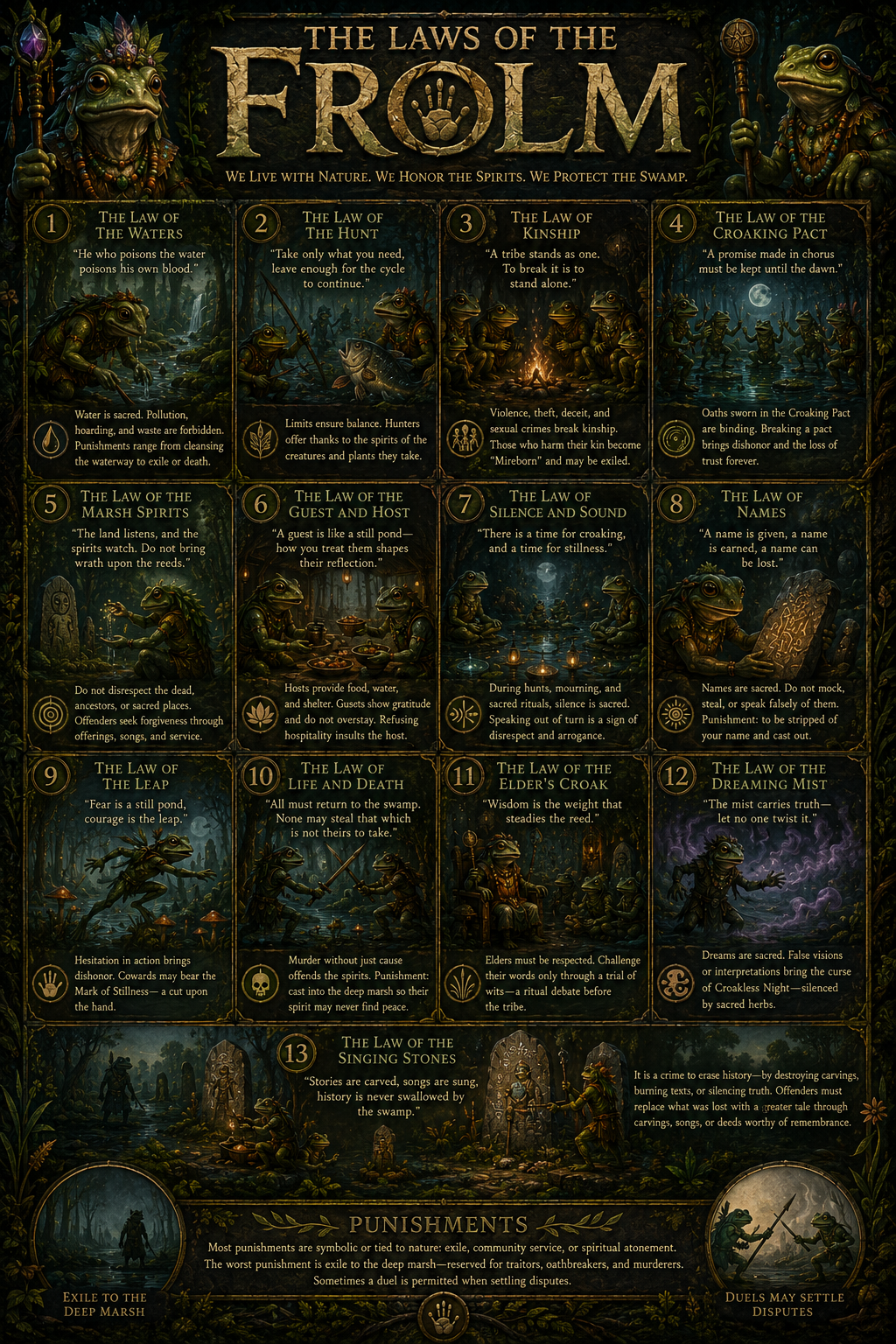
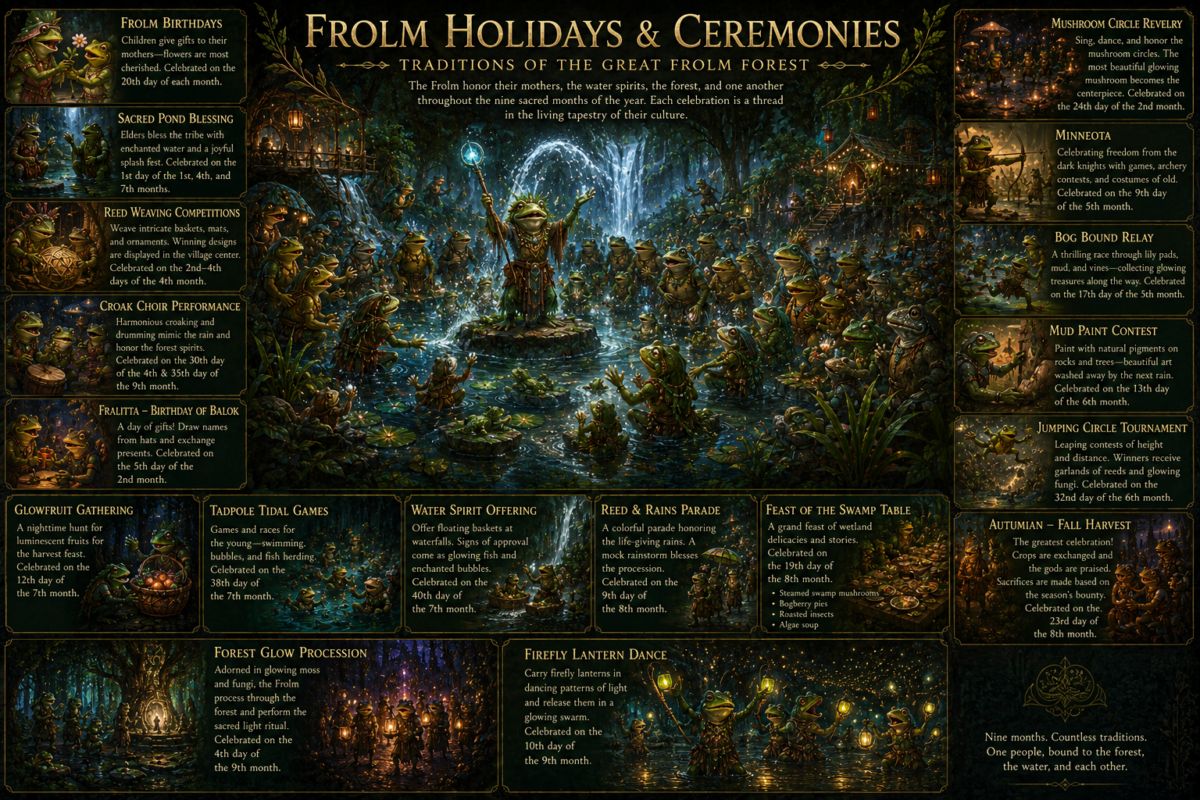
The Frolm count days by the pulse of the “Great Croak”—an ambient magical vibration that echoes through sacred reeds once every 5.2 days. No spell may be cast without the blessing of the Croakkeeper on Croakday.

🏛️ 5. Cultural and Religious Observances

Time is also social. Your world’s cultures may:

Measure years by the reign of monarchs or religious leaders

Track time using generational trees or oral myths

Denote age by how many “Harvest Moons” one has witnessed

Rituals may only be performed during:

Celestial events (e.g., solar tides, comet rains)

Specific moon phases

Anniversary of a divine appearance

✨ Frolm Idea:

During the Dimming Days, when both moons vanish for three nights, no frog may sing, and even children are forbidden to speak. This marks the sacred mourning for the “Ancestor Without Song.”

⏳ 6. Alternative Timekeeping Devices

Don’t stop with clocks and sundials. In your world, time may be told by:

Song cycles – bards sing the same tune every morning as a “wake signal”

Orbglow – a crystal that changes color with ambient cosmic energy

Elder gongs – giant toadstools that ring when stepped on by elders
Make time experiential rather than just numerical.

🛠️ 7. Practical Tips for Integration

To bring your time system into your story naturally:

Use characters to reference time organically: “Meet me on the second chill of Vornak’s Grasp.”

Show rituals based on timekeeping: “She lit the incense as the twin shadows crossed.”

Include unique units of measurement: “Two flickers past the dawn-shift” instead of “2 hours ago.”

You don’t need to explain everything—just enough to show it’s meaningful and consistent.

✅ Final Thoughts

Creating a unique calendar or time system isn’t just about adding flavor—it’s about deepening immersion, anchoring your story in a world that moves to its own rhythm. Whether based on physics, mysticism, or cultural nuance, your timekeeping system can make your setting unforgettable.

Support me on Patreon

Return to Home


Navigating Space Magic

Inventing Magical Navigation and Exploration

When we think of space travel, we often default to sleek starships, advanced propulsion systems, and blinking consoles. But in science fantasy, space is not just a physical realm—it’s a metaphysical one, where magic and mystery eclipse math and machinery. In such worlds, navigating the cosmos isn’t about fuel and gravity wells. It’s about intent, enchantment, and the will of the stars themselves.

Welcome to the arcane frontier, where sorcerers chart stardust currents, ships ride ley lines through the void, and wayfarers use ancient relics to fold space with a whisper. If you’re building a fantasy universe where magic replaces or augments space travel, this guide will help you shape your own system of mystical navigation and exploration.


🌌 1. The Nature of Space in a Magical Universe

Before building a navigation system, decide how space itself functions in your universe. Is it:

A physical void, vast but mutable by magic?

A layered reality, with spiritual or dream-like layers between stars?

A living entity, with consciousness and resistance to intrusion?

A weblike structure, with magical threads connecting worlds?

Each interpretation changes the rules. For example, if space is sentient, then navigation may require negotiation, sacrifice, or spiritual harmony. If it’s layered, travelers might shift through planes, not just parsecs.

✨ 2. Modes of Magical Space Travel

Here are some creative magical methods to traverse the stars:

🌠 Starpath Walking

Some navigators “walk” among the stars through ritual projection or transmutation. This may involve:

Dreamwalking: Traveling through the Astral Plane or Starrealm.
Body transfiguration: Becoming light, energy, or voidstuff.
Soul caravans: Traveling as a disembodied spirit, temporarily leaving the body behind.

🧭 Ley Line Sailing: Cosmic ley lines crisscross space, like mystical wormholes. Ships or mages who align with these currents can:
“Sail” on solar winds of magical energy.

Tap into ancient runes or glyphs encoded in planetary fields.
Use ritual bearings to maintain direction, lest they drift into unknown dimensions.

🌌 Portal Constellations: Magicians can summon temporary gateways between stellar points by aligning with celestial events or constellations:
Only when the constellation of the Phoenix rises does the path to the Fire Nebula open.

Ritual circles must be cast beneath mirrored skies, where stars are visible and mirrored in still water.

🔮 Sentient Navigators: Instead of tech, spacefaring societies may rely on:
Living compasses: Creatures or spirits that inherently “feel” direction.
Bound star-spirits or oracles who read the “cosmic winds” and whisper coordinates.

Symbiotic crystals that “resonate” with specific planetary harmonies.

🗺️ 3. Magical Navigation Tools & Techniques

What do explorers use to avoid getting lost in infinite space?

🧿 Arcane Star Charts: Maps made of enchanted parchment or living ink that shifts with the cosmos.

Only readable under starlight, moonlight, or with third-eye activation.

🧭 Etheric Compasses – Point not north, but to your heart’s desire, homeworld, or a beacon spell.

May malfunction near black holes, curses, or anti-magic zones.

🕯️ Cosmic Drift Beacons

Left behind by earlier travelers.

Emit telepathic pulses, glowing auras, or trails visible to “those who know how to look.”

📿 Memory Tethers

A form of spatial magic that ties a person or object to a specific location.
Cast using sacred tokens, names, or fragments of the destination.

🌒 4. Mystical Obstacles in Space

Magical travel shouldn’t be easy. Here are spaceborne hazards for tension and flavor:

🌀 Dimensional Eddies

Regions where space bends unpredictably, sending ships into alternate timelines or mirror worlds.

🐉 Astral Predators

Beings that feed on magic, or track star-sailing mages by their energy signature.

🕳️ Spellvoids

Anti-magic zones that snuff out enchantments.
Navigators may lose orientation, propulsion, or even consciousness.

🗣️ Echoes of the Past

Ghosts of old voyages, cursed chants, or time loops.

Ships may “hear” phantom distress calls or encounter long-dead versions of themselves.

🌌 5. Who Are the Navigators?

Think about who can traverse the cosmos, and what training, bloodline, or tools they require:

The Starborn: Those born during cosmic alignments, with innate navigation gifts.

Chronomancers: Mages who “read” the past and future to avoid mistakes in the present.

Void Priests: Religious sects who believe travel is communion with the divine void.

Mapwrights: Mystical cartographers who create their own paths by walking them first.

These figures might be rare, revered, feared, or exploited, adding cultural depth and stakes to your world.

🪐 6. Destinations: Mystical Worlds & Locations

Finally, space isn’t just for moving through—it’s for finding wonders:

The Singing Moons: Planets that emit song-like vibrations, altering memory and mood.

Nebulae Temples: Built from solidified stardust, holding ancient secrets.

The Mirror Belt: An asteroid field reflecting not just light, but truths about the traveler.

Stargrave: A place where gods once died, now haunted by immense arcane energy.

Each place may require specific rituals, spells, or sacrifices to reach or survive, further enriching your lore.

🔭 Final Thoughts: Magic Over Rockets

Space magic lets you break free from the constraints of physics and fuel gauges. You can build a universe ruled by wonder, spirit, and mystery, where traveling to another world is a test of heart, mind, and soul—not just engineering.

So next time you imagine your characters leaping between stars, don’t think “warp drive.” Think sigils and stardust, whispered spells and ancient maps inked in moonlight.

Let the magic guide them.

Purchase Creating Life book (Affiliate Link)

Return to Home

Environmental Challenges in a Science Fantasy World

How to Incorporate Natural and Magical Disasters, Space Hazards, and Ecological Issues

Creating a vibrant and believable science fantasy world isn’t just about the cool technology, mythical creatures, or dazzling spells. One often overlooked—but incredibly rich—aspect of worldbuilding is how the environment behaves and how it challenges the inhabitants. Whether your story unfolds on a war-torn moon, an oceanic world riddled with sea beasts, or a realm where ley lines pulse with volatile energy, environmental challenges can enrich narrative stakes, deepen lore, and anchor your world in compelling realism.
In this article, we’ll explore how to weave natural disasters, magical anomalies, space hazards, and ecological dilemmas into your science fantasy world—and how these elements can elevate your plot, characters, and themes.

🌋 1. Natural Disasters: The Familiar Made Strange

While volcanoes, hurricanes, tsunamis, and earthquakes are familiar phenomena, in a science fantasy setting, you can twist them to reflect your world’s unique physics or geography.

Creative Ideas:

Plasma Storms: On a planet with high magnetic interference, lightning storms might crackle with radioactive energy or distort time.

Floating Quakes: In a world with floating continents or anti-gravity zones, tectonic shifts could cause entire landmasses to crash or drift into space.

Crystal Quakes: If your world grows magical crystals underground, mining them could lead to crystalline eruptions or shattering “glass-quakes.”

Tips:

Use disasters to spark political intrigue (e.g., nobles blame each other for the collapse of a floating city).

Show how cultures adapt—nomadic groups may follow the path of migrating safe zones between fire swells or acid rains.

🔮 2. Magical Disasters: When the Arcane Backfires

Magic isn’t always a benevolent force. Like nuclear energy, it can be wildly unstable. Consider how the misuse, corruption, or over-harvesting of magical power might devastate your world.

Magical Catastrophes:

Spellquakes: Magical aftershocks ripple from failed rituals, tearing through the weave of reality and altering gravity or biology.

Ley Line Eruptions: Areas saturated in magical energy can “erupt” like volcanoes, releasing raw chaos that mutates wildlife or corrupts minds.

Mana Blight: A form of magical pollution where excessive spellcraft drains the life force from an area, turning it into a barren gray zone.

Narrative Uses:

The aftermath of a magical war might include wastelands where time doesn’t flow or where illusions are permanent.

A cult could attempt to summon a god by destabilizing the ley grid, causing regional arcane storms.

🌌 3. Space Hazards: Celestial Threats and Cosmic Dread

If your science fantasy world includes orbital colonies, deep space travel, or gods who dwell in the stars, cosmic hazards add drama and scale.

Potential Hazards:

Radiation Rings: After a failed planetary defense shield collapsed, dangerous radiation rings now orbit the planet and must be navigated carefully.

Void Flares: Stars blink in and out of existence, creating reality-tearing pulses that shatter space stations.

Graviton Anomalies: Invisible wells of warped time-gravity that trap ships or bring forth ancient relics from collapsed timelines.

Story Hooks:

A city on a ring-world may be at risk from solar storms every few decades, creating a ritualized mass migration called the Sun Flight.

An asteroid infected with “living dark matter” may crash into your planet, spreading madness and dimensional instability.

🌱 4. Ecological Issues: Magic and Tech Meet Nature

Whether you’re drawing inspiration from climate change, invasive species, or toxic industries, ecological challenges can mirror real-world issues through a fantastical lens.

Possible Ecological Scenarios:

Magical Overfarming: A society that harvests spells from magical plants might cause magical deserts or “arcane famines.”

Terraforming Gone Wrong: A planet partially terraformed now features clashing ecosystems—desert lizards in lush rainforests, or deep-sea fish in mountaintop lakes.

Living Machines: Ancient bio-tech constructs, once dormant, begin to consume forests to rebuild themselves—shifting the balance of life.
Long-Term Impacts:

Class divisions might emerge between those who live in “Green Zones” protected from corruption and those exiled to poisoned lands.

Entire faith systems could develop around restoring the natural balance, with druids or eco-engineers viewed as prophets or heretics.

🌀 5. Blending Themes: Use Environmental Conflict to Drive Story

Environmental hazards shouldn’t just be background noise—they can actively shape your narrative.

Conflict Generation:

Characters: A mage suffering from Mana Sickness after exposure to blight. A space pilot traumatized by a Graviton Rift collapse.

Cultures: Nomads worshipping a volcano as a god. Sky cities hoarding clean air while surface dwellers suffocate.

Factions: Technocrats exploiting nature vs. mystics seeking harmony. Terraformers vs. Preservationists.

Moral Questions:

Is it right to colonize a new world if the indigenous species are sentient—but silent?

Should a society continue using magic if it heals people but causes slow decay to the environment?

Can magic be “cleaned up” with tech—or should it be banned?

⚙️ 6. Practical Integration: Making It All Fit

Here’s how to seamlessly integrate these elements:

History: Tie disasters to past events. Maybe a ruined empire fell because of a ley line rupture 500 years ago.

Geography: Let the landscape reflect its history—rivers glowing with residual magic, forests shaped by ancient storms.

Religion/Myth: Build lore around environmental cataclysms. Perhaps certain beasts only emerge before a void quake.

Technology: Let tech evolve as a response—arcane weather prediction devices, magic-purifying fungi, or mech suits that withstand solar flares.
Magic Rules: Establish clear mechanics for magical pollution or overuse. Consistency makes even the strangest environments feel real.

🌍 Conclusion: Your World Is Alive—So Make It Breathe

Environmental challenges are more than just spectacle—they shape civilizations, define conflict, and mirror timeless struggles between power and balance. Whether you’re crafting a world ruined by magic or struggling to survive a dying sun, these environmental tensions give your science fantasy setting depth, urgency, and meaning.

Build your world like it’s a character: give it scars, tempers, cycles, and breath. Let readers feel the heat of solar storms, the chill of void winds, and the ache of a world on the edge of collapse—and watch your narrative come to life.


Buy Creating Life

Return to Home

Creating Language and Symbols in Science Fantasy

Tips for Designing a Linguistic System that Merges Alien Languages with Mystical Symbols

In the science fantasy genre, where technology and magic coexist, one of the most powerful ways to immerse your readers or viewers in your world is through language and symbols. A well-constructed linguistic system—especially one that blends alien grammar with arcane glyphs—does more than make your world feel lived-in. It conveys culture, power, and identity.

Whether it’s the Force-sensitive runes of a forgotten alien empire or the cryptic techno-glyphs of a robotic priesthood, the interplay between spoken language and mystical symbolism becomes a narrative and aesthetic force.
Let’s dive into the art and craft of creating a hybrid linguistic system for your science fantasy world.

1. Define the Purpose of the Language and Symbols

Before creating a language or script, ask yourself what role it plays in your world. Consider the following:

Who uses it? Is it the language of the ruling class, ancient machines, nomadic mystics, or alien scholars?

Why is it unique? Does it tap into magical forces, control technology, or encode forbidden knowledge?

What is its tone? Harsh and mechanical? Flowing and melodic? Hauntingly ambiguous?

🧠 Tip: Languages aren’t just tools—they’re artifacts of worldview. A culture that believes the universe sings might use a musical or tonal language. A species that values precision may have mathematically structured syntax.

2. Create Phonetics that Reflect the Culture or Species

Start with sound design—even before grammar. Imagine how your language feels when spoken. You can draw from real-world inspiration:

Harsh, click-based phonemes for insectoid or reptilian races (inspired by Xhosa or !Kung)

Smooth, vowel-heavy syllables for ethereal or fae-like beings (inspired by Polynesian languages)

Monotone or mechanical speech patterns for AI entities (drawn from Morse code or binary)

🔊 Bonus: You can record sample dialogue or create pronunciation guides to help readers or players engage more deeply.

3. Blend Grammar Systems from Human and Non-Human Concepts

Now comes structure. Grammar systems can be wildly different depending on how alien your species is.

Some creative options:

Object-Subject-Verb (OSV) word order to disorient human expectations
Telepathic or emotion-based grammar, where verb tense shifts based on emotional state

Inflection-based syntax, where tone or pitch alters meaning

Glyph-triggered language, where a spoken word means something different depending on what symbol is nearby

🧬 Example: An alien word for “travel” might be different when spoken next to a fire rune versus a water rune, indicating the method of travel—burning portal vs. underwater tunnel.

4. Design a Symbolic System That Complements the Language

Symbols (or glyphs, sigils, or runes) should not just be aesthetic—they should convey layers of meaning.

Ask:

Is each symbol a letter, a word, or a concept?

Are symbols pictographic (like Egyptian hieroglyphs), abstract (like Norse runes), or functional (like circuit schematics)?

Do they interact with reality, e.g., activating technology or magic when drawn or spoken?

You can merge alien geometry with mystical energy diagrams. For example:
Concentric circles could represent cycles of life or time.

Fractals could reflect infinite knowledge or multidimensional thinking.
Crystalline structures might be the base for technological incantations.
📜 Practical use: A mage-tech interface may require a chant and a glyph drawn in the air with a plasma stylus.

5. Create Tiers of Complexity

Not all speakers need to understand everything. This gives room for:

Secret dialects: Hidden meanings known only to the elite

Magical gradation: Low-level users use basic runes; high-level users combine them for advanced spells or controls

AI-mystic hybrids: Machines that can “speak” arcane languages through code and emit light-glyphs instead of sound

🎮 In gameplay or narrative, this could function like unlocking ancient knowledge—each symbol unlocks more sophisticated use.

6. Embed Linguistic Relics into Your World

Scatter ancient tablets, forbidden grimoires, encrypted control panels, or graffiti from the old world. This does three things:

  • Deepens immersion
  • Allows mystery and puzzles
  • Encourages language decoding by readers/players

Consider using this like Tolkien’s Elvish inscriptions or Mass Effect’s Prothean artifacts. Allowing your audience to slowly decode meaning builds intrigue.

🧩 Example: A stone tablet reads:

“Θ͝ΛΣ = 7th cycle. Portal sealed. Song required. Blood optional.”
The audience knows just enough to fear what’s coming.

7. Link Language to Power

One of the coolest things in science fantasy is when language shapes reality. If language is tied to magical technology, then speaking the “true name” of a thing could override it—be it a sentient ship, a storm generator, or a bio-organic weapon.

📖 Narrative idea: Only those fluent in the Old Speech can awaken the buried AI guardians. But speaking it also risks mental overload or attracting cosmic predators.

8. Tools to Help Build Your Language and Symbol Systems

Here are some tools and techniques:

Language Creation Tools:

Vulgarlang.com – For auto-generating naturalistic languages

Polyglot – A language creation studio

IPA (International Phonetic Alphabet) – Helps you make realistic-sounding words

Symbol Design Tools:

Vector design tools like Inkscape

Glyph editors like FontForge or Calligraphr (turn symbols into fonts)
Reference real-world writing systems: Sanskrit, Sumerian cuneiform, Korean Hangul, and Tibetan scripts

🎨 Tip: Combine visual motifs like circuits, stardust trails, or dragon-scale patterns for maximum fusion between tech and magic.

Final Thought: Language Is Culture

Remember, you’re not just creating words or symbols—you’re crafting the voice of a people. Their fears, dreams, rituals, and technologies are embedded in how they speak and write. The more thought you put into how language and symbols operate in your science fantasy world, the more unforgettable and alive it becomes.

Whether your characters chant to summon plasma storms or use rune-coded DNA to activate interdimensional gates, a hybrid language system will elevate your worldbuilding to new heights.

Buy Creating Life (Affiliate Link)

Return to Homepage