Frolm Deities

Sign up for my Newsletter Here

Get Curse of Kredaria for free

Support Me on Patreon

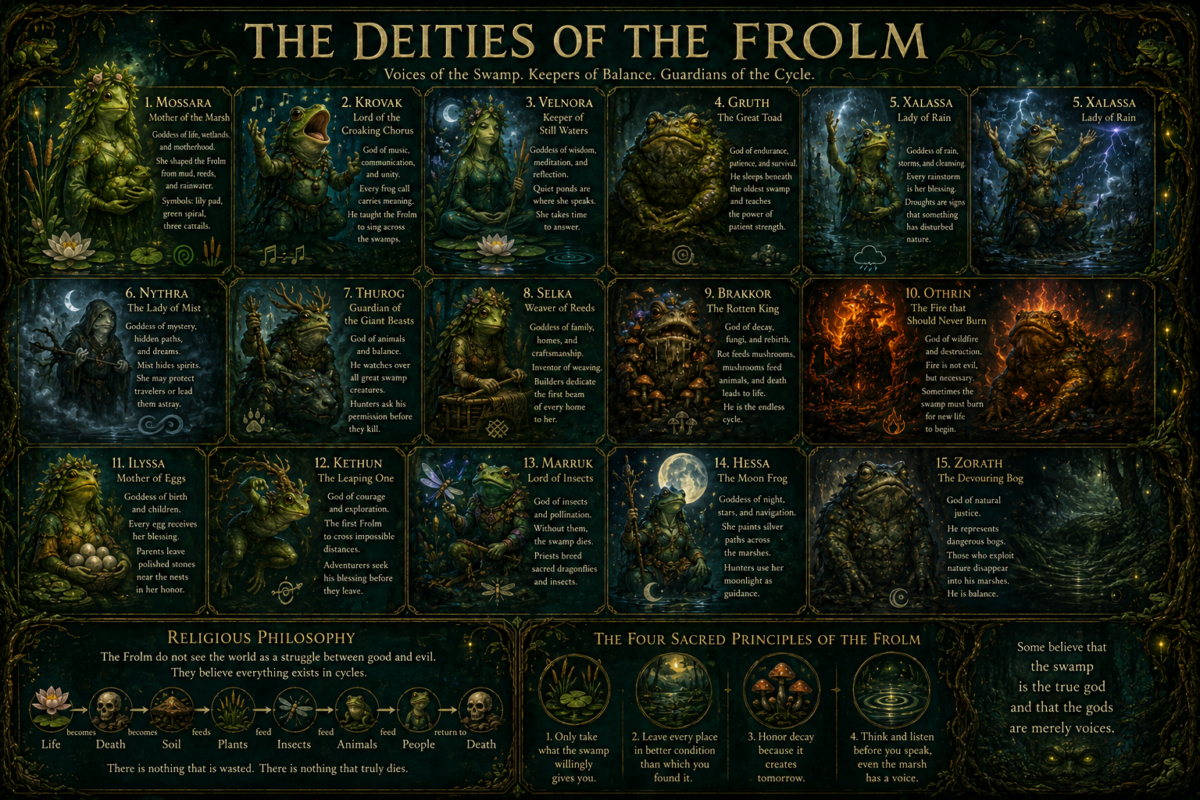
1. Mossara – Mother of the March

She is known as the Goddess of life, wetlands, and motherhood. She is also the supreme goddess among several of the frolm tribe. Mossara is said to have given the Creatrix the idea to create frolm aas a race and that she would watch over them. The frolm were shaped from mud, reeds, and rainwater. Her symbols are the lily pad, green spiral, and three cattails. She is often followed by midwives, farmers, and village elders.

2. Krovak – Lord of the Croaking Chorus

Krovak is known as the god of music, communication, and unity. The frolm believe that every frog call carries meaning with it. He has taught them how to sing to one another across swamps. Frolm priests communicate important messages through a variety of ceremonial chants.

3. Velnora – Keeper of Still Waters

Velnora is known as the goddess of wisdom, meditation, and reflection. Many frolm believe that quiet ponds are places where she speaks. Those who are seeking guidance, even by non-frolm travelers, sit beside still water for days waiting for the answer. She often takes a while to answer.

4. Gruth – The Great Toad

Gruth is known as the god of endurances, patience, and survival. He is said to be an humongous ancient toad said to sleep beneath the oldest swamp. He also teaches the frolm patience. Frolm warrior may gather together before partaking in a long campaign.

5. Xalassa – Lady of Rain

Xalassa is the goddess of rain, storms, and cleansing. In fact, every rainstorm is seen as one of her blessings. These rains often get frolm into the mood to be festive and sometimes parties are thrown at random with the heavy rains. However, droughts are seen as signs that something has disturbed nature.

6. Nythra – The Lady of Mist

Nythra is the goddess of mystery, hidden paths, dreams. The morning fog is said to hide spirits. Those traveling through a thick mist often leave offerings before enterting. She may protect travelers or lead them astray if they have ill will.

7. Thurog – Guardian of the giant beast

Thurog is said to be the god of animals and balance. Frolm believe that every giant swamp creature belongs to him including the great beasts who dwell in the Great Frolm Forest. Hunters will ask him for permission before killing. However, if one takes more than what is needed, his anger will be stirred.

8. Selka – Weaver of Reeds

Selka is the goddess of family, homes, and craftsmanship. She is the inventor of weaving and builders often dedicate the first beam of every home to her.

9. Brakkor – The Rotten King

Brakkor is the god of decay, fungi, rebirth. Some think he is the strangest deity. The frolm do not fear rot, rot feeds mushrooms which feeds animals, and animals feed the swamp. Death leads to life. He represents this endless cycle.

10. Othrin – The Fire that should never burn

Othrin is the god of wildfire and destruction. Unlike woodland elves, the frolm fear fire that isn’t controlled. Othrin is not evil, but necessary. Sometimes a part of the swamp may have to burn for new life to begin.

11. Ilyssa – Mother of Eggs

Ilyssa is the Goddess of birth and children. Every egg receives her blessing. Parents leave polished stones near the nests in honor of her.

12. Kethun – The Leaping One

Kethun is the God of courage and exploration. He is considered the first frolm to cross impossible distances. Those who are young adventurers seek his blessing before they leave for their quest.

13. Marruk – Lord of Insect

Marruk is the god of insects and pollination. While many people in Zalonia hate insects, the frolm recognize that without them, the swamp dies. Some of his priests breed sacred dragonflies and insects.

14. Hessa – The Moon Frog

Hessa is the goddess of the night, stars, and navigation. She is known to paint silver paths across the marshes and hunters use her moonlight as guidance.

15. Zorath – The Devouring Bog

Zorath is the god of natural justice. He represents dangerous bogs. There is the belief that those who exploit nature eventually disappear into his marches. He’s more an inevitable force of balance than he is a villian.
Religious Philosophy

The frolm don’t see the world as a struggle between good and evil. Instead, they believe that everything exists in cycles like life becomes death, death becomes the soil, the soil feeds plants, plants feed insects and some animals, insects feed animals, and animals feed the people. The people eventually return to death. There is nothing that is wasted and there is nothing that truly dies.

The Four Sacred Principles of the Frolm
Their four main teachings are summarized like this

1. Only take what the swamp willingly gives to you.
2. Leave every place in better condition from which you found it.
3. Honor decay because it creates tomorrow
4. Think and listen before you speak, even the marsh has a voice

Some believe that the swamp is the true god and that the gods are merely voices.

Sign up for my Newsletter Here

Get Curse of Kredaria for free

Support Me on Patreon

Frolm Food

Sign up for my Newsletter Here

Get Curse of Kredaria for free

Support Me on Patreon

Insect & Small Creature-Based Foods

(Because they are frog-like, they often enjoy such things as protein-rich insects, crustaceans, and amphibious creatures)

Maple-Covered Grasshoppers

This is their favorite treat and is often used at festivals. It is a sweet and crunchy food made from roasted grasshoppers glazed with maple syrup

Bogshrimp Skewers

These are large, juicy freshwater shrimp, typically found in jungle pools. They like to grill it over mosswood fires and then brush it with citrus-infused nectar.

Firefly Larvae Dumplings

These are soft, glowing larvae that are wrapped in edible lily leaves. They are steamed which gives off a faint golden hue.

Rainmoth Caterpillar Stew

This is a slow-cooked dish made with large caterpillars that absorb the flavors of jungle broth and swamp spices.

Flicker Beetle Jerky

This is where beetles are dried and marinated with juices that are sweet or sour. They create a chewy, tangy snack that store well for long journeys. They are the frolm’s equivalent to the mede seeds.

Moss Crab Legs

This is a soft-shelled crab which grows near the Frolm’s water habitats. It is boiled with fermented reeds and spicy rivergrass.

Glowing Spider Eggs

These are a delicacy of spider egg sacs that are mixed with honeydew sap and crushed flower petals. They are generally eaten raw or fermented for added flavor.

Fruits, Seeds, and Plant-Based Foods

Because the frolm live in a jungle, their diet includes such things as exotic fruits and energy-packed plants.

Glowfruit Chunks

This is a bioluminescent fruit with a tart-sweet taste. These are usually eaten raw or dried into chewy strips.

Swamp Melon

This is a large watery fruit with a jelly-like interior. It is sometimes fermented into a mildly alcoholic drink.

Lily Pad Wraps

These are large edible leaves that are filled with several nuts, seeds, and spiced mushroom paste.

Sticky Vine Pods

These are soft, nutty pods which ooze a caramel-like sap when they are cracked open. They are often chewed like gum or as a topping on food.

Rainberry Soup

This is a thick, purple berry soup. It is served cold and mixed with fermented swamp nectar.

Mistnut Paste

This is a high-energy nut better made from ground jungle nuts. They are sometimes spread on roasted insect legs or can be used as a dip.

Marsh Fungus Loaf

This is a dense, spongy bread made from combining wild mushrooms and tree-root flour

Swamp & Water-Based Dishes

Being amphibious, frolm eat food from rivers, lakes, and marshes

Bogfish Stew

This is a rich, slow-cooked fish stew which is infused with jungle spices and thickened with crushed fern roots.

Mudslime Noodles

This is a gelatinous, translucent noodle. It is made from algae and fermented swamp moss and served in a hot broth.

Saltwater Eel Fillets

These are tender slices of eel that are smoked over an aromatic wood and dipped in fermented fruit sauces.

Bubblefruit Ferment

This is a fizzy, plant-based drink which is made from soaking swamp berries until they are naturally fermented and become mildly alcoholic

Riverweed Salad

This is a cold dish made from such things as crunchy river plants, lotus roots, and edible swamp flowers

Driftwood Clams

These are a shellfish that grows on floating logs. It is harvested and steamed with tangy flower nectar.

Desserts & Treats

Moss-Honey Tarts

These are soft pastries usually made from crushed nuts and honey from the swamp. They are baked and contain edible leaves.

Frogspawn Pudding

This is a jelly-like dish that is made from small floating seed that look like frog eggs. They are generally served with berry syrup.

Sizzlefruit Crisp

These are dried, spiced fruit slices which crackle and tingle a bit when eaten due to their natural effervescence.

Dewdrop Jellies

These are crystal-clear rainwater-based jellies made with floral nectar and served in costly cups.

Glazed Mushroom Caps

These are sweet, chewy mushroom heads that are dipped into a caramelized sap. They are often sprinkled with dried moss flakes, depending on the frolm’s taste.

Cultural Notes on Frolm Eating Habits

Because they only eat every few days, their meals are generally high in fats and proteins. There are some foods, such as the glowing fungi, that have magical properties to them and are sometimes used in rituals. Some frolm fast before certain ceremonies, which creates a more symbolic feel around the feast. There are certain feasts that are communal, depending on the celebration
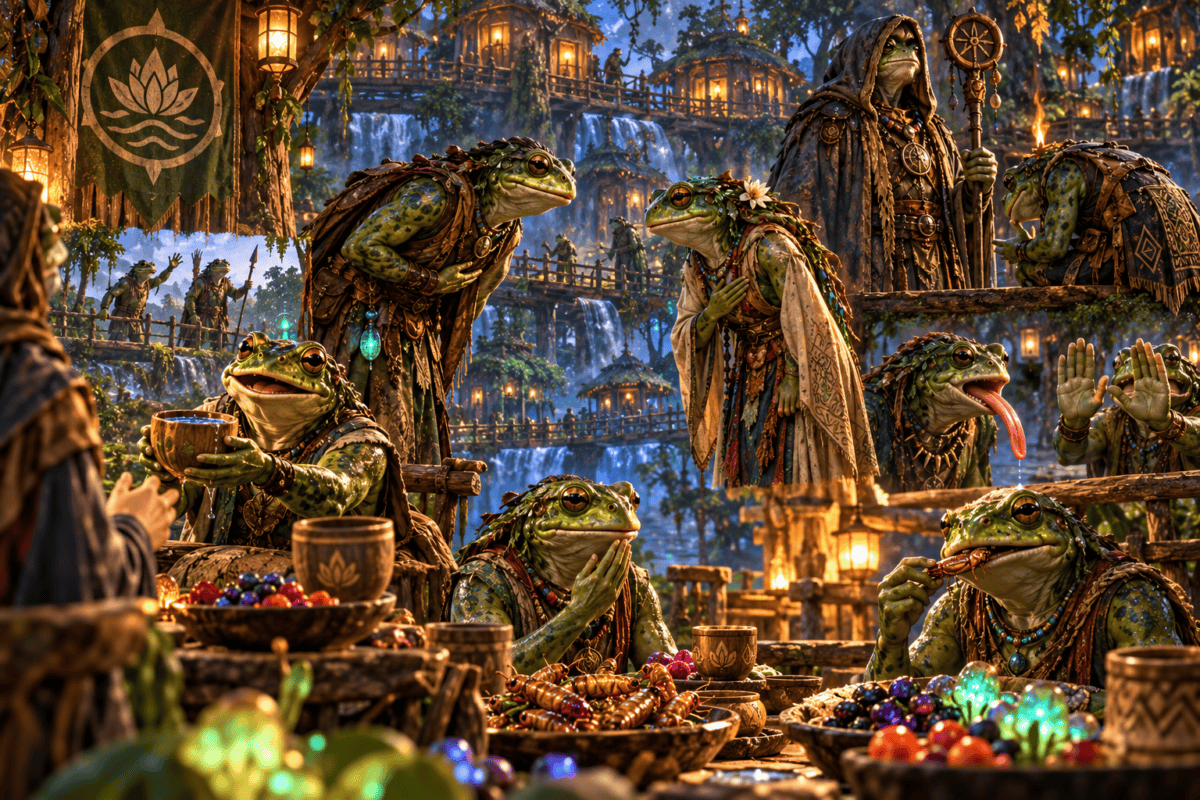
Frolm only use knives for cutting; otherwise, they eat with their tongues, which can stretch a couple of feet.
Frolm generally don’t consume alcohol because it is unhealthy for them, more so than other species.
The water within the forest is usually drinkable unless it is around where the water trolls live, since they pollute the water. Frolm generally stay away from this part of the forest.
Frolm generally use rectangular tables that are made from the wood they gather in certain places of the forest. They often use dead wood to build them.
Frolm won’t eat anything that is frog-like because they feel like they are connected with the frogs. In fact, it is considered a severe crime in some areas within the Great Frolm Forest. They are also allergic to bread products, and can even break out in hives if they touch anything that has to do with bread.
Frolm like sweeten bugs as their favorite, and sometimes they like them with spices and homemade sauces. They don’t use salt at all because they react poorly to salt. It is almost like a poison to them because it will dehydrate them, and frolm are dependent on staying moist.

Frolm: Lesser Laws

Support Me On Patreon

Sign up for my Newsletter on the right side

Get Curse of Kredaria for Free

Warrior’s Age

A warrior must be 30 or over to go to war, but under 400. This keeps younger and inexperienced frolm from joining at a young age.

The Glowfruit Rule

Glow fruit, which is a rare and bioluminescent delicacy, can only be harvested during the Festival of Sacred Bloom. Only limited quantities are allowed to be gathered. If someone harvests too many, they may get banned from the next festival and be required to plant and nurture new glowfruit trees.

The Silence of the Moonlit Marsh

When the regular moon is full, frolm aren’t permitted to make loud noises in the Moonlit Marsh because they may disturb nocturnal spirits. If someone breaks this law, they must offer a symbolic gift, such as rare insects or glowing moss, to the march spirits during a special ritual. This law keeps the frolm respectful of the forest.

The Pact of the Great Trees

Frolm are not permitted to cut down a living green without permission being granted by the Forest Elders, and they usually only approve of this if the tree poses a threat or is diseased. Breaking this law will require the offender to plant at least ten saplings and take care of them until they are fully grown

The frogspawn covenant

Anything related to a frog, such as tadpoles and frogs themselves, is protected at all costs. They are symbols for the future of the frolm. This offense is punished with banishment from breeding pools for one season. This law is in place for the frolms’ survival.

The Leap of Passage

Frolm youth are required to do a ceremonial leap from a special tree into a deep pond. This is a rite of passage to adulthood. If they don’t make this leap then they may not have the right to participate in certain community decisions. This is meant to strengthen cultural

The Law of Shared Spoils

Anything caught from a successful hunt or a foraging expedition, must be shared with the entire village. There must be special portions that are received by the elderly and sick. Those who refuse to acknowledge this may be temporarily banned from hunting or foraging. On top of that, the offender must make an offering to the community. This insures that no one in the village goes hungry and also supposed communal well-being.

The Guardian’s Vow

Frolm warriors, also known as Bogkeepers, need to swear to protect their territory from outsiders. This helps to ensure the safety of the hamlet. If one neglects his duty, the warrior must undergo a purification ritual and then spend an entire season patrolling the outskirts of the swamps alone. This helps to reinforce the importance of vigilance and protection of the frolm.

The Glowstone Edict

Glowstones are magical crystals that illuminate the forest. They are only allowed to be mined during specific lunar phases with the supervision of an elder miner. If someone is caught mining without permission, it can result in the confiscation of the crystals and a mandatory month of service in the mines to restore balance. This law makes sure that overmining doesn’t happen and retains the preservation of glowstones.

The Ritual of Rain

During times of drought, it is mandatory for all the frolm to participate in a community-wide raid-calling ritual which is led by a Raincaller. A Raincaller is a highly respected shaman who often oversees a territory and has more authority than hamlet leaders. If someone doesn’t attend without a good reason, this will result in a symbolic “thirsting day” where the individual isn’t allowed to drink from the sacred water. This law helps to strengthen unity and ensures collective effort during droughts.

The Boundary Accord

Frolm aren’t allowed to cross the boundaries of their territory without special permission from the council. These risks could expose their location to possible threats. If a frolm breaks this law, he must endure a period of isolation and reflection in a guarded section of the marsh. The purpose of this is that it protects frolm from outer dangers and ensures the secrecy of their homeland.

The Feast of First Fruits

The first fruits of the harvest season must be offered to the forest and tree spirits during a feast before any of it is consumed or stored. Those who break this law must fast for a day and make reparations by preparing the feast itself. This law honors the forest and tree spirits and shows thankfulness for the land’s bounty.

The Marchlight Law

This law requires travelers to carry marshlights (bioluminescent lanterns) during the night so they don’t disturb nocturnal predators or step into dangerous bogs. If one breaks this law, then it is mandatory to provide service as a night guide for the village for eight days (A week in Zalonia). The purpose of this law is to ensure the safety of travelers and maintain harmony with the nocturnal ecosystem.

The Pack of the Croaking Chorus

During certain parts of the year, the frolm must join in the Croaking Chorus to call for rain or to celebrate the changing of seasons. If one refuses to participate without a good reason, they are required to care for the village’s elder frogs for a season. This helps to strengthen cultural identity and reinforces their bond with the Great Frolm Forest and weather cycles.

The Spirit Grove Prohibition

It is strictly forbidden for one to enter the Spirit Grove without permission from the elders. The Spirit Grove is a sacred part of the forest where powerful spirits and ancient trees reside. Someone who disobeys this law results in a purification ritual along with a year of service as a caretaker of the grove. The purpose of this law is to protect the most sacred area of their territory and maintain the balance between the frolm and the spirits.

The conflict of oaths

If two oaths come in conflict, they must bring it before the leader of that community, and if things aren’t resolved, it is voted on by 13 frolm randomly selected. The majority wins.

Asking permission

Theft is unusual to the frolm since they believe that everything is collectively owned. However, it is respectful to ask someone if they need something rather than just taking it unexpectedly.

Voting laws

Frolm can vote for the area’s council once they turn 23 and can vote for the leader at the age of 31. At 22 frolm are considered adults even though their life has basically just begun.

Campaigning is prohibited

Frolm leaders don’t campaign for a position of power like we are used to in our society. Instead, voters discuss among themselves who should be nominated. No more than nine frolm can be nominated at a time. After they vote for the nine, they choose the top three and then vote between them on who the leader is going to be. The council has many more nominees, and the top thirteen are chosen.

Frolm Discussion

There are mostly friendly discussions among the frolm as to who to vote for and about religion and the gods. Frolm don’t mind being silent in the midst of others. It doesn’t get awkward as it does with humans. Sometimes there can be debate on the interpretation of the thirteen main laws. Sometimes they discuss laws that should be implemented.

A Warning for Lesser Crimes

Frolm who don’t follow the rules often get a warning the first time if it is a minor offense. The second time, some action is taken, such as the frolm’s right to visit other villages. A third offense could cause the frolm to be thrown in one of their prisons for a few days to try to teach the rebellious frolm a lesson. Frolm typically aren’t that rebellious and are good at keeping to frolm traditions.

See Also

Overview of the Frolm

Frolm Holidays and Ceremonies

Support Me On Patreon

Sign up for my Newsletter on the right side

Books to Read(Affiliate Links)

Creating Life – By Ralph Ellefson

The Art of World Building Workbook – By Ralph Ellefson

Fantasy World Building: A Guide To Developing Mythic Worlds and Legendary Creatures – By Mark Nelson

The 13 Sacred Laws of the Frolm


Sign up for my newsletter on the Right

Get Curse of Kredaria for free

Support Me on Patreon

The Frolm, being a tribal amphibian-humanoid species, have laws that are deeply connected to nature, survival, community, and the balance of their swampy environment. Their laws are both practical and spiritual, ensuring harmony among their people and the ecosystem.

1. The Law of the Waters

“He who poisons the water poisons his own blood.”

Since water is sacred to the frolm, they place it in high regard and forbid pollution, hoarding, and wasting water. If someone comes along and contaminates a sacred waterway or a stream, they will be punished depending on the offense. If it is a small breach of the law, they may be required to purify the waterway. However, under more extreme crimes, the criminal can be exiled or even put to death.

2. The Law of the Hunt

“Take only what you need, leave enough for the cycle to continue.”

This law has to do with how much one can take from nature. For example, there are limits on hunting and fishing because there needs to be a balance that is maintained. Hunters are required to leave an offering to the spirits they hunt and the plants they take.

3. The Law of Kinship

“A tribe stands as one. To break it is to stand alone.”

There are many ways this law can be broken, such as violence, theft, deceit, sexual crimes, and so on. If they harm their kin unjustly, they are considered to be “Mireborn” (outcasts), and this can even lead to exile.

4. The Law of the Croaking Pact

“A promise made in chorus must be kept until the dawn.”

There is an action among the frolm called the Croaking Pact, which is a tribal ritual of agreement. If a frolm swears an oath of this kind, they must uphold their pact. If they don’t, it could cause dishonor for the lawbreaker.

5. The Law of the Marsh Spirits

“The land listens, and the spirits watch. Do not bring wrath upon the reeds.”

The frolm see nature as being spiritual, and therefore it is forbidden to anger the spirits of the land. This can happen by disrespecting the dead, destroying sacred sites, or speaking ill of their ancestors. The penalty for breaking this law isn’t as extreme as some of the other penalties. Those who offend must seek forgiveness through rituals, such as offering carvings, songs, and sacrifices of time where they work as servants.

6. The Law of the Guest and Host

“A guest is like a still pond—how you treat them shapes their reflection.”

Among the frolm, hospitality in itself is sacred. If someone is hosting, they are required to offer food, water, and a place to rest. For the guests, they must not overstay their welcome and show gratitude to the ones helping them out. If a guest refuses hospitality without a good reason, it is seen as an insult to the host.

7. The Law of Silence and Sound

“There is a time for croaking, and a time for stillness.”

Silence is very important in frolm rituals. During hunts, mourning rituals, and sacred ceremonies, frolm are required to be quiet at certain times. They are careful not to speak out of turn or disrupt deep thought because it is a sign of disrespect and arrogance.

8. The Law of Names

“A name is given, a name is earned, a name can be lost.”

Names are very important in frolm society. For example, they avoid learning the names of their enemies because it could cause empathy and distraction on the battlefield. Frolm earn a second name if they do great deeds. These names must never be mocked, stolen, or spoken falsely. The punishment for this is to have one’s name stripped, in which they would be “Nameless,” and an outcast to society.

9. The Law of the Leap

“Fear is a still pond, courage is the leap.”

When one hesitates in times of action, it is seen as a weakness. In hunts, battle, and when difficulty presents itself, a frolm must act decisively because cowardice brings dishonor. A frolm warrior who runs away without cause may be given a Mark of Stillness to show their shame. The cut is generally made on the hand.

10. The Law of Life and Death

“All must return to the swamp. None may steal that which is not theirs to take.”

The greatest crime among the frolm is murder. Taking life without a just cause is considered an offense to the very spirits of nature. However, in times of self-defense, sacred duels, and war, one can kill. Those who unjustly murder are thrown into the deepest parts of the swamp so their spirit may never find peace.

11. The Law of the Elder’s Croak

“Wisdom is the weight that steadies the reed.”

An elder’s wisdom is considered sacred, and they must be respected when they speak. It is disrespectful to interrupt an elder unless there is an emergency. If a frolm wants to challenge an elder’s words, it must be done through a trial of wits, which is a ritual debate before the tribe.

12. The Law of the Dreaming Mist

“The mist carries truth—let no one twist it.”

Dreams are viewed as sacred messages, and it is frowned upon not to tell the truth about a vision or give false prophecies. The only ones who may interpret dreams for others are the shaman or the elder of a certain tribe. Frolm, who spread false visions, may be cursed with something called the Croakless Night. It is a punishment where they are made to drink a certain herb that takes away their speech for a time.

13. The Law of the Singing Stones

“Stories are carved, songs are sung, history is never swallowed by the swamp.”

History is important to the frolm so it is considered a crime to erase history. Whether it’s by the destruction of sacred carvings, burning old texts, or silencing truth. A frolm that breaks this law is supposed to replace it with a greater tale through carvings, songs, or actions worthy of remembrance.

Most punishments are symbolic or tied to nature, such as exile, community service, or spiritual atonement. The worst punishment is to be exiled to the deep marsh, which is reserved for traitors, oathbreakers, and murderers.

Sometimes a duel is permitted when settling disputes

See Also:

Overview of the Frolm

Frolm Holidays and Ceremonies

Support Me On Patreon

See also:

Frolm Basic

Frolm Holidays and Ceremonies

Sign up for my Newsletter on the right side

Books to Read(Affiliate Links)

Creating Life – By Ralph Ellefson

The Art of World Building Workbook – By Ralph Ellefson

Fantasy World Building: A Guide To Developing Mythic Worlds and Legendary Creatures – By Mark Nelson

Frolm (Species)

Sign Up For My Newsletter on the right

Get Curse of Kredaria for free

BASIC

The frolm are Frog/human like creatures that live among the Great Frolm Forest and sometimes in tall trees. They can leap 20 feet into the air on average and have no problem climbing trees because they can easily leap up to the branches. The highest one has ever jumped is about 30 feet. They use many strange rituals in worshiping their gods. They blend in with their surroundings giving them much advantage against enemies.

Their skin is green and scaly like a frog. The men can grow beards when they get older and many of the frolm leaders grow them.

CHILDREN

In normal times, each frolm couple is allowed to have two children. There are exceptions given to have three to help keep the population even as some don’t have any or one. Pregnancy usually lasts about five months. Frolm are considered children until they are about thirty. Children are not allowed to leave the Great Frolm Forest due to the dangers on the outside. They often play with toys made of wood such as figurines. Some children treat these figurines like they are sacred. A child’s opinion is generally respected among the frolm, as their children are fast learners and smart.

FOOD

Frolm eat vegetables and large bugs, and their favorite snack is maple-covered grasshoppers cooked over a fire. They only need to eat every two or three days. They can go without eating for weeks and survive, perhaps up to 80 days with no food. They need water, though, and can’t survive for long if they are not well hydrated. The Great Frolm Forest provides them with the hydration that they need in order to survive. It is difficult for the frolm to survive outside of the forest for more than three months, so not many leave the forest for prolonged periods of time.

SLEEP

Frolm have a way of not stressing about future things too much and can fall asleep easily like they do when traveling with the elves. They generally require about five hours of sleep and usually go to bed around midnight. They sleep in beds made of hay, which has been padded down for comfort. Frolm don’t tend to have vivid dreams while sleeping. They also wake up very fast and don’t deal with grogginess like many humans.

Customs

  • Say “Will you welcome me into your home?” when you want to enter a frolm home.
  • They offer guests the most comfortable chair.
  • They try not to know the names of those who they go to war with.
  • Crossing one’s heart with their arm when meeting someone new.

LEADERSHIP

They have various tribes, and there is usually a leader and a council. The leader and the council preside over about 200-400 frolm a piece. There are many frolm hamlets throughout the forest. They rarely have disagreements with other tribes and like to live in peace.

WARRIOR FROLM

There are generally 20-30 warrior frolm in each Hamlet. They are often sent out to the edge of the forest to make sure that nothing dangerous enters

There is a ritual done when a frolm becomes a warrior. There is usually a big celebration with a few frolm at a time becoming a warrior. They will have festivals that last about 3 days with dancing and partying. The new warriors are announced and honored. Frolm only allow men to become warriors, as women don’t really have that desire as they would rather do things like attend a garden.

MARRIAGE
.

They practice arranged marriages. Before the shadowthieves, it was the women who arranged the marriages and performed the weddings. Frolm are not bothered by their marriages being arranged. After the marriage, a bucket of maple syrup is poured over the heads of the couple.

BIRTHDAYS

The frolm celebrate birthdays in groups where the entire Hamlet comes together and feasts. This is done about six times throughout the year and is often celebrated on days that are not the actual birthday of the frolm. They give treats as gifts. Once a frolm turns thirty, their birthdays are no longer celebrated.

There is generally a small celebration when a new frolm enters the world. This celebration usually lasts a day, and the family is showered with gifts that will help raise the new frolm. Frolm often look out for one another and help each other out. At the birth itself, usually the mother, father, and the person who is delivering the frolm is present. Birth is a lot less painful for frolm women than human women. However, usually up to their 4th cousins attend the celebration after the birth, which is usually scheduled for the next day unless it interferes with one of their other celebrations.

Generally, the whole family that lives in the household helps with raising a child.

CLIMATE CELEBRATIONS

The climate often plays a role in the celebrations and customs of the frolm. They generally take shade as best as possible on really hot days so they don’t die of dehydration. They generally love the rain the most when it comes to the weather. This is because they are amphibian-like creatures. It does rain a lot in the Great Frolm Forest, which has a very moist atmosphere.

CROPS

Most of the frolm crops are taken from what naturally grows in the forest. They eat fruit, vegetables, insects, and sometimes small prey. They are careful about balancing out their small prey so they don’t kill too many, which would make the small prey species become extinct.

LIVING SITUATIONS

Frolm often live in the same house as their uncles, aunts, and grandparents. When the family becomes big enough, some will move out to make room for more frolm. Frolm keep track of their family to the 4th cousin because they are a family-oriented species. Even when frolm move out of their homes, they generally don’t move far from where they originally were. Frolm are also good at keeping the population even, so they don’t have to deal with overpopulation. Therefore, a lot of families are typically found in the same community.

GROWING UP

Many of the boy frolm go into training for a warrior, while others train for other things, such as a trade, for instance becoming a blacksmith. They do most of their learning through family and don’t have formal teaching unless the frolm wants to learn magic in Magdad. They do have a damp place in Magdad made especially for the frolm since they have difficulty surviving without the moisture found in their forest. The only training that is formal is for those who want to be warriors. However, math, reading, and history are all informally taught as the frolm grows.

DRESS

Frolm usually dress lightly and use forms of skin for armor rather than metal. They can’t fight that well when wearing metal armor because it is heavy, and frolm aren’t built with as much strength as a human. They usually make sure they are dressed light and often wear shorts and a vest-like coat.
Funerals

FUNERALS

The funeral of one passing is observed in the utmost seriousness. Those close to the dead often cry, and the funeral ceremony can last up to three days. Mourning the loss can last up to 30 days. They usually offer the dead up with flames to the gods that they acknowledge. This happens on the first day of the funeral, while the next two days frolm come together to eat and comfort each other. The ones who handle the dead bodies are generally leaders of the area, such as the council members.

One reason they use cremation is so the dead will not rise, as this has happened before, so they take precautions against it. They believe that if the body is burned, the soul will move on to its next journey. There have been near-death experiences where frolm believe they have entered an afterlife of some sort, but they can’t explain it using mere words. The dead are generally revered when it comes to the frolm, and the dead body is treated as if it were sacred. They don’t keep the ashes of the dead because they believe they should move on without continually mourning the dead.

WEAPONS

The weapons used most by the frolm are bows and arrows, light-weight swords, and daggers. Because they have better eyesight than humans, they are generally better with the bow. However, they are generally frailer and therefore don’t typically use the heavier weapons. Usually, it is just the frolm warriors who carry weapons unless there is an attack on the forest itself; then many more frolm will take up weapons to defend their homes. The frolm are generally trusting of one another and feel that there is no purpose in carrying weapons within their communities. There are many warrior frolm who gather on the edge of the forest to keep it protected. Each guard spends about a week at a time on the edge of the forests, but is allowed to return to their family for 3 weeks at a time.

Holidays

A commune of the frolm generally gather together during popular holidays and feast together for celebration. Since there are no servant frolm, all the frolm eat together and each takes responsibility for getting the food, cooking the food, and serving the food. Even the leader frolm partakes in the chores necessary for the gathering. There is no special seating for those who are higher up.

VISITORS

It’s rare to have visitors unless the frolm live near the main path that cuts through the Great Frolm Forest. In these places, they are usually prepared for guests of different species who are traveling through. Most of the travelers are human or medes. They have beds that can be used for medes and their large wings. They usually don’t have to worry about the medes food-wise because medes carry mede seeds with them when they leave their territories to explore the world.

WORDS FOR FOREST

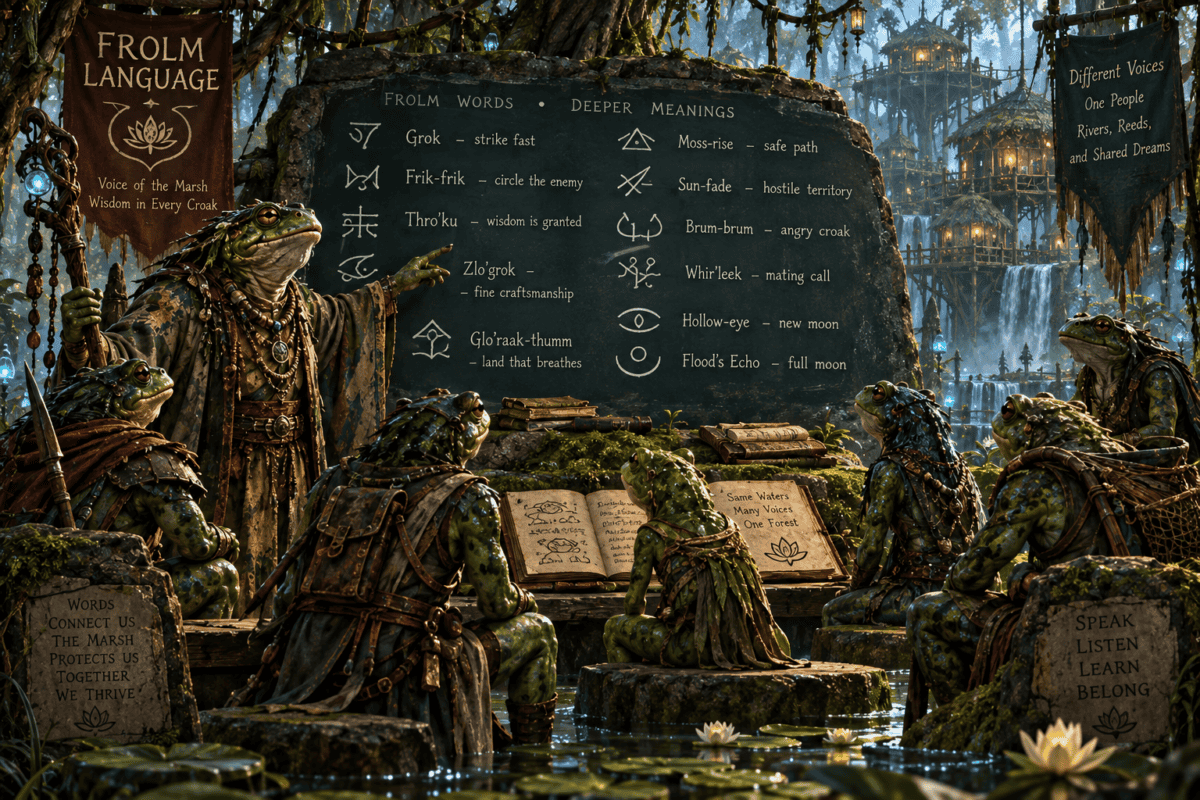
They have fifteen or so words for a forest, including woodland, barkle, leafton, etc. The forest is very important to their lives, so they have many words for it. The most valuable thing for the frolm is the forest itself. They have a deep reverence for nature.

THIRTEEN LAWS

They have a scroll of their thirteen most important laws that some are supposed to swear by. Swearing by it, but not being honest about it can result in a curse, or they may exile the one who dishonestly swore.

OTHER

They also love candles. Frolm are typically left handed which can throw some people off when it comes to dueling.

Frolm don’t keep a written history and everything is told by mouth. Only the medes who do research write down what they are taught by the frolm. The frolm have no trouble giving information to the medes since the species are generally at peace with each other.

Frolm believe that everything is owned collectively and often borrow from each other without needing permission. This can throw some people off who are from other cultures. However, the frolm only do this from within their communities and wouldn’t “borrow” things from a non-frolm.

Most frolm want to grow up in peace and want families. A small commune is ideal for them. They don’t like crowded spaces and like to move about without hindrances. Some do desire to serve in the military, but they are allowed to retire when they hit 400 and can typically spend the rest of their lives the way they want whether it is sitting by a pond with their spouse, or exploring the Great Frolm Forest. Frolm often have individual wants.

FIGHTING

They are tribal like and are extremely talented with the bow, often matched with the elves accuracy. They are good at ax throwing and climbing trees as well.

Frolm are not supposed to know the personal names of their enemies so they don’t sympathize with them.

Frolm use leather armor because their body structure doesn’t allow them to move well in metal armor. The armor is green and brown which makes it hard to see them in the forest.

It is custom for frolm warriors to be required to go on a quest in order to prove themselves worthy of being a warrior. These quests vary depending on the frolm. Some are simple quests such as getting a book from one of the mede libraries. Then they can be dangerous like protecting someone who needs to go on a journey through dangerous territory. The frolm are required to be 30 years old to become an official warrior.

They are also good with spears and many of their guards are required to use one. They generally don’t throw them but use them by thrusting and stabbing. Only in a dire situation do they throw them. They have relatively big heads, about 5 times the size of the blade of an arrow.

HOMES


They have houses in the trees and on the ground. There are roped bridges in the trees and in some cases, swirling staircases that lead up to the trees and homes

They live in large rectangular houses which fit extended family such as uncles and grandparents. Their homes often consist of a large table, for example, Trinya’s table can seat up to sixteen frolm. Households generally eat dinner together unless there is a celebration where they will eat publicly with the rest of the frolm.

PRIMARY HUTS


Before the shadow thieves, there were various sections of the woods where an elder would be in charge. There is one of those remaining. However, each frolm section could have been said to have one of these. The meeting place would be a large hut that seemed to be built from fallen trees and sheltered with hay. It was a large building, perhaps thirty feet wide and twenty feet tall. The doorway was in the shape of a half-opened mouth. Three steps to the door entrance, where two frolm guards stood with powerfully built spears, with spearheads five times the size of the arrowheads.

No weapons are allowed inside besides the guards at the entrance
The elder sits at the far end from the entrance and is usually the oldest in a group of frolm. The elder can be a male or female. There are certain things that can disqualify a frolm becoming an elder, such as previous crimes and injuries that would hinder their performance.
Frolm proceedings are very formal
There is a leading scholar, usually a prophecy interpreter – who is present during the day along with the elder frolm at the primary hut. He is usually aware of things like prophecy and what prophecy interpreters have said and tends to work as an advocate for those who are being accused. He knows the laws and will help those in trouble if he sees fit. He acts as a guide to the elder. He is the only democratically elected frolm; however, to qualify for an election, the leading scholar has to pass certain tests to demonstrate that they are knowledgeable enough for the position.

COUNCILS and PROPHECY


A total of ten to sixteen frolm are part of the council. They are usually elected by an agreement between the elder and the leading scholar.

Frolm Prophecies – The Frolm keep written prophecies that are related to their race specifically. They also have frolm interpreters. Frolm prophets are generally quite rare. The prophecy regarding the woodland elves and frolm uniting to defeat the shadow thieves was given fifteen years prior. However, these prophecies are generally vague, and therefore there is a need for prophecy interpreters. Even the prophets themselves don’t understand their prophecies.

The prophecy interpretation of the elves coming, “They said that the frolm are doomed and that the shadow thieves shall overthrow us. However, only in humility will we survive. Aine will send among you what you hate, and it is up to the frolm to do as they wish. However, this decision will determine the frolm’s fate.”

It is rare for the frolm to have a formal high-court dinner, but if there is going to be a change in the legal system, those who are the highest authority will meet together which is often a council of 15. There are generally about 400-1000 frolm that live in each of their divisions.

During a formal meeting of the higher ups, the head frolm of the area sits at one of the table’s end. If the interpretor of prophecy is present, they usually are seated at the other end.

See Also:

Support Me On Patreon

Sign up for my Newsletter on the right side

Books to Read (Affiliate Links)

Creating Life – By Ralph Ellefson

The Art of World Building Workbook – By Ralph Ellefson

Fantasy World Building: A Guide To Developing Mythic Worlds and Legendary Creatures – By Mark Nelson

Get Curse of Kredaria for free