The 13 Sacred Laws of the Frolm


Sign up for my newsletter on the Right

Get Curse of Kredaria for free

Support Me on Patreon

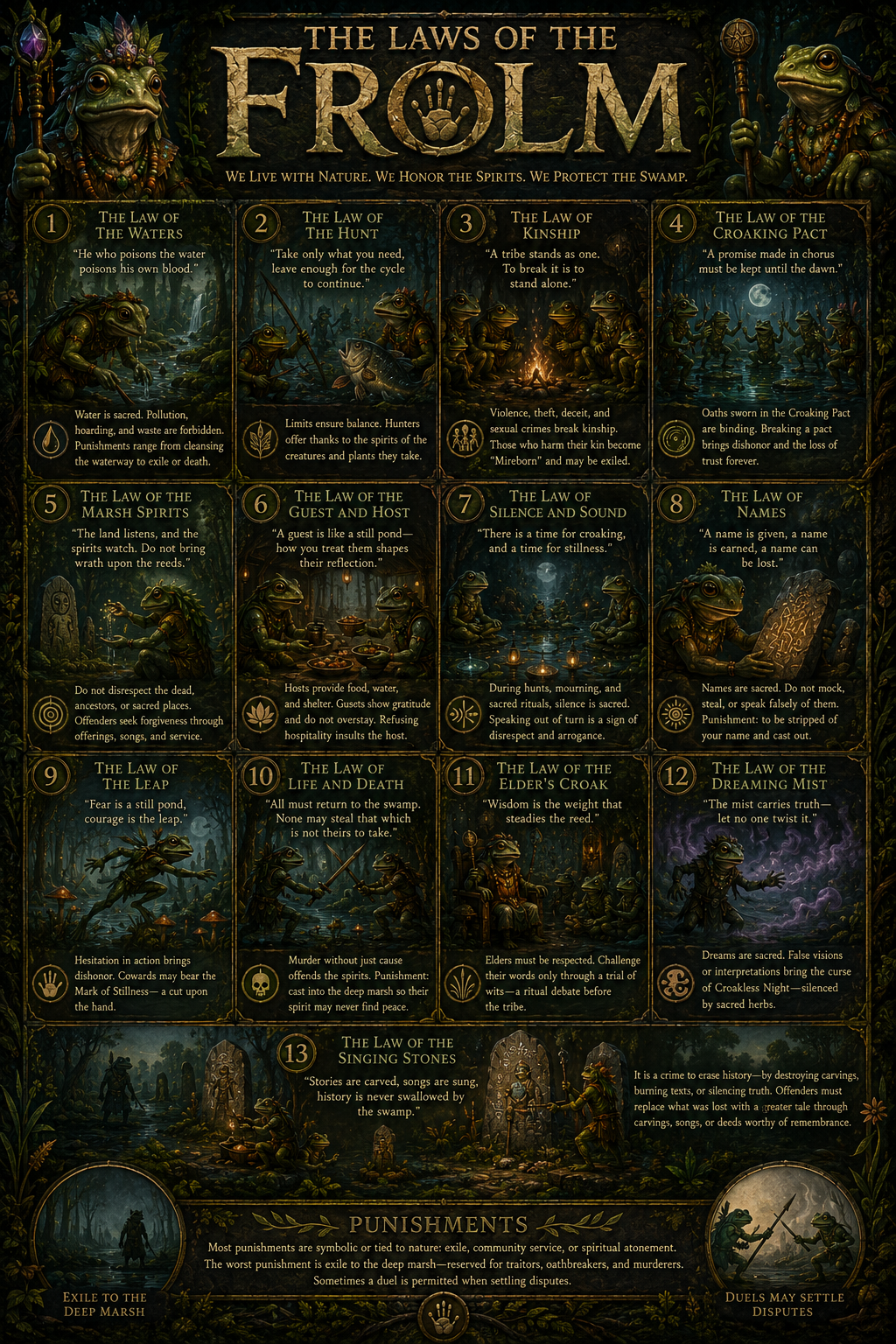
The Frolm, being a tribal amphibian-humanoid species, have laws that are deeply connected to nature, survival, community, and the balance of their swampy environment. Their laws are both practical and spiritual, ensuring harmony among their people and the ecosystem.

1. The Law of the Waters

“He who poisons the water poisons his own blood.”

Since water is sacred to the frolm, they place it in high regard and forbid pollution, hoarding, and wasting water. If someone comes along and contaminates a sacred waterway or a stream, they will be punished depending on the offense. If it is a small breach of the law, they may be required to purify the waterway. However, under more extreme crimes, the criminal can be exiled or even put to death.

2. The Law of the Hunt

“Take only what you need, leave enough for the cycle to continue.”

This law has to do with how much one can take from nature. For example, there are limits on hunting and fishing because there needs to be a balance that is maintained. Hunters are required to leave an offering to the spirits they hunt and the plants they take.

3. The Law of Kinship

“A tribe stands as one. To break it is to stand alone.”

There are many ways this law can be broken, such as violence, theft, deceit, sexual crimes, and so on. If they harm their kin unjustly, they are considered to be “Mireborn” (outcasts), and this can even lead to exile.

4. The Law of the Croaking Pact

“A promise made in chorus must be kept until the dawn.”

There is an action among the frolm called the Croaking Pact, which is a tribal ritual of agreement. If a frolm swears an oath of this kind, they must uphold their pact. If they don’t, it could cause dishonor for the lawbreaker.

5. The Law of the Marsh Spirits

“The land listens, and the spirits watch. Do not bring wrath upon the reeds.”

The frolm see nature as being spiritual, and therefore it is forbidden to anger the spirits of the land. This can happen by disrespecting the dead, destroying sacred sites, or speaking ill of their ancestors. The penalty for breaking this law isn’t as extreme as some of the other penalties. Those who offend must seek forgiveness through rituals, such as offering carvings, songs, and sacrifices of time where they work as servants.

6. The Law of the Guest and Host

“A guest is like a still pond—how you treat them shapes their reflection.”

Among the frolm, hospitality in itself is sacred. If someone is hosting, they are required to offer food, water, and a place to rest. For the guests, they must not overstay their welcome and show gratitude to the ones helping them out. If a guest refuses hospitality without a good reason, it is seen as an insult to the host.

7. The Law of Silence and Sound

“There is a time for croaking, and a time for stillness.”

Silence is very important in frolm rituals. During hunts, mourning rituals, and sacred ceremonies, frolm are required to be quiet at certain times. They are careful not to speak out of turn or disrupt deep thought because it is a sign of disrespect and arrogance.

8. The Law of Names

“A name is given, a name is earned, a name can be lost.”

Names are very important in frolm society. For example, they avoid learning the names of their enemies because it could cause empathy and distraction on the battlefield. Frolm earn a second name if they do great deeds. These names must never be mocked, stolen, or spoken falsely. The punishment for this is to have one’s name stripped, in which they would be “Nameless,” and an outcast to society.

9. The Law of the Leap

“Fear is a still pond, courage is the leap.”

When one hesitates in times of action, it is seen as a weakness. In hunts, battle, and when difficulty presents itself, a frolm must act decisively because cowardice brings dishonor. A frolm warrior who runs away without cause may be given a Mark of Stillness to show their shame. The cut is generally made on the hand.

10. The Law of Life and Death

“All must return to the swamp. None may steal that which is not theirs to take.”

The greatest crime among the frolm is murder. Taking life without a just cause is considered an offense to the very spirits of nature. However, in times of self-defense, sacred duels, and war, one can kill. Those who unjustly murder are thrown into the deepest parts of the swamp so their spirit may never find peace.

11. The Law of the Elder’s Croak

“Wisdom is the weight that steadies the reed.”

An elder’s wisdom is considered sacred, and they must be respected when they speak. It is disrespectful to interrupt an elder unless there is an emergency. If a frolm wants to challenge an elder’s words, it must be done through a trial of wits, which is a ritual debate before the tribe.

12. The Law of the Dreaming Mist

“The mist carries truth—let no one twist it.”

Dreams are viewed as sacred messages, and it is frowned upon not to tell the truth about a vision or give false prophecies. The only ones who may interpret dreams for others are the shaman or the elder of a certain tribe. Frolm, who spread false visions, may be cursed with something called the Croakless Night. It is a punishment where they are made to drink a certain herb that takes away their speech for a time.

13. The Law of the Singing Stones

“Stories are carved, songs are sung, history is never swallowed by the swamp.”

History is important to the frolm so it is considered a crime to erase history. Whether it’s by the destruction of sacred carvings, burning old texts, or silencing truth. A frolm that breaks this law is supposed to replace it with a greater tale through carvings, songs, or actions worthy of remembrance.

Most punishments are symbolic or tied to nature, such as exile, community service, or spiritual atonement. The worst punishment is to be exiled to the deep marsh, which is reserved for traitors, oathbreakers, and murderers.

Sometimes a duel is permitted when settling disputes

See Also:

Overview of the Frolm

Frolm Holidays and Ceremonies

Support Me On Patreon

See also:

Frolm Basic

Frolm Holidays and Ceremonies

Sign up for my Newsletter on the right side

Books to Read(Affiliate Links)

Creating Life – By Ralph Ellefson

The Art of World Building Workbook – By Ralph Ellefson

Fantasy World Building: A Guide To Developing Mythic Worlds and Legendary Creatures – By Mark Nelson
Frolm Holidays and Ceremonies

Sign up for my newsletter on the right

Get Curse of Kredaria for free

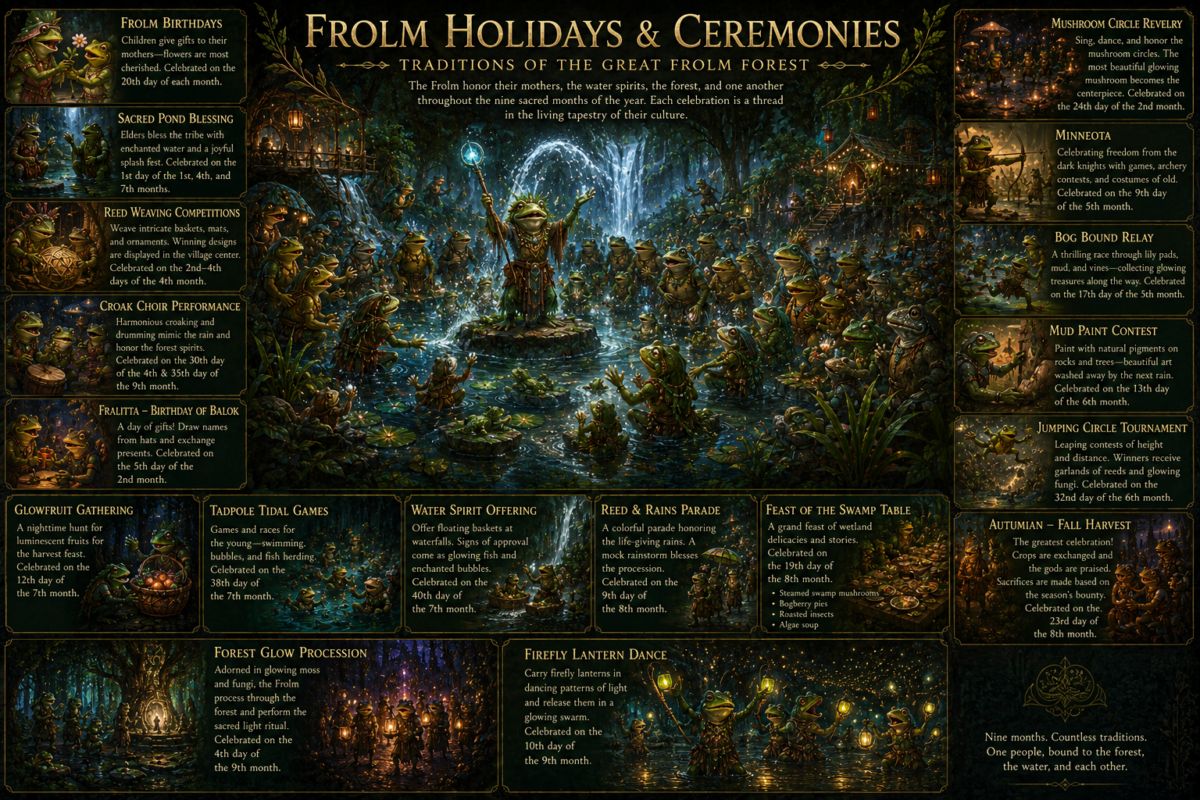
The Frolm have various holidays that they celebrate.

Frolm birthdays

Gifts are given from the children to their mothers. If a young one has a birthday, he/she will go get or make a gift for his/her mother. They greatly respect mothers for being able to bear children, and that’s why they get the gifts. Flowers are a popular gift from a child to their mother. This takes place on the twentieth of each month, so kids who were born in that month celebrate it in the middle.

Sacred pond blessing

This is where the frolm elders lead a ceremonial gathering around a sacred pond. There are various sacred ponds throughout the Great Frolm Forest, and most tribes have one. If a tribe doesn’t have one, they visit a neighboring tribe that has one. The leaders sprinkle enchanted water onto the gathering crowd, which blesses them for the coming season. This is a way to thank the water spirits and ensure future prosperity. After the blessing ritual is a communal splash fest, where the frolm joyfully dive into the pond. This is done three times a year because they recognize three seasons. It is done on the first day of the first month, the first day of the fourth month, and the first day of the seventh month, as there are nine months a year that are recognized by Zalonians.

Reed Weaving Competitions

The Reed Weaving Competitions are where participants weave reeds into intricate baskets, decorative ornaments, and mats. This acknowledges their craftsmanship. It also creates practical tools or festive decorations. Designers who win have their designs displayed in the village center until the festival is over. This festival lasts three days. It is from the second to the fourth day of the fourth month.

Croak Choir Performance

The frolm can sing, but through croaks. Twice a year, they gather together to create harmonious croaking songs which mimic the sounds of the forest during the rainy seasons. They take place on the fourth month and thirtieth day and the ninth month and thirty-fifth day. They do it in honor of their natural vocal talents and give thanks to the forest spirits for a bountiful harvest. Many frolm who participate drum on something such as hollow logs and other percussion type things found in the forest.

Fralitta

The birthday of Balok. This is celebrated on the fifth day of the second month. Everyone exchanges one gift. Usually one gift is given to each of the frolm from another individual. They draw out of hats to see who gets which gifts. Gifts can be things like weapons, herbs, flower seeds, flowers, and other things among the frolm.

Frogsong Storytelling

The Frogsong Storytelling is where elders and bards tell tales of their ancestors, forest spirits, and past harvests. This is accompanied by sound effects and croaking rhythms made by the audience. It’s a way to pass down history and strengthen the cultural bond among participants. The tales often have a moral lesson attached to them with values such as gratitude, perseverance, or harmony with nature. This occurs on the tenth day of the third month.

Mushroom Circle Revelry

The mushroom circle revelry is where the frolm gather around naturally or magically grown mushroom circles. This is where they sing, dance, and share various tales. This is a way to honor the interconnectedness of the forest’s ecosystem. The most beautifully glowing mushroom is chosen as the festival centerpiece. It is used in the closing ritual. This takes place on the twenty-fourth day of the second month.

Reed Weaving Competitions

The Reed Weaving Competitions are where participants weave reeds into intricate baskets, decorative ornaments, and mats. This acknowledges their craftsmanship. It also creates practical tools or festive decorations. Designers who win have their designs displayed in the village center until the festival is over. This festival lasts for three days. It is from the second to the fourth day of the fourth month.

Minneota – Celebration when they gained their independence from the dark knights thousands of years ago. It is celebrated by games, drinking, and all-out partying. Some dress in old-fashioned clothes as frolm dressed thousands of years ago. There are archery contests, which are one of the main attractions. The celebration takes place during the ninth day of the fifth month.

Bog Bound Relay

.
This is a race where participants leap between large lily pads, wade through muddy water, and climb slick vines. It is competitive, and the top five contestants each receive a prize. There are often at least a hundred competitors. It is a celebration related to their agility and physical connection to the wet forest. The competition includes collecting special glowing mushrooms or fruit on their way through, which are added to the feast celebrated afterward. It is usually celebrated on the fifth month and seventeenth day when the weather of the Great Frolm Forest is most moist.

Mud Paint Contest

Since they live in a moist forest, there is no lack of mud among the frolm. They use richly colored muds, plant extracts, and natural pigments to paint items on large rocks or tree trunks. These paintings only last until the next rain washes them away. This is done on the sixth month and thirteenth day of the year.

Jumping Circle Tournament

This is a leaping contest to see who can leap the highest or the furthest with the use of tree stumps or small ponds for jumping platforms. The record-highest jump was thirty-two feet in the air, and the furthest jump was fifty-four feet. This event highlights their physical prowess and amphibian agility while at the same time, providing enjoyment and friendly competition. The winners receive garlands of woven reeds and glowing fungi as trophies. This usually takes place on the sixth month thirty-second day of the year.

Glowfruit Gathering

The glowfruit gathering is a nighttime scavenger hunt. The frolm will search for luminescent fruits that are hidden throughout the forest. The fruits are used in the harvest feast. There is also a competitive nature about it when the most glowfruit gathered by an individual or group earns them the honor of presenting the first dish during the feast. It’s celebrated in the seventh month on the twelfth day.

Tadpole Tidal Games

Tadpole Tidal Games are games from frolm children which include swimming races in shallow ponds, catching bubbles enchanted to float away. They also herd small schools of harmless fish into rings. It teaches the younger frolm about their aquatic heritage. This provides them with joyful memories of the harvest season. Those who do well receive miniature carved wooden tadpoles as keepsakes. This takes place on the thirty eighth day of the seventh month.

Water spirit Offering

The Water Spirit Offering is where frolm gather at a sacred waterfall (or spring if no waterfall is available). They offer floating baskets filled with harvest goods, flowers, and glowing lanterns to the water spirits. This makes sure that the spirits’ continued blessings for future harvests. If the water spirits are pleased, they will send glowing fish and enchanted bubbles as signs of approval. This celebration takes place on the fortieth day of the seventh month

Rede and Rains Parade

During this parade, frolm wear costumes made from moss, reeds, and bright flower petals. They parade through their village while mimicking the sounds of rainfall with homemade instruments. This celebration is based on the life-giving rains that keeps their home moist for their survival. At the end of the parade they do a mock rainstorm created by the elders. They use enchanted droplets of water that float above the procession. After this, they shower down. This is celebrated on the ninth day of the eighth month.

Feast of the Swamp Table

This is where a long, communal table is set up across logs and stones that are adorned with moss, vines, and water flowers. It holds a variety of wetland delicacies. This is done on the nineteenth day of the eighth month. There are various dishes which include:

– Steamed swamp mushrooms wrapped in leaves.
– Bogberry pies that are sweetened with honeydew sap.
– Roasted insects seasoned with wild herbs and maple syrup.
– Algae soup which is served in hollowed-out gourds.

The guests often take turns at offering toasts and sharing stories about their connection to the harvest.

Autumian

Fall harvest. Crops are exchanged and the gods are praised if it is a good harvest, usually the twenty-third day of the eighth month. Depending on how well the season went there are a different number of sacrifices. This is the biggest celebration of the year.

Forest Glow Procession

The Forest Glow Procession is a time when frolm decorate themselves with glowing moss, fungi, and bioluminescent paint. This creates a mesmerizing light show as they go through the forest trails. This is symbolic of their oneness with the forest and shows thankfulness for its bounty. This is the biggest celebration a year, as frolm meet at one of the biggest trees in the forest. A magical light ritual is performed, symbolic of the bond between the frolm and their land. It is celebrated on the fourth day of the ninth month.

Firefly Lantern Dance

During this event, the frolm carry glowing jars of captured fireflies and create weaving patterns of light throughout the forest. This dance is in honor of the illumination of the dark season ahead so it is often celebrated during the ninth month and tenth day. They also pay homage to the forest’s natural luminescence. At the end of the dance, the fireflies are released forming a spectacular glowing swarm that lights the night sky.

Sign up for my Newsletter on the right side

Books to Read (Affiliate Links)

Creating Life – By Ralph Ellefson

The Art of World Building Workbook – By Ralph Ellefson

Fantasy World Building: A Guide To Developing Mythic Worlds and Legendary Creatures – By Mark Nelson

Get Curse of Kredaria for free