Blog

Designing Unique Bodies of Water in Science Fantasy Worlds

Sign up for my Newsletter Here

Get Curse of Kredaria for free

Support Me on Patreon

Rethinking Rivers, Oceans, and Aquatic Mysticism Beyond Earthly Logic
In a world where science and magic intertwine, bodies of water don’t just quench thirst or serve as travel routes—they pulse with ancient intelligence, carry dimensional echoes, or respond to arcane frequencies. Whether you’re building planets with liquid methane lakes or rivers that rewrite history, crafting aquatic systems in your world can unlock rich symbolism, culture, and drama.

This post dives into inspired and original types of water bodies for science fantasy settings and how to use them meaningfully in your story.

🌊 Classic Oceans with a Twist

1. The Endless Deep

  • A sentient ocean that forgets and remembers you depending on the tide.
  • Its tides are pulled by twin moons—one physical, one spectral.
  • Sailors whisper prayers into bottles; the ocean answers weeks later.
  • Creatures evolve from thoughts lost at sea.

Narrative Hooks:

  • A civilization that treats the ocean as a god—or a demon.
  • Naval expeditions aimed at reaching the fabled “Center Memory Reef.”

2. Etheric Oceans

  • Oceans made not of water, but liquid magic.
  • Shimmering tides emit energy that boosts or scrambles spellcasting.
  • Ships must be partially alive to survive its arcane surges.
  • Water changes color depending on the emotional state of its nearest civilization.

Uses in Storytelling:

  • Port cities built on rituals as much as docks.
  • Coral libraries that “record” ambient magical history in the Ethersea.

🪷 Invented Bodies of Water

3. Lacuna Pools

  • Still, mirror-like pools found in craters where time behaves strangely.
  • Gazing into them shows your past lives or potential futures.
  • Dropping items in may either erase them from history or teleport them elsewhere.’
  • Worshiped by seers and outlawed by empirical societies.

4. The Meltflow Network

  • Underground rivers of radiant, molten material—part magma, part life force.
  • Used to power cities above with geothermal-spell converters.
  • Accessible only to tunneling creatures or via soul anchors.
  • Exposure causes vivid dreams—or permanent hallucinations.

Narrative Potential:

  • A city’s reliance on the Meltflow drives political unrest as its temperature rises.
  • Creatures who can “swim” through both lava and consciousness.

5. Rivers of Echo

  • Flowing streams that “remember” sound and replay moments of great importance.
  • Whispered words become audible again during certain moon phases.
  • Entire battles, confessions, or proposals echo through the water centuries later.
  • Rogue mages use it to trace secret histories.

🧊 Exotic Lakes and Seas

6. Glacial Seas of Thought

  • Massive frozen oceans on an ancient moon where thoughts freeze into sculptures.
  • Walkers on the ice hear the frozen screams and songs of ancient civilizations.
  • Magic users can chisel memories into the ice and cast them as spells.
  • Civilizations trade frozen emotions as currency.

7. The Sinking Sea

  • A dense, bottomless body of dark liquid that pulls even air and light inward.
  • No known bottom—used as a dumping ground for cursed or unstable tech.
  • Myths say the sea is a tear from a dead god’s eye.
  • Creatures that live here can only be described in dreams.

8. The Blooming Bay

  • A shallow, luminous bay where aquatic plants bloom into the air, forming floating gardens.
  • Used as a neutral diplomatic zone by warring nations.
  • The plants produce spores that enhance psionic abilities.
  • Local fauna feed on psychic residue and mimic thoughts.

🌌 Cosmic and Interdimensional Waters

9. Star Tides

  • Rivers of water flowing through space between moons or ships.
  • Carried by gravity wells and magical conduits.
  • Traveled by creatures that breathe vacuum and vapor.
  • Often mined for their pure aether content.

10. The Veil Lakes

  • Interdimensional “pools” that exist simultaneously on several planes.
  • Stepping into one takes you to an identical lake… but on another planet or timeline.
  • Used by smugglers, sages, and invading armies.
  • Veil-lakes shift location without warning—mapping them is a lost art.

🛶 Cultural Roles of Water

Even if your water isn’t magical, how people interact with it can be world-defining.

  • Sacred Rivers: Used for memory cleansing or as part of coming-of-age rituals.
  • Forbidden Seas: Rumored to house weaponized weather or exiled gods.
  • Floating Cities: Built on AI-maintained archipelagos or atop dreaming sea creatures.

📝 Tips for Inventing Aquatic Features

Anchor one law of physics or magic, then twist it: e.g., water that flows upward, evaporates into memory mist, etc.

Give each body of water cultural significance—how does it affect trade, belief, and diplomacy?

Tie fauna and flora into the water—bioluminescent jellyfish with prophetic patterns? Carnivorous lotus? Herds of semi-intelligent plankton?

🎇 Final Thought

In science fantasy, water is never just H₂O. It’s a mirror, a memory, a weapon, a gateway. Let oceans be stained with starlight, rivers hum with haunted voices, and lakes reflect dimensions as yet unborn. The more alive your water feels, the more immersive your world becomes.

Sign up for my Newsletter Here

Get Curse of Kredaria for free

Support Me on Patreon

Creating Life – By Ralph Ellefson

The Art of World Building Workbook – By Ralph Ellefson

Fantasy World Building: A Guide To Developing Mythic Worlds and Legendary Creatures – By Mark Nelson


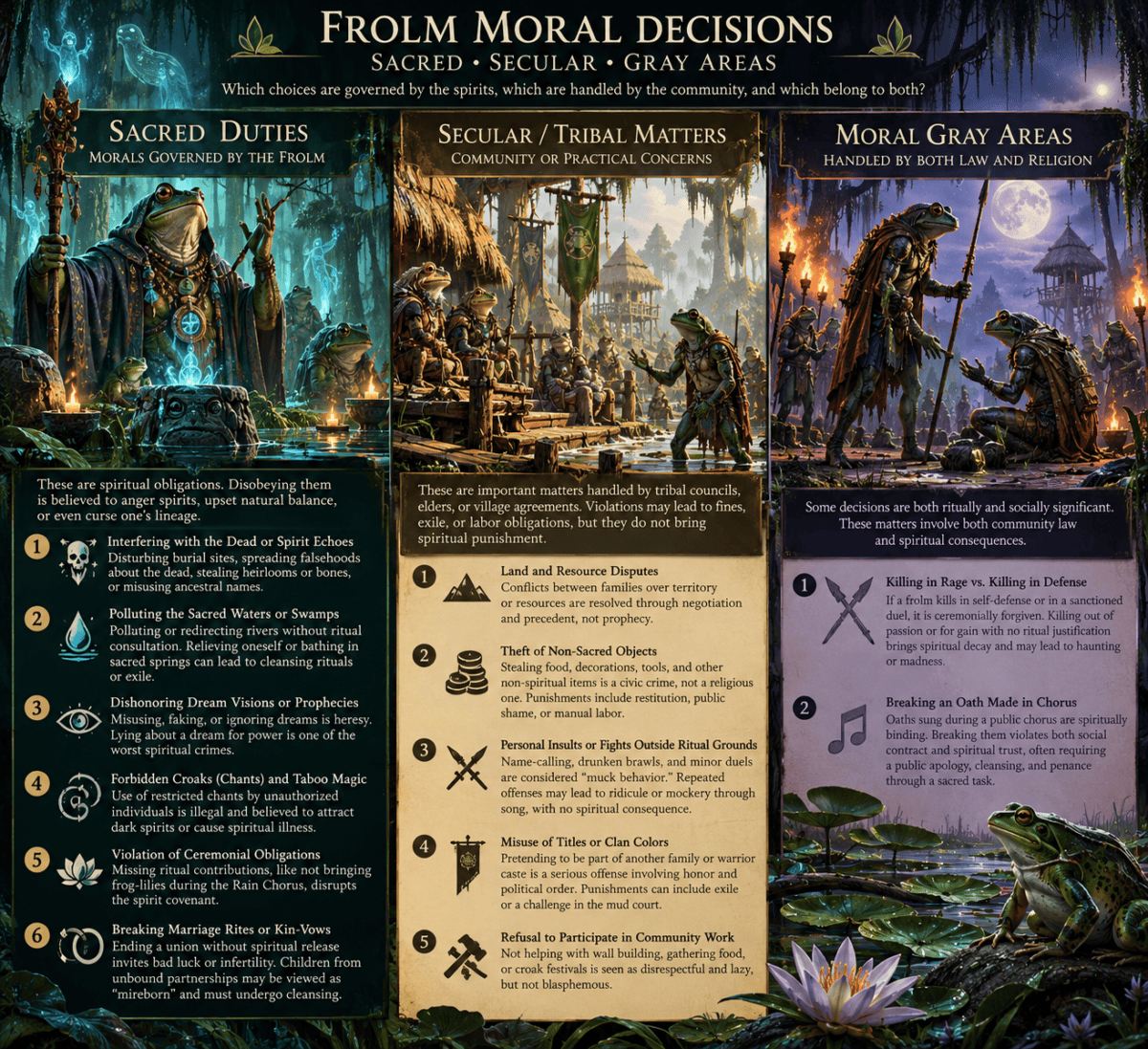
The 13 Sacred Laws of the Frolm


Sign up for my newsletter on the Right

Get Curse of Kredaria for free

Support Me on Patreon

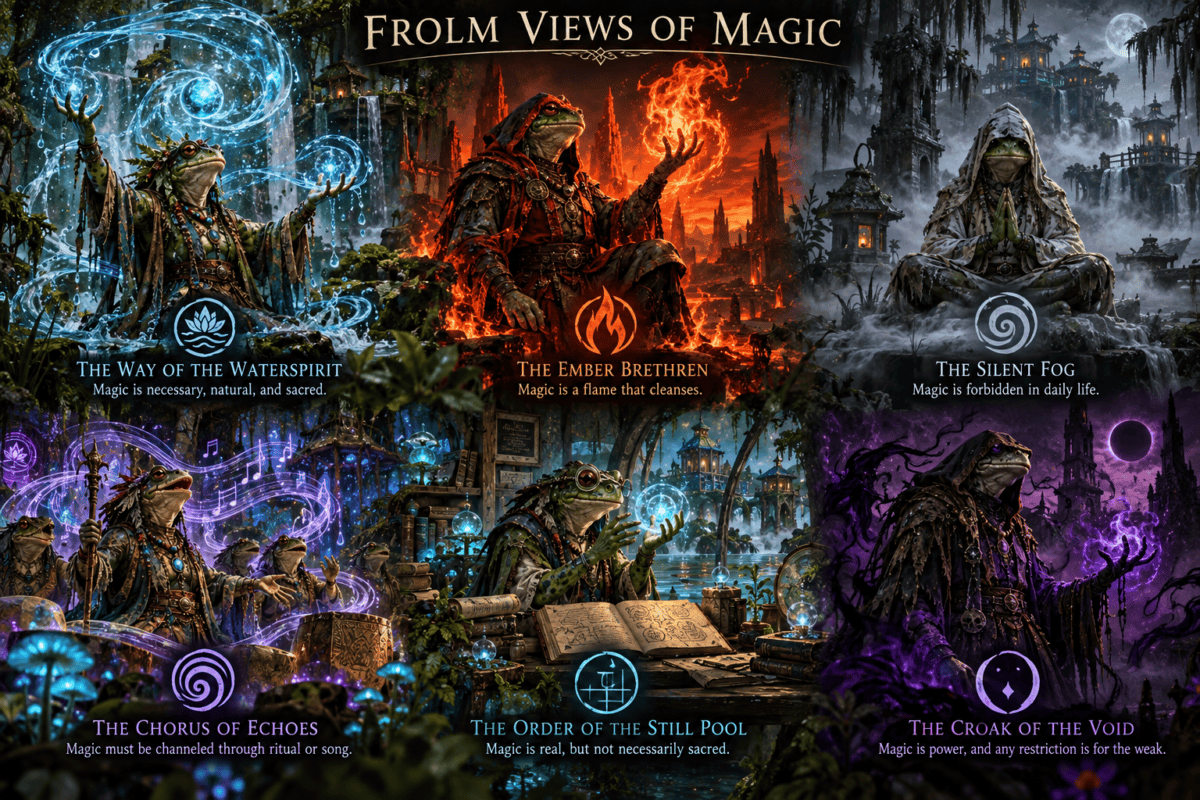
The Frolm, being a tribal amphibian-humanoid species, have laws that are deeply connected to nature, survival, community, and the balance of their swampy environment. Their laws are both practical and spiritual, ensuring harmony among their people and the ecosystem.

1. The Law of the Waters

“He who poisons the water poisons his own blood.”

Since water is sacred to the frolm, they place it in high regard and forbid pollution, hoarding, and wasting water. If someone comes along and contaminates a sacred waterway or a stream, they will be punished depending on the offense. If it is a small breach of the law, they may be required to purify the waterway. However, under more extreme crimes, the criminal can be exiled or even put to death.

2. The Law of the Hunt

“Take only what you need, leave enough for the cycle to continue.”

This law has to do with how much one can take from nature. For example, there are limits on hunting and fishing because there needs to be a balance that is maintained. Hunters are required to leave an offering to the spirits they hunt and the plants they take.

3. The Law of Kinship

“A tribe stands as one. To break it is to stand alone.”

There are many ways this law can be broken, such as violence, theft, deceit, sexual crimes, and so on. If they harm their kin unjustly, they are considered to be “Mireborn” (outcasts), and this can even lead to exile.

4. The Law of the Croaking Pact

“A promise made in chorus must be kept until the dawn.”

There is an action among the frolm called the Croaking Pact, which is a tribal ritual of agreement. If a frolm swears an oath of this kind, they must uphold their pact. If they don’t, it could cause dishonor for the lawbreaker.

5. The Law of the Marsh Spirits

“The land listens, and the spirits watch. Do not bring wrath upon the reeds.”

The frolm see nature as being spiritual, and therefore it is forbidden to anger the spirits of the land. This can happen by disrespecting the dead, destroying sacred sites, or speaking ill of their ancestors. The penalty for breaking this law isn’t as extreme as some of the other penalties. Those who offend must seek forgiveness through rituals, such as offering carvings, songs, and sacrifices of time where they work as servants.

6. The Law of the Guest and Host

“A guest is like a still pond—how you treat them shapes their reflection.”

Among the frolm, hospitality in itself is sacred. If someone is hosting, they are required to offer food, water, and a place to rest. For the guests, they must not overstay their welcome and show gratitude to the ones helping them out. If a guest refuses hospitality without a good reason, it is seen as an insult to the host.

7. The Law of Silence and Sound

“There is a time for croaking, and a time for stillness.”

Silence is very important in frolm rituals. During hunts, mourning rituals, and sacred ceremonies, frolm are required to be quiet at certain times. They are careful not to speak out of turn or disrupt deep thought because it is a sign of disrespect and arrogance.

8. The Law of Names

“A name is given, a name is earned, a name can be lost.”

Names are very important in frolm society. For example, they avoid learning the names of their enemies because it could cause empathy and distraction on the battlefield. Frolm earn a second name if they do great deeds. These names must never be mocked, stolen, or spoken falsely. The punishment for this is to have one’s name stripped, in which they would be “Nameless,” and an outcast to society.

9. The Law of the Leap

“Fear is a still pond, courage is the leap.”

When one hesitates in times of action, it is seen as a weakness. In hunts, battle, and when difficulty presents itself, a frolm must act decisively because cowardice brings dishonor. A frolm warrior who runs away without cause may be given a Mark of Stillness to show their shame. The cut is generally made on the hand.

10. The Law of Life and Death

“All must return to the swamp. None may steal that which is not theirs to take.”

The greatest crime among the frolm is murder. Taking life without a just cause is considered an offense to the very spirits of nature. However, in times of self-defense, sacred duels, and war, one can kill. Those who unjustly murder are thrown into the deepest parts of the swamp so their spirit may never find peace.

11. The Law of the Elder’s Croak

“Wisdom is the weight that steadies the reed.”

An elder’s wisdom is considered sacred, and they must be respected when they speak. It is disrespectful to interrupt an elder unless there is an emergency. If a frolm wants to challenge an elder’s words, it must be done through a trial of wits, which is a ritual debate before the tribe.

12. The Law of the Dreaming Mist

“The mist carries truth—let no one twist it.”

Dreams are viewed as sacred messages, and it is frowned upon not to tell the truth about a vision or give false prophecies. The only ones who may interpret dreams for others are the shaman or the elder of a certain tribe. Frolm, who spread false visions, may be cursed with something called the Croakless Night. It is a punishment where they are made to drink a certain herb that takes away their speech for a time.

13. The Law of the Singing Stones

“Stories are carved, songs are sung, history is never swallowed by the swamp.”

History is important to the frolm so it is considered a crime to erase history. Whether it’s by the destruction of sacred carvings, burning old texts, or silencing truth. A frolm that breaks this law is supposed to replace it with a greater tale through carvings, songs, or actions worthy of remembrance.

Most punishments are symbolic or tied to nature, such as exile, community service, or spiritual atonement. The worst punishment is to be exiled to the deep marsh, which is reserved for traitors, oathbreakers, and murderers.

Sometimes a duel is permitted when settling disputes

See Also:

Overview of the Frolm

Frolm Holidays and Ceremonies

Support Me On Patreon

See also:

Frolm Basic

Frolm Holidays and Ceremonies

Sign up for my Newsletter on the right side

Books to Read(Affiliate Links)

Creating Life – By Ralph Ellefson

The Art of World Building Workbook – By Ralph Ellefson

Fantasy World Building: A Guide To Developing Mythic Worlds and Legendary Creatures – By Mark Nelson

Frolm Holidays and Ceremonies

Sign up for my newsletter on the right

Get Curse of Kredaria for free

The Frolm have various holidays that they celebrate.

Frolm birthdays

Gifts are given from the children to their mothers. If a young one has a birthday, he/she will go get or make a gift for his/her mother. They greatly respect mothers for being able to bear children, and that’s why they get the gifts. Flowers are a popular gift from a child to their mother. This takes place on the twentieth of each month, so kids who were born in that month celebrate it in the middle.

Sacred pond blessing

This is where the frolm elders lead a ceremonial gathering around a sacred pond. There are various sacred ponds throughout the Great Frolm Forest, and most tribes have one. If a tribe doesn’t have one, they visit a neighboring tribe that has one. The leaders sprinkle enchanted water onto the gathering crowd, which blesses them for the coming season. This is a way to thank the water spirits and ensure future prosperity. After the blessing ritual is a communal splash fest, where the frolm joyfully dive into the pond. This is done three times a year because they recognize three seasons. It is done on the first day of the first month, the first day of the fourth month, and the first day of the seventh month, as there are nine months a year that are recognized by Zalonians.

Reed Weaving Competitions

The Reed Weaving Competitions are where participants weave reeds into intricate baskets, decorative ornaments, and mats. This acknowledges their craftsmanship. It also creates practical tools or festive decorations. Designers who win have their designs displayed in the village center until the festival is over. This festival lasts three days. It is from the second to the fourth day of the fourth month.

Croak Choir Performance

The frolm can sing, but through croaks. Twice a year, they gather together to create harmonious croaking songs which mimic the sounds of the forest during the rainy seasons. They take place on the fourth month and thirtieth day and the ninth month and thirty-fifth day. They do it in honor of their natural vocal talents and give thanks to the forest spirits for a bountiful harvest. Many frolm who participate drum on something such as hollow logs and other percussion type things found in the forest.

Fralitta

The birthday of Balok. This is celebrated on the fifth day of the second month. Everyone exchanges one gift. Usually one gift is given to each of the frolm from another individual. They draw out of hats to see who gets which gifts. Gifts can be things like weapons, herbs, flower seeds, flowers, and other things among the frolm.

Frogsong Storytelling

The Frogsong Storytelling is where elders and bards tell tales of their ancestors, forest spirits, and past harvests. This is accompanied by sound effects and croaking rhythms made by the audience. It’s a way to pass down history and strengthen the cultural bond among participants. The tales often have a moral lesson attached to them with values such as gratitude, perseverance, or harmony with nature. This occurs on the tenth day of the third month.

Mushroom Circle Revelry

The mushroom circle revelry is where the frolm gather around naturally or magically grown mushroom circles. This is where they sing, dance, and share various tales. This is a way to honor the interconnectedness of the forest’s ecosystem. The most beautifully glowing mushroom is chosen as the festival centerpiece. It is used in the closing ritual. This takes place on the twenty-fourth day of the second month.

Reed Weaving Competitions

The Reed Weaving Competitions are where participants weave reeds into intricate baskets, decorative ornaments, and mats. This acknowledges their craftsmanship. It also creates practical tools or festive decorations. Designers who win have their designs displayed in the village center until the festival is over. This festival lasts for three days. It is from the second to the fourth day of the fourth month.

Minneota – Celebration when they gained their independence from the dark knights thousands of years ago. It is celebrated by games, drinking, and all-out partying. Some dress in old-fashioned clothes as frolm dressed thousands of years ago. There are archery contests, which are one of the main attractions. The celebration takes place during the ninth day of the fifth month.

Bog Bound Relay

.
This is a race where participants leap between large lily pads, wade through muddy water, and climb slick vines. It is competitive, and the top five contestants each receive a prize. There are often at least a hundred competitors. It is a celebration related to their agility and physical connection to the wet forest. The competition includes collecting special glowing mushrooms or fruit on their way through, which are added to the feast celebrated afterward. It is usually celebrated on the fifth month and seventeenth day when the weather of the Great Frolm Forest is most moist.

Mud Paint Contest

Since they live in a moist forest, there is no lack of mud among the frolm. They use richly colored muds, plant extracts, and natural pigments to paint items on large rocks or tree trunks. These paintings only last until the next rain washes them away. This is done on the sixth month and thirteenth day of the year.

Jumping Circle Tournament

This is a leaping contest to see who can leap the highest or the furthest with the use of tree stumps or small ponds for jumping platforms. The record-highest jump was thirty-two feet in the air, and the furthest jump was fifty-four feet. This event highlights their physical prowess and amphibian agility while at the same time, providing enjoyment and friendly competition. The winners receive garlands of woven reeds and glowing fungi as trophies. This usually takes place on the sixth month thirty-second day of the year.

Glowfruit Gathering

The glowfruit gathering is a nighttime scavenger hunt. The frolm will search for luminescent fruits that are hidden throughout the forest. The fruits are used in the harvest feast. There is also a competitive nature about it when the most glowfruit gathered by an individual or group earns them the honor of presenting the first dish during the feast. It’s celebrated in the seventh month on the twelfth day.

Tadpole Tidal Games

Tadpole Tidal Games are games from frolm children which include swimming races in shallow ponds, catching bubbles enchanted to float away. They also herd small schools of harmless fish into rings. It teaches the younger frolm about their aquatic heritage. This provides them with joyful memories of the harvest season. Those who do well receive miniature carved wooden tadpoles as keepsakes. This takes place on the thirty eighth day of the seventh month.

Water spirit Offering

The Water Spirit Offering is where frolm gather at a sacred waterfall (or spring if no waterfall is available). They offer floating baskets filled with harvest goods, flowers, and glowing lanterns to the water spirits. This makes sure that the spirits’ continued blessings for future harvests. If the water spirits are pleased, they will send glowing fish and enchanted bubbles as signs of approval. This celebration takes place on the fortieth day of the seventh month

Rede and Rains Parade

During this parade, frolm wear costumes made from moss, reeds, and bright flower petals. They parade through their village while mimicking the sounds of rainfall with homemade instruments. This celebration is based on the life-giving rains that keeps their home moist for their survival. At the end of the parade they do a mock rainstorm created by the elders. They use enchanted droplets of water that float above the procession. After this, they shower down. This is celebrated on the ninth day of the eighth month.

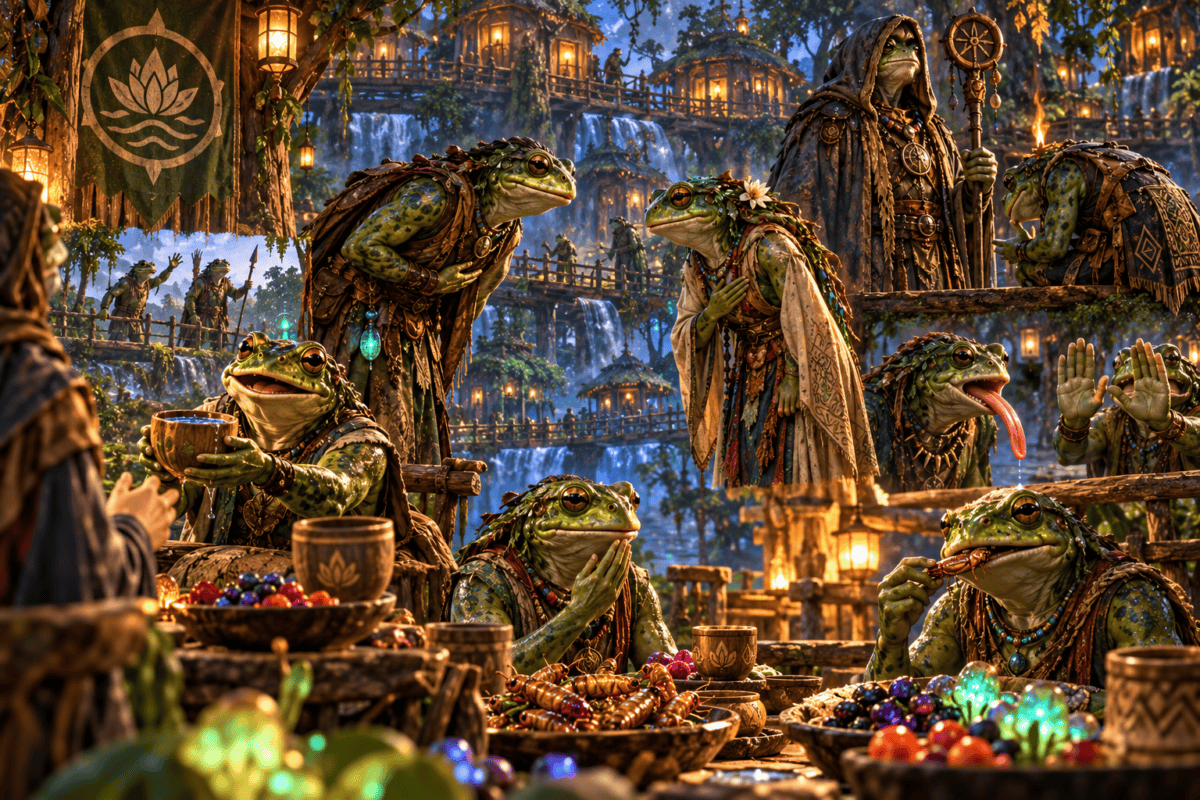
Feast of the Swamp Table

This is where a long, communal table is set up across logs and stones that are adorned with moss, vines, and water flowers. It holds a variety of wetland delicacies. This is done on the nineteenth day of the eighth month. There are various dishes which include:

– Steamed swamp mushrooms wrapped in leaves.
– Bogberry pies that are sweetened with honeydew sap.
– Roasted insects seasoned with wild herbs and maple syrup.
– Algae soup which is served in hollowed-out gourds.

The guests often take turns at offering toasts and sharing stories about their connection to the harvest.

Autumian

Fall harvest. Crops are exchanged and the gods are praised if it is a good harvest, usually the twenty-third day of the eighth month. Depending on how well the season went there are a different number of sacrifices. This is the biggest celebration of the year.

Forest Glow Procession

The Forest Glow Procession is a time when frolm decorate themselves with glowing moss, fungi, and bioluminescent paint. This creates a mesmerizing light show as they go through the forest trails. This is symbolic of their oneness with the forest and shows thankfulness for its bounty. This is the biggest celebration a year, as frolm meet at one of the biggest trees in the forest. A magical light ritual is performed, symbolic of the bond between the frolm and their land. It is celebrated on the fourth day of the ninth month.

Firefly Lantern Dance

During this event, the frolm carry glowing jars of captured fireflies and create weaving patterns of light throughout the forest. This dance is in honor of the illumination of the dark season ahead so it is often celebrated during the ninth month and tenth day. They also pay homage to the forest’s natural luminescence. At the end of the dance, the fireflies are released forming a spectacular glowing swarm that lights the night sky.

Sign up for my Newsletter on the right side

Books to Read (Affiliate Links)

Creating Life – By Ralph Ellefson

The Art of World Building Workbook – By Ralph Ellefson

Fantasy World Building: A Guide To Developing Mythic Worlds and Legendary Creatures – By Mark Nelson

Get Curse of Kredaria for free

Deborah Jenson

Basic

Deborah goes to Washington University college. She is 20 years old. She is from Missoula, Montana. She has blue eyes and straight blonde hair. She likes to wear turtleneck sweaters with blue jeans.

She considers herself an introvert and is very goal focused and isn’t interested in dating. She is frustrated by the quest and feels that she has no choice. She is neither a partier or drinker. She is good at discerning whether she needs to be careful of someone.

She lived what most would consider an everyday life. She was a law-abiding citizen and a good student. She had parents who were supportive of her and who were also law-abiding citizens.

Home Life

Besides when she is at college. She lives at home with both parents who are moderately rich. She lived in a very proper home with relatively strict rules.

Love Life

She had a boyfriend named Mark when she was 17 which only last a few months because she found him to be a distraction. She tried dating again at 18 with a guy named Roger, but he was too possessive for her. Since she has entered college, she hasn’t been interested in dating despite many offers. She doesn’t really care to ever be married and sometimes thinks that she might be asexual.

Her part in the story

She comes into play in book two. She travels with Dan, Amandria, and her brother to help Amandria find her mother.

Personality Style

She is introverted and may come across as cold to some people. Her quest is to become an archaeologist and study history so she is very career oriented. She isn’t interested in kids, nor does she want any of her own. She is difficult to make friends with but generally is close to her professors.

Psychological Struggles

She is a perfectionist which is known as Atelophobia. She suffers from OCD and also Obsessive Compulsive Personality Disorder.

She is dromophobic and afraid to cross busy streets. She is also Gleotophobic and afraid that people are looking at her and laughing as she does simple things like walking down the street.
Family

Her father is a businessman who sells auto and life insurance and her mother is a CPA. Her younger, brother, goes to college. She was never that close to either of her parents as they spent a lot of time working. She is close to her brother Adam, in fact, she views him as her best friend being that she doesn’t make friends that easily.

Strengths

She is curious and likes to explore and discover things. She has a strong love for learning.

Weaknesses

She is practical and a perfectionist which sometimes makes her relationships with others difficult.

Tags/Habits

She has to do everything twice. Obsessed with symmetry. Chews on pens. She is obsessed with wearing blue. Bites and chews lip.

Other History

She had perfect attendance from K-12 and so far at college which causes her some grief when she has to go on the journey. When she was 11 she discovered an ancient native pot while digging down in the dirt, as was her hobby. She still has the pot that she places in her bedroom where she lives.

Likes/Dislikes/Tastes/Hobbies

She likes classical music and some music that is popular including rock. She loves musicals and drama for movies. She always dreamed of going to Broadway and watching a performance. She loves “Phantom of the Opera.” She also likes music from the baroque and romance periods. She doesn’t like rap nor metal.

She practices Yoga and is very flexible. She also likes weight training and aerobic exercise so she can stay in shape. She is into card games, but doesn’t like video games. She likes mountain climbing, river hikes, and scenic views.

Living Arrangement

She lives in a dorm with a roommate named Barbara. She doesn’t like it because of lack of privacy and has convinced her parents to help pay for an apartment off campus. Her roommate is kind of a slob which annoys Deborah.

Political and moral stances

She has rather conservative points of view. She doesn’t care about LBGT rights. She is against the legalization of pot because she believes it is unhealthy. She believes in fiscal responsibility and despises that people cheat the welfare system. She wants tighter borders because she feels that would reduce crime.

She is very Catholic with her beliefs, so she believes in the 10 commandments, is anti-abortion, and attends Mass every Sunday. She is not judgmental of others however, and believes that people can participate in other religions without being punished in Hell for their beliefs. She is against the whole “Take a Knee” thing and sees it as unpatriotic. She supports the death penalty for murderers, second offense rapists, and second offense child molesters.

Pet Peeves

Anything that distracts her from her studies, slobs, heavy traffic, people staring at her, loud babies in settings like restaurants, loud people, etc. She also hates it when men whistle at her. She sometimes wishes she were ugly so men didn’t hit on her, however, she believes that being in good health is the best for her.

Talents

She is a critical thinker, researcher, good with money, she is good at planning things which is part of her frustration with the quest, she plays violin well (But has trouble performing in front of people due to her fear of being laughed at), she is good at bowling. She is well organized

Things She Is Not Good at

Handling clutter, spur of the moment activities, performing in front of people whether it be speaking or violin, making long term friendships.

Goals

From a young age she was taught that financial success should be her primary goal. Therefore, she started off wanting to be a doctor and live in a big house with a family. As she grew older, she realized that she wasn’t really interested in the medical field and thought of becoming a CPA like her mother. However, while she was good with numbers, accounting wasn’t her thing. At age 18 she decided she wanted to be an archaeologist as she loves to dig and discover history. She no longer has the goal of getting married and having a family but rather becoming a successful archeologist who discovers new things.

Motivation

Her love of archeology which actually works against her on the quest to find Amandria’s mother with the exception of a few things and sometimes her knowledge comes in handy.

Positive Trait

She is motivated and determined to succeed at life.

Negative Trait

Her lack of friendliness, but she doesn’t really mind not having friends.

Nicknames

Deb, Smarts (Because she is sharply intelligent and gets good grades)

How will she be remembered/Self-Concept

She was good at whatever she put her hand to.

Trauma

She was sexually harassed when she was 18 at a restaurant she used to work at by a few coworkers. It was so bad that she was afraid to go outside. They always made sexual jokes and laughed, and she felt like she was being laughed at.

Secrets

She doesn’t really care for her parents because they never were really there in her life beside suppling financial assistance. She doesn’t tell this to Adam, but sometimes she will hint at it in their conversations.

Power

None, besides her intellect.

Adversaries

She actually sees Amandria as an adversary and can’t stand her the whole journey.

Allies

Adam is the only person she completely trusts. She does like Dan though, but pities him because of his relationship with Amandria.

Darkest Hour

When she gets accused of the professor’s murder

Shining Moments

Various academic awards she has received throughout her life.

Message to the World/Legacy

Study, try your best and you will succeed

Underworld Realms in Science Fantasy: Designing Caverns, Depths, and Hollow Planets

Sign Up for My News Letter on the right

Get Curse of Kredaria for free

Underworld realms are some of the most powerful settings in science fantasy. They tap into primal human instincts—fear of darkness, awe of the unknown, reverence for what lies beneath—while also offering immense creative freedom. Whether your characters descend into endless caverns, navigate buried civilizations, or discover an entire hollow planet, these settings can become more than locations: they can shape culture, technology, religion, and myth.

This guide walks you through designing underworld realms that feel vast, alien, and believable—without sacrificing wonder.

1. Caverns as Living Systems, Not Empty Spaces

The biggest mistake in underground worldbuilding is treating caverns like empty dungeons. Real underworlds should feel alive.

Think in layers

Instead of one massive cave, imagine a vertical ecosystem:

Upper Caverns – Near-surface tunnels with airflow, fungi, insects, scavengers, and early settlements.
Mid-Depth Zones – Reduced oxygen, strange fauna, mineral forests, bioluminescent organisms, and ancient ruins.

Abyssal Depths – Extreme pressure, alien physics, sentient darkness, energy fields, or reality distortions.

Each layer should:

  • Have its own resources
  • Support different species
  • Pose unique dangers
  • Shape cultures differently

In science fantasy, you can justify this with geothermal gradients, alien biology, or exotic energies instead of strict realism.

2. Light as a Resource (and a Weapon)

Light is everything underground—and that gives you storytelling leverage.
Sources of light

Bioluminescent flora/fauna (fungal forests, glowing insects, living crystal reefs)

Artificial suns powered by ancient tech or magic-reactors

Energy veins running through the rock like glowing blood

Reflected surface light channeled through massive shafts or mirrors

Cultural consequences

  • Light may be sacred, taxed, hoarded, or weaponized
  • Darkness-dwelling species may see light as blinding or corruptive
  • Some civilizations may never experience total darkness—or total light
  • Ask yourself: Who controls illumination, and what happens when it’s taken away?

3. Subterranean Civilizations: Adaptation Shapes Culture

  • Life underground forces evolution—biological, technological, and philosophical.
  • Physical adaptations
  • Pale or translucent skin
  • Enlarged eyes—or no eyes at all
  • Echolocation or vibration-based perception
  • Symbiosis with glowing organisms

Societal differences

  • Architecture carved vertically instead of horizontally
  • Cities grown from crystal, fungus, or living stone
  • Trade based on minerals, spores, heat, or energy rather than food
  • Time measured by geothermal pulses, machine cycles, or ritual events

Underground cultures often value stability, memory, and tradition, because collapse is always one earthquake away.

4. Hollow Planets: The Ultimate Underworld

Hollow planets push science fantasy into mythic territory—and that’s a good thing.

Structural concepts

  • A shell world with civilizations living on the inside surface
  • A central artificial sun or gravity core
  • Vast inner skies filled with floating continents
  • Oceans clinging to the inner crust due to gravity manipulation

Why hollow planets work

You don’t need hard science perfection—just internal consistency. Possible explanations include:

Ancient megastructures built by extinct godlike beings

  • Gravity-altering materials
  • Reality-bending cosmic phenomena
  • A planet that is actually an engineered habitat

Narrative potential

  • Surface dwellers unaware of the world beneath
  • Inner civilizations believing they live on the “true surface”
  • Wars over access shafts or planetary engines
  • The fear that the shell is cracking

A hollow planet isn’t just a setting—it’s a cosmic secret.

5. The Underworld as a Psychological Space

Underworld realms often mirror internal journeys.

  • Descending underground can represent:
  • Loss of innocence
  • Confrontation with buried truths
  • Separation from gods, stars, or authority
  • A test before rebirth or transformation

Science fantasy excels when:

  • Technology replaces myth, but symbolism remains
  • Ancient machines are worshipped as gods
  • Data vaults replace ancestral memory
  • AI guardians take the role of underworld judges

If your world has myths, religions, or forbidden knowledge—put it underground.

6. Hazards Beyond Monsters

Monsters are expected. Environmental danger is more interesting.
Consider:

  • Cave collapses triggered by sound or emotion
  • Reality distortions caused by exotic minerals
  • Time behaving differently at extreme depths
  • Sentient geology that reacts to thought or blood
  • Fungal plagues that rewrite DNA

The underworld should feel hostile but purposeful, as if it doesn’t want intruders—but tolerates those who adapt.

7. Making It Feel Vast

Scale is everything underground.

Use:

  • Endless vertical shafts instead of flat tunnels
  • Cities stacked like stalactites
  • Ancient elevators descending for days
  • Maps that are incomplete, contradictory, or forbidden
  • Characters should never be certain how deep they truly are.

Final Thought: The Underworld Is a Worldbuilder’s Playground

Caverns, depths, and hollow planets let you blend:

  • Myth and machinery
  • Horror and beauty
  • Ancient pasts and far futures

In science fantasy, the underworld isn’t just below—it’s beneath understanding. Design it with intention, and it will become one of the most memorable parts of your world.

Support Me On Patreon

Sign up for my Newsletter on the right side

Books to Read (Affiliate Links)

Creating Life – By Ralph Ellefson

The Art of World Building Workbook – By Ralph Ellefson

Fantasy World Building: A Guide To Developing Mythic Worlds and Legendary Creatures – By Mark Nelson

Get Curse of Kredaria for free