Support Me On Patreon
Sign up for my Newsletter on the right side
Get Curse of Kredaria for Free
Warrior’s Age
A warrior must be 30 or over to go to war, but under 400. This keeps younger and inexperienced frolm from joining at a young age.
The Glowfruit Rule
Glow fruit, which is a rare and bioluminescent delicacy, can only be harvested during the Festival of Sacred Bloom. Only limited quantities are allowed to be gathered. If someone harvests too many, they may get banned from the next festival and be required to plant and nurture new glowfruit trees.
The Silence of the Moonlit Marsh
When the regular moon is full, frolm aren’t permitted to make loud noises in the Moonlit Marsh because they may disturb nocturnal spirits. If someone breaks this law, they must offer a symbolic gift, such as rare insects or glowing moss, to the march spirits during a special ritual. This law keeps the frolm respectful of the forest.
The Pact of the Great Trees
Frolm are not permitted to cut down a living green without permission being granted by the Forest Elders, and they usually only approve of this if the tree poses a threat or is diseased. Breaking this law will require the offender to plant at least ten saplings and take care of them until they are fully grown
The frogspawn covenant
Anything related to a frog, such as tadpoles and frogs themselves, is protected at all costs. They are symbols for the future of the frolm. This offense is punished with banishment from breeding pools for one season. This law is in place for the frolms’ survival.
The Leap of Passage
Frolm youth are required to do a ceremonial leap from a special tree into a deep pond. This is a rite of passage to adulthood. If they don’t make this leap then they may not have the right to participate in certain community decisions. This is meant to strengthen cultural
The Law of Shared Spoils
Anything caught from a successful hunt or a foraging expedition, must be shared with the entire village. There must be special portions that are received by the elderly and sick. Those who refuse to acknowledge this may be temporarily banned from hunting or foraging. On top of that, the offender must make an offering to the community. This insures that no one in the village goes hungry and also supposed communal well-being.
The Guardian’s Vow
Frolm warriors, also known as Bogkeepers, need to swear to protect their territory from outsiders. This helps to ensure the safety of the hamlet. If one neglects his duty, the warrior must undergo a purification ritual and then spend an entire season patrolling the outskirts of the swamps alone. This helps to reinforce the importance of vigilance and protection of the frolm.
The Glowstone Edict
Glowstones are magical crystals that illuminate the forest. They are only allowed to be mined during specific lunar phases with the supervision of an elder miner. If someone is caught mining without permission, it can result in the confiscation of the crystals and a mandatory month of service in the mines to restore balance. This law makes sure that overmining doesn’t happen and retains the preservation of glowstones.
The Ritual of Rain
During times of drought, it is mandatory for all the frolm to participate in a community-wide raid-calling ritual which is led by a Raincaller. A Raincaller is a highly respected shaman who often oversees a territory and has more authority than hamlet leaders. If someone doesn’t attend without a good reason, this will result in a symbolic “thirsting day” where the individual isn’t allowed to drink from the sacred water. This law helps to strengthen unity and ensures collective effort during droughts.
The Boundary Accord
Frolm aren’t allowed to cross the boundaries of their territory without special permission from the council. These risks could expose their location to possible threats. If a frolm breaks this law, he must endure a period of isolation and reflection in a guarded section of the marsh. The purpose of this is that it protects frolm from outer dangers and ensures the secrecy of their homeland.
The Feast of First Fruits
The first fruits of the harvest season must be offered to the forest and tree spirits during a feast before any of it is consumed or stored. Those who break this law must fast for a day and make reparations by preparing the feast itself. This law honors the forest and tree spirits and shows thankfulness for the land’s bounty.
The Marchlight Law
This law requires travelers to carry marshlights (bioluminescent lanterns) during the night so they don’t disturb nocturnal predators or step into dangerous bogs. If one breaks this law, then it is mandatory to provide service as a night guide for the village for eight days (A week in Zalonia). The purpose of this law is to ensure the safety of travelers and maintain harmony with the nocturnal ecosystem.
The Pack of the Croaking Chorus
During certain parts of the year, the frolm must join in the Croaking Chorus to call for rain or to celebrate the changing of seasons. If one refuses to participate without a good reason, they are required to care for the village’s elder frogs for a season. This helps to strengthen cultural identity and reinforces their bond with the Great Frolm Forest and weather cycles.
The Spirit Grove Prohibition
It is strictly forbidden for one to enter the Spirit Grove without permission from the elders. The Spirit Grove is a sacred part of the forest where powerful spirits and ancient trees reside. Someone who disobeys this law results in a purification ritual along with a year of service as a caretaker of the grove. The purpose of this law is to protect the most sacred area of their territory and maintain the balance between the frolm and the spirits.
The conflict of oaths
If two oaths come in conflict, they must bring it before the leader of that community, and if things aren’t resolved, it is voted on by 13 frolm randomly selected. The majority wins.
Asking permission
Theft is unusual to the frolm since they believe that everything is collectively owned. However, it is respectful to ask someone if they need something rather than just taking it unexpectedly.
Voting laws
Frolm can vote for the area’s council once they turn 23 and can vote for the leader at the age of 31. At 22 frolm are considered adults even though their life has basically just begun.
Campaigning is prohibited
Frolm leaders don’t campaign for a position of power like we are used to in our society. Instead, voters discuss among themselves who should be nominated. No more than nine frolm can be nominated at a time. After they vote for the nine, they choose the top three and then vote between them on who the leader is going to be. The council has many more nominees, and the top thirteen are chosen.
Frolm Discussion
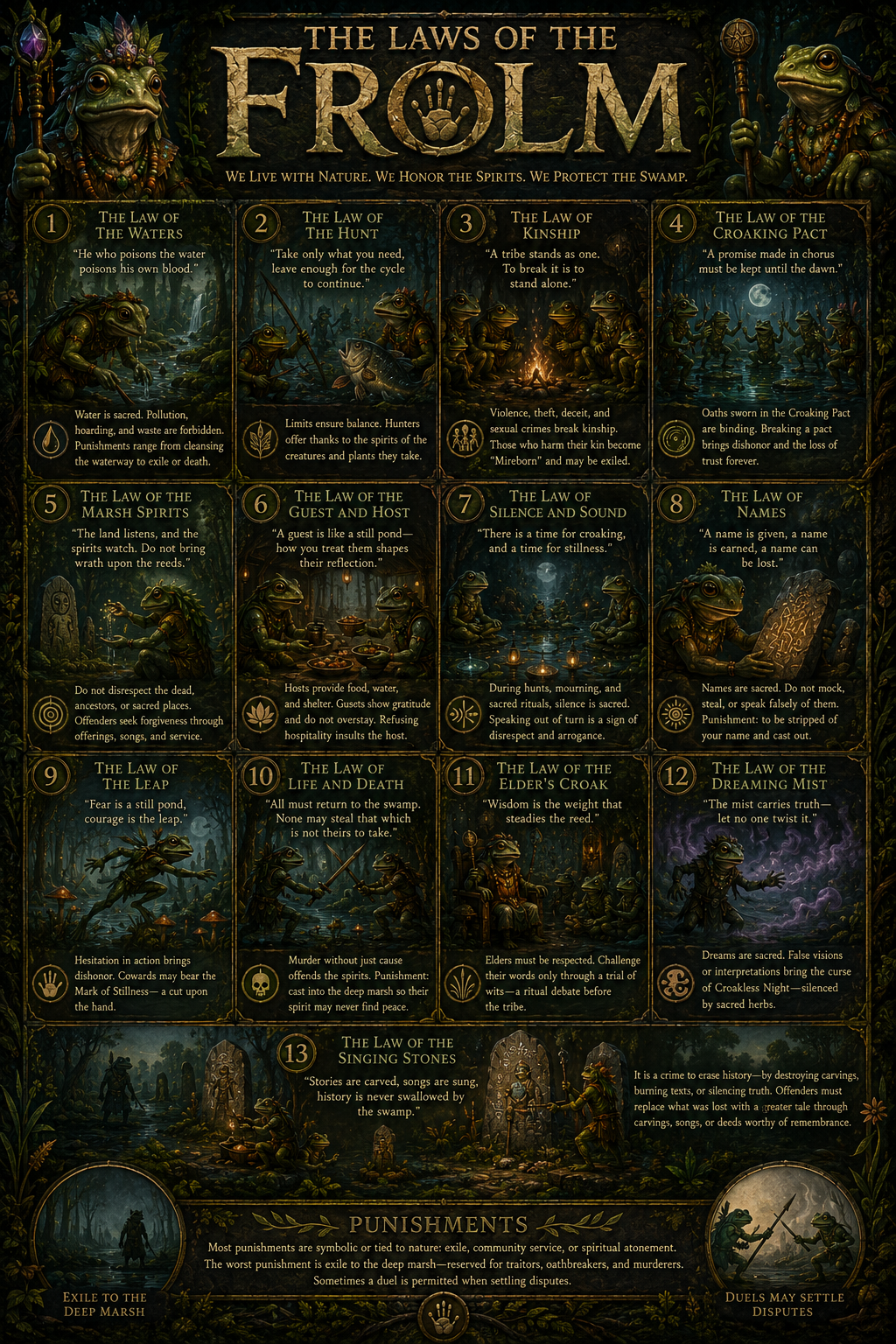
There are mostly friendly discussions among the frolm as to who to vote for and about religion and the gods. Frolm don’t mind being silent in the midst of others. It doesn’t get awkward as it does with humans. Sometimes there can be debate on the interpretation of the thirteen main laws. Sometimes they discuss laws that should be implemented.
A Warning for Lesser Crimes
Frolm who don’t follow the rules often get a warning the first time if it is a minor offense. The second time, some action is taken, such as the frolm’s right to visit other villages. A third offense could cause the frolm to be thrown in one of their prisons for a few days to try to teach the rebellious frolm a lesson. Frolm typically aren’t that rebellious and are good at keeping to frolm traditions.
See Also
Support Me On Patreon
Sign up for my Newsletter on the right side
Books to Read(Affiliate Links)
Creating Life – By Ralph Ellefson
The Art of World Building Workbook – By Ralph Ellefson
Fantasy World Building: A Guide To Developing Mythic Worlds and Legendary Creatures – By Mark Nelson