Designing Unique Bodies of Water in Science Fantasy Worlds

Sign up for my Newsletter Here

Get Curse of Kredaria for free

Support Me on Patreon

Rethinking Rivers, Oceans, and Aquatic Mysticism Beyond Earthly Logic
In a world where science and magic intertwine, bodies of water don’t just quench thirst or serve as travel routes—they pulse with ancient intelligence, carry dimensional echoes, or respond to arcane frequencies. Whether you’re building planets with liquid methane lakes or rivers that rewrite history, crafting aquatic systems in your world can unlock rich symbolism, culture, and drama.

This post dives into inspired and original types of water bodies for science fantasy settings and how to use them meaningfully in your story.

🌊 Classic Oceans with a Twist

1. The Endless Deep

  • A sentient ocean that forgets and remembers you depending on the tide.
  • Its tides are pulled by twin moons—one physical, one spectral.
  • Sailors whisper prayers into bottles; the ocean answers weeks later.
  • Creatures evolve from thoughts lost at sea.

Narrative Hooks:

  • A civilization that treats the ocean as a god—or a demon.
  • Naval expeditions aimed at reaching the fabled “Center Memory Reef.”

2. Etheric Oceans

  • Oceans made not of water, but liquid magic.
  • Shimmering tides emit energy that boosts or scrambles spellcasting.
  • Ships must be partially alive to survive its arcane surges.
  • Water changes color depending on the emotional state of its nearest civilization.

Uses in Storytelling:

  • Port cities built on rituals as much as docks.
  • Coral libraries that “record” ambient magical history in the Ethersea.

🪷 Invented Bodies of Water

3. Lacuna Pools

  • Still, mirror-like pools found in craters where time behaves strangely.
  • Gazing into them shows your past lives or potential futures.
  • Dropping items in may either erase them from history or teleport them elsewhere.’
  • Worshiped by seers and outlawed by empirical societies.

4. The Meltflow Network

  • Underground rivers of radiant, molten material—part magma, part life force.
  • Used to power cities above with geothermal-spell converters.
  • Accessible only to tunneling creatures or via soul anchors.
  • Exposure causes vivid dreams—or permanent hallucinations.

Narrative Potential:

  • A city’s reliance on the Meltflow drives political unrest as its temperature rises.
  • Creatures who can “swim” through both lava and consciousness.

5. Rivers of Echo

  • Flowing streams that “remember” sound and replay moments of great importance.
  • Whispered words become audible again during certain moon phases.
  • Entire battles, confessions, or proposals echo through the water centuries later.
  • Rogue mages use it to trace secret histories.

🧊 Exotic Lakes and Seas

6. Glacial Seas of Thought

  • Massive frozen oceans on an ancient moon where thoughts freeze into sculptures.
  • Walkers on the ice hear the frozen screams and songs of ancient civilizations.
  • Magic users can chisel memories into the ice and cast them as spells.
  • Civilizations trade frozen emotions as currency.

7. The Sinking Sea

  • A dense, bottomless body of dark liquid that pulls even air and light inward.
  • No known bottom—used as a dumping ground for cursed or unstable tech.
  • Myths say the sea is a tear from a dead god’s eye.
  • Creatures that live here can only be described in dreams.

8. The Blooming Bay

  • A shallow, luminous bay where aquatic plants bloom into the air, forming floating gardens.
  • Used as a neutral diplomatic zone by warring nations.
  • The plants produce spores that enhance psionic abilities.
  • Local fauna feed on psychic residue and mimic thoughts.

🌌 Cosmic and Interdimensional Waters

9. Star Tides

  • Rivers of water flowing through space between moons or ships.
  • Carried by gravity wells and magical conduits.
  • Traveled by creatures that breathe vacuum and vapor.
  • Often mined for their pure aether content.

10. The Veil Lakes

  • Interdimensional “pools” that exist simultaneously on several planes.
  • Stepping into one takes you to an identical lake… but on another planet or timeline.
  • Used by smugglers, sages, and invading armies.
  • Veil-lakes shift location without warning—mapping them is a lost art.

🛶 Cultural Roles of Water

Even if your water isn’t magical, how people interact with it can be world-defining.

  • Sacred Rivers: Used for memory cleansing or as part of coming-of-age rituals.
  • Forbidden Seas: Rumored to house weaponized weather or exiled gods.
  • Floating Cities: Built on AI-maintained archipelagos or atop dreaming sea creatures.

📝 Tips for Inventing Aquatic Features

Anchor one law of physics or magic, then twist it: e.g., water that flows upward, evaporates into memory mist, etc.

Give each body of water cultural significance—how does it affect trade, belief, and diplomacy?

Tie fauna and flora into the water—bioluminescent jellyfish with prophetic patterns? Carnivorous lotus? Herds of semi-intelligent plankton?

🎇 Final Thought

In science fantasy, water is never just H₂O. It’s a mirror, a memory, a weapon, a gateway. Let oceans be stained with starlight, rivers hum with haunted voices, and lakes reflect dimensions as yet unborn. The more alive your water feels, the more immersive your world becomes.

Sign up for my Newsletter Here

Get Curse of Kredaria for free

Support Me on Patreon

Creating Life – By Ralph Ellefson

The Art of World Building Workbook – By Ralph Ellefson

Fantasy World Building: A Guide To Developing Mythic Worlds and Legendary Creatures – By Mark Nelson
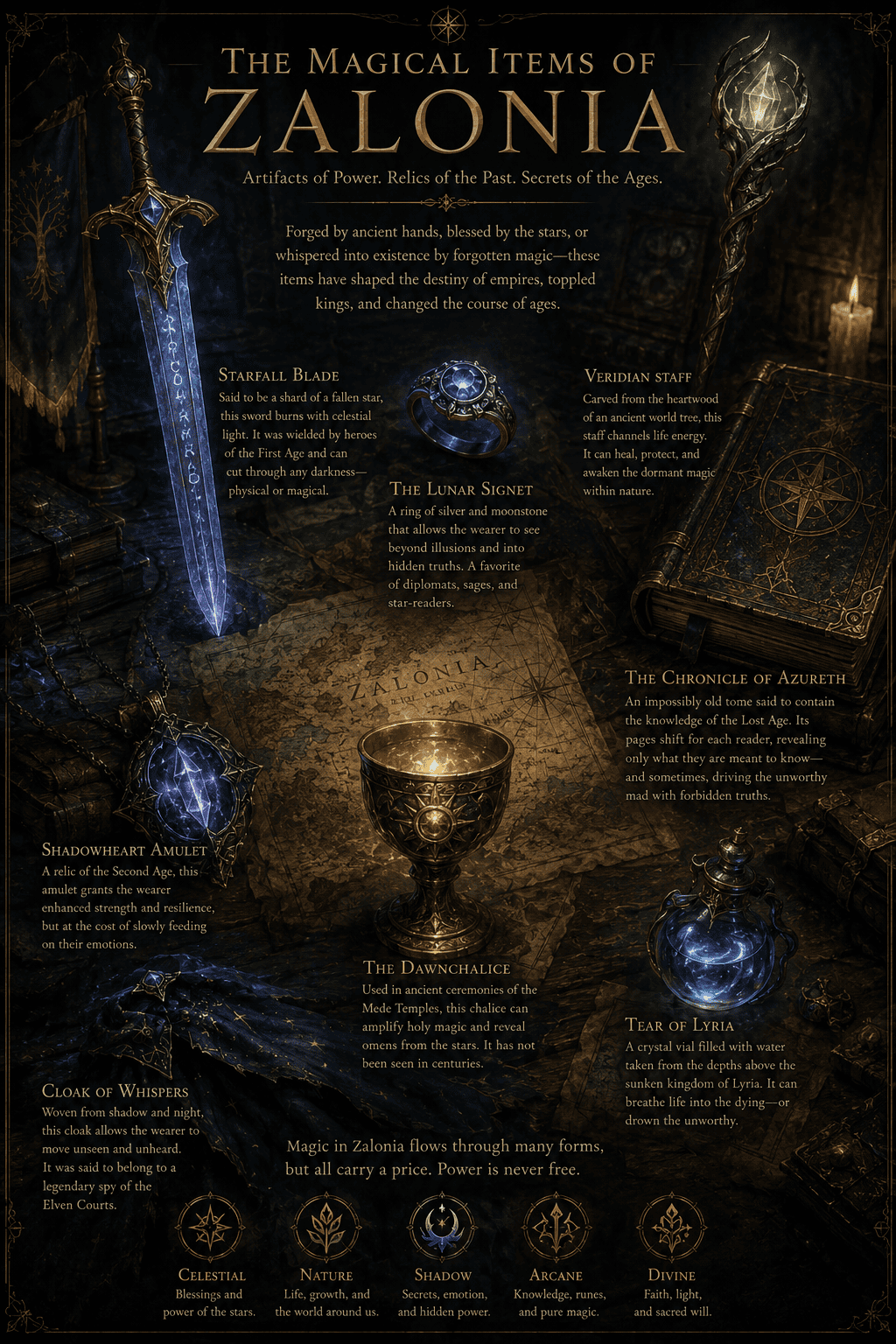
 

Magical Items of Zalonia

Sign up for my newsletter on the right

Get Curse of Kredaria for free

1. The Shattered Crown of Kings

Description: A crown once worn by an ancient king who united a vast empire. The crown was shattered into several pieces when the empire fell, and each piece is now held by different rival factions, each claiming to be the true heir to the throne. This was the first place to be destroyed in the Great Battle of the First Age.

Controversy: Scholars argue over who has the right to reunite the crown, as ancient texts are unclear about the true lineage of the kings. Different regions and factions claim the crown’s fragments as their own, leading to political and military conflict. Some even believe that reuniting the crown would bring back the old empire, while others fear it would awaken a terrible curse.

2. The Tablet of Prophecy

Description: A stone tablet said to contain a prophecy about the world’s future. However, the tablet is incomplete, and scholars have debated for centuries over the missing pieces, each interpreting the prophecy in radically different ways.

Controversy: Various religious and political groups claim that the tablet supports their agenda, often using it to justify wars, leadership changes, or societal upheaval. Some scholars believe that the missing pieces are deliberately hidden, while others think they were destroyed to prevent a dark future.

3. The Sword of the Fallen Star

Description: A blade forged from a meteorite that fell to the planet during the Second Age. The sword is said to have been wielded by an ancient hero who saved the world from a great evil.

Controversy: While some believe the sword belongs to the descendants of the hero, others claim that the blade has corrupted those who wield it, and that it was actually a tool of ancient evil. The sword’s true origins are shrouded in mystery, and some argue that it should be destroyed, while others think it could be a weapon of salvation in future conflicts.

4. The Scrolls of Eternity

Description: An ancient collection of scrolls said to contain the secrets of immortality. They were believed to have been written by an ancient race that vanished mysteriously. They were found by the quintum as they searched the parts of the Isles of Desolation that were still not underwater.

Controversy: While many scholars dismiss the scrolls as myths, some claim to have found fragments, leading to fierce debate over whether the knowledge should be shared with the world. Religious orders claim that immortality is a violation of natural law, while others seek the scrolls for personal gain. Conflicts arise over whether the scrolls are real, and if so, who deserves to hold them.

5. The Bones of Dragon-like Species

Description: Massive bones discovered in a remote mountain range, believed to be the remains of the first dragon-like species—a creature central to the mythology of many cultures in the world.

Controversy: Different races and kingdoms claim the bones as their heritage, and some argue over whether the creature was a benevolent god or a malevolent beast. There are also disputes over the bones’ potential power, with some believing they could be used to resurrect dragons, while others think they hold untold magical energy. Religious factions might view the bones as sacred relics, while others want to harness their power for war. There are questions as to whether the bones belong to a dragon or not because there is only one dragon that is known, and is alive. Some, especially the medes don’t believe they are bones of an actual dragon. This is because the dragon in Zalonia is one of the great beasts, and there is only one of each when it comes to great beasts, so there can be only one dragon.

6. The Everglass Chalice

Description: A mystical chalice said to grant eternal youth to anyone who drinks from it. The chalice is believed to have been used by an ancient royal family, but its origins are obscure.

Controversy: Some claim that the chalice is cursed, as every ruler who drank from it met a tragic end. Others view it as a symbol of power and immortality. Competing factions fight over its authenticity, with some calling it a forgery and others seeking to control its power. There is also debate about whether eternal youth should be wielded at all.

7. The Compass of the Lost Age

Description: An ancient, ornate compass said to guide its bearer to a lost city that holds unimaginable riches or ancient knowledge. However, it no longer points to a true direction, and only a few know how to decipher its movements.

Controversy: Explorers, adventurers, and nations all vie for control of the compass, each interpreting its movements differently. Some believe the lost city holds magical artifacts that could change the balance of power in the world, while others argue the city never existed and that the compass is a trap leading to doom. Theories abound about whether the compass was broken, enchanted, or never worked as intended.

8. The Staff of Ascension

Description: A powerful staff said to have been wielded by a god-like figure who ruled the world in ancient times. The staff is believed to bestow god-like powers on whoever holds it, but it has been lost for centuries. The staff is virtually indestructible. Magicians seek it out because they want to use it to add to their powers.

Controversy: Various religious and political groups claim that the staff belongs to them, and there are rumors that it has reappeared. Some factions argue that the staff’s power should never be used again, as it caused the downfall of the ancient civilization. Others believe it could bring peace and unity, leading to conflicts over who should wield it.

9. The Mask of the Betrayer

Description: A golden mask worn by an ancient figure who betrayed their people, leading to the downfall of an entire kingdom. Legends say that the mask holds the power of the betrayer’s spirit and can influence whoever wears it.

Controversy: The mask is found and passed between rulers and thieves alike, each claiming they are immune to its curse. Some believe the mask is a key to great power, while others think it will bring ruin to whoever possesses it. Different factions try to destroy it, while others see it as a tool to rewrite history or undo the betrayal.

10. The Mirror of Truth

Description: A large mirror said to reveal the true nature of anyone who looks into it. It was once held by a great king who used it to judge his people, but it has been lost for generations.

Controversy: When the mirror is rediscovered, some claim it is a forgery, while others believe it shows not just the truth of individuals but the truth of the world itself. People fear what the mirror might reveal about their leaders or their own dark secrets. Religious leaders might argue that only the gods should know the full truth, while rebels see it as a tool to expose corrupt rulers.

11. The Coin of Destiny

Description: An ancient coin said to determine the fate of empires. Whoever flips the coin will receive a prophecy or a vision of the future, but the outcomes are always ambiguous, leading to multiple interpretations.

Controversy: The coin is passed between rulers, adventurers, and fortune-seekers, each trying to use it to gain an edge. However, the vague and cryptic visions it provides cause as much chaos as clarity, leading to wars and betrayals based on different interpretations of the same vision.

12. The Book of Unwritten Tales

Description: A massive, ancient tome that is said to write itself, recording the deeds of those who are destined to change the world. The book’s pages are blank when first found, but it begins to write as events unfold.

Controversy: Different leaders and factions vie to control the book, each believing that their destiny is recorded within. Some see it as a divine oracle, while others think it is cursed and will doom those who seek to fulfill the prophecies it contains. There are also rumors that the book can be manipulated or rewritten by those with the right knowledge.

Other Stuff

Other Stuff

Support Me On Patreon

Sign up for my Newsletter on the right side

Books to Read (Affiliate Links)

Creating Life – By Ralph Ellefson

The Art of World Building Workbook – By Ralph Ellefson

Fantasy World Building: A Guide To Developing Mythic Worlds and Legendary Creatures – By Mark Nelson

Get Curse of Kredaria for free

Return to Tales of Zalonia

The Fourth Age Of Zalonia

Sign up for the newsletter on the right

Get Curse of Kredaria for free

Age of Chaos – Alien invaders try to take over Zalonia by brute force creating vast armies. Even the Protectors of Zalonia are infiltrated and almost ambush the frolm. This accumulates to the greatest battle of all time in Zalonia. The only ones who escape the war are the woodland elves and the medes who migrate to the south. They cannot use nuclear force this time because of the inner magic the Creatrix made in the world so they have do use a different means. They still want the purple gems that is in Zalonia for their own world.

Timeline

Age 4 – Year 401 – Gnonows begin to infiltrate Zalonia slowly – Some of the aliens pretended to be gods again and manipulated the races of Zalonia to their side.

Age 4 – Year 473 – King Arsidious’s Birth – He trained a poor person of the Kingdom of Veronona and understood that poor people were just as valuable. There was a tournament held with 123 soldiers (Matthias exaggerates with 128) and Vincent makes it to the final four, not the final two as suggested by Matthias. He created a strong kingdom with a period of peace of about 20 years and he ended up fighting in the Great battle that brought the Fourth Age to an End.

Age 4 – Year 531 – Alien Conquest – The aliens take over the northern volcanic area and sends out their followers of each race to infiltrate the various communities throughout Zalonia. Many places fall when the influencers manipulated inhabitants to fall under the Aliens.

Age 4 – Year 531 – There is a great collapse in the roker teerritory due to a giant earthquake which makes them more volunerable.

Age 4 – Year 525 – Frolm and Woodland Elf Pact – When the Protectors of Zalonia start to gain major influence in conquering parts of the world, the frolm and woodland elves make a contract to oppose the Protectors when they come for the southern lands.

Age 4 – Year 532 – Magdad falls – Magdad has generally held its own in the first three ages but is infiltrated by the minions of the gnonows. It will never recover fully as an elite controlled by the gnonows is what is found in the Fifth Age.

Age 4 – Year 533 – Medes and Migration – Most of the medes in the northeast come into the war and are the last ones to do so. However, some medes disagree and migrate south to the volcanoes

Age 4 – Years 479 – 534 – The Great Battle of the Fourth Age reaches its Peak

Age 4 – Year 534 – The Golden Light – The story of the golden light is told which is where this age ends. This is where Sheila and her army is devastated, but she is able to escape through a portal.

See Also:

Other Stuff

Support Me On Patreon

Sign up for my Newsletter on the right side

Books to Read (Affiliate Links)

Creating Life – By Ralph Ellefson

The Art of World Building Workbook – By Ralph Ellefson

Fantasy World Building: A Guide To Developing Mythic Worlds and Legendary Creatures – By Mark Nelson

Get Curse of Kredaria for free

Return to Tales of Zalonia

The Third Age Of Zalonia

Sign up for my newsletter on the right

Get Curse of Kredaria for free

This is a time when history of the first two ages become legend because of the disease that wiped out a good portion of Zalonia. No one seems to know the true origins anymore and most things are speculation and myth. The medes do a lot of historical studies and are able to retain some knowledge from the first two ages. They also wonder if the Lost Age actually happened, or if it was only part of the first two ages.

Timeline

Age 3 – Year 1 – The Great plague comes to an end, leaving Zalonia in devastation.

Age 3 – Years 1-154 – Splintering of Factions – Outside of Ruinoneo seems to be mostly wilderness with tribal like factions. These factions vary, as some are peaceful, others are warlike, and some like to cause trouble. The quintum, medes, rokars, and frolm were far away from the plague and weren’t involved in the tribes. This means the tribes were mostly human and sxion. There is one tribe of woodland elves that gather during this time who become wanderers and explorers.

Age 3 – Year 53 – The Founding of dark matter magic. Some people embrace while others outlaw it because of its unpredictable nature. A new course in Magdad teaches about this kind of magic.

Age 3 – Year 103-249 – The Portal to our world remains open – This allows for people to go through the wormhole if they find it, and spiritual beings also cross back and forth. The Watchers who have been released from their prisons in the stars get stronger. In our world, the time frame is 1890-2036. In the time of the Watchers, technology quickly comes forth in our world. They also find ancient secrets in Zalonia which they use as a guide to teach humans from our world technology. The Watchers are not all on the same page and don’t have the same motives as they did before the flood.

Age 3 – Jenna and Company – Year 232-253 – Jenna’s chronology in the world is the same as in the fantasy world which is kind of bizarre because the timing is generally reversed from ours. However, the crossing of portals screws up the chronology while it is open. This brings the Age of the Lost to an end. This is the first age that ends without some kind of devastation.

See Also:

Support Me On Patreon

Sign up for my Newsletter on the right side

Books to Read (Affiliate Links)

Creating Life – By Ralph Ellefson

The Art of World Building Workbook – By Ralph Ellefson

Fantasy World Building: A Guide To Developing Mythic Worlds and Legendary Creatures – By Mark Nelson

Get Curse of Kredaria for free

Return to Tales of Zalonia


The Second Age of Zalonia

Sign up for my newsletter on the right

Get Curse of Kredaria for free

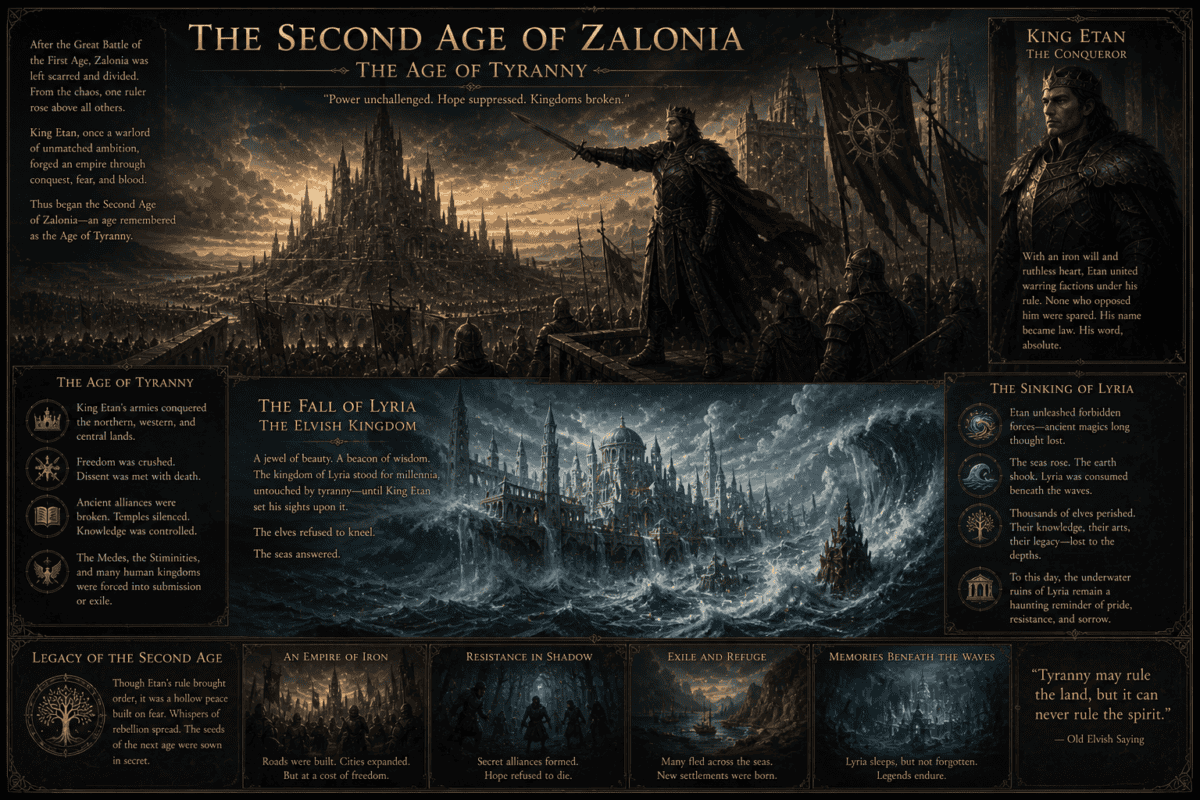
Age of tyranny – time lasted (3839 years) It quickly became a time of overburdening some rules. If the rules were broken, death was the penalty. Eating the wrong food on the wrong day became a penalty of death. Eventually, even sex became looked down upon as evil. About 100 years after sex became against the law, the races were weakened. Lyria sank during this time. The Soul Chaser and Creatrix weren’t nearly as involved during this period and let the species of the world do their own thing. Syvania was around, working with her secret society and gathering knowledge.

Timeline

Age 2 – First 100 years, human conquest begins – The humans quickly were able to get the Sxion on their side by offering them homes and teaching them battle.

Age 2 – Year 15 – The Sevenfold Accord is made by the seven races of Zalonia to keep the peace in the world. War crimes are punishable by death according to the accords. It seems that they have realized the damage that the Great Battle of the First Age had done so they agreed to no more war.

Age 2 – Year 44 – The City of Tarvon is rebuilt after being devastated during the Great Battle of the First Age

Age 2 – Year 67-190 – There is an explosion in the amount of large cities that are built.

Age 2 – Year 86 – The Temple of Dreams is founded and plays a pivotal role within the life of Zalonians. The magic behind the temple is mysterious and unknown. Many rulers and travelers visit the Temple of Dreams to get guidance. It is also the only place where prophecies can be done, as prophecy is considered a bad omen apart from the temple.

Age 2 – Year 165 – The medes grow their library with subjects that have to do with the sciences including astronomy because they study the skies.

Age 2 – Year 180 to 233 – The Rokers build many of their caves which they dwell within.

Age 2 – Year 233 – Humans Overtake the Rokers – The rokers were the easiest race to be conquered and were forced into the human armies. The only thing that was challenging was trying to find them in their endless caves. However, they surrendered because they couldn’t remain in their caves forever.

Age 2 – 331-505 – The Medes and quintum work together to map out the oceans.

Age 2 – Year 546 – Humans Gain rule of Great Frolm Forest – While the frolm can’t leave the forest for long periods of time, there were great battles fought that led to the frolm eventually losing ground and their territory. They could stay in the forest however, as long as they paid homage to their human rulers.

Age 2 – Year 1090 – Humans Defeat the Elves – The elves were able to keep humans at bay for hundreds of years, but human, rokar, and sxion armies continued to attack. Eventually the elves surrendered and humans enter Lyria. Woodland elves were not conquered, but they worked together to migrate toward the southern part of the United Territories.

Age 2 – Year 1893-1896 – Woodland Elves come to Frolm aid – With the woodland elves in the south, they are able to scheme with the frolm to enter and stave back the humans, weakening their hold on the Great Frolm Forest. The Frolm and Woodland Elves became strong allies until the Fourth Age.
Age 2 – Year 2089 – Wizard Escapes with people – Because historical figure King Etan was quickly conquering lands, a wizard transports skilled humans to another planet to begin fresh. This is where Marcia and Lucinda end up in the year 2119.
Age 2 – Year 2093 – Rule of Etan – Etan is renown to be the most tyrannical ruler ever and has taken over most of Zalonia

Age 2 – Year 2095 – King Etan and Quintum wars – The quintum were never fully defeated, but humans were able to acquired some of their territory and drove some out to sea and to explore other lands.

Age 2 – Year 2895 – Lyria Sinks – This event kills all the Lyrain elves but the woodland elves. Lyrain elves who were not in their homeland at the time became woodland elves.

Age 2 – Year 3827-3830 – The Great Plague – A plague hits Zalonia where the Green moon can been seen in many places. The plague is strongest near Ruinoneo and wipes out several beings of the 7 races, especially humans and sxion. Legend has it that the plague was magical because it didn’t seem to affect the remaining woodland elves. Three years of the plague brought this age to an end.

See Also:

Support Me On Patreon

Sign up for my Newsletter on the right side

Books to Read (Affiliate Links)

Creating Life – By Ralph Ellefson

The Art of World Building Workbook – By Ralph Ellefson

Fantasy World Building: A Guide To Developing Mythic Worlds and Legendary Creatures – By Mark Nelson

Get Curse of Kredaria for free

Return to Tales of Zalonia