The 13 Sacred Laws of the Frolm


Sign up for my newsletter on the Right

Get Curse of Kredaria for free

Support Me on Patreon

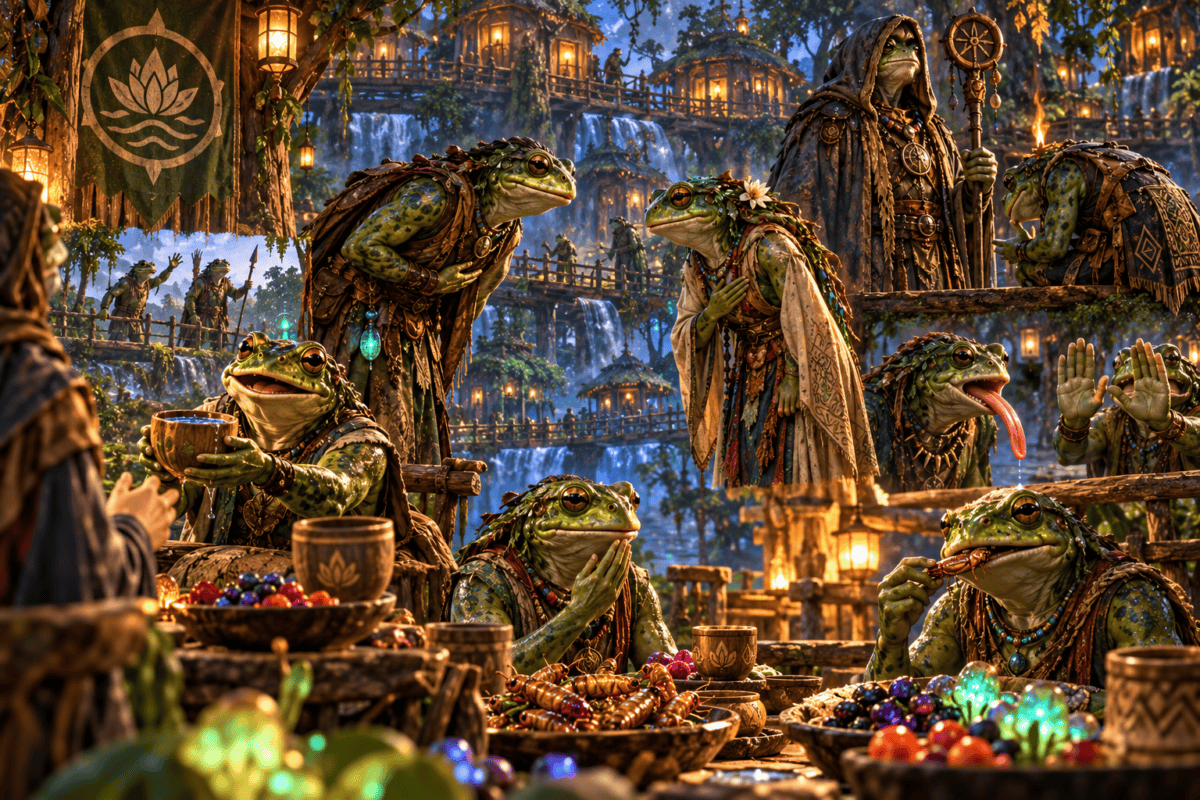
The Frolm, being a tribal amphibian-humanoid species, have laws that are deeply connected to nature, survival, community, and the balance of their swampy environment. Their laws are both practical and spiritual, ensuring harmony among their people and the ecosystem.

1. The Law of the Waters

“He who poisons the water poisons his own blood.”

Since water is sacred to the frolm, they place it in high regard and forbid pollution, hoarding, and wasting water. If someone comes along and contaminates a sacred waterway or a stream, they will be punished depending on the offense. If it is a small breach of the law, they may be required to purify the waterway. However, under more extreme crimes, the criminal can be exiled or even put to death.

2. The Law of the Hunt

“Take only what you need, leave enough for the cycle to continue.”

This law has to do with how much one can take from nature. For example, there are limits on hunting and fishing because there needs to be a balance that is maintained. Hunters are required to leave an offering to the spirits they hunt and the plants they take.

3. The Law of Kinship

“A tribe stands as one. To break it is to stand alone.”

There are many ways this law can be broken, such as violence, theft, deceit, sexual crimes, and so on. If they harm their kin unjustly, they are considered to be “Mireborn” (outcasts), and this can even lead to exile.

4. The Law of the Croaking Pact

“A promise made in chorus must be kept until the dawn.”

There is an action among the frolm called the Croaking Pact, which is a tribal ritual of agreement. If a frolm swears an oath of this kind, they must uphold their pact. If they don’t, it could cause dishonor for the lawbreaker.

5. The Law of the Marsh Spirits

“The land listens, and the spirits watch. Do not bring wrath upon the reeds.”

The frolm see nature as being spiritual, and therefore it is forbidden to anger the spirits of the land. This can happen by disrespecting the dead, destroying sacred sites, or speaking ill of their ancestors. The penalty for breaking this law isn’t as extreme as some of the other penalties. Those who offend must seek forgiveness through rituals, such as offering carvings, songs, and sacrifices of time where they work as servants.

6. The Law of the Guest and Host

“A guest is like a still pond—how you treat them shapes their reflection.”

Among the frolm, hospitality in itself is sacred. If someone is hosting, they are required to offer food, water, and a place to rest. For the guests, they must not overstay their welcome and show gratitude to the ones helping them out. If a guest refuses hospitality without a good reason, it is seen as an insult to the host.

7. The Law of Silence and Sound

“There is a time for croaking, and a time for stillness.”

Silence is very important in frolm rituals. During hunts, mourning rituals, and sacred ceremonies, frolm are required to be quiet at certain times. They are careful not to speak out of turn or disrupt deep thought because it is a sign of disrespect and arrogance.

8. The Law of Names

“A name is given, a name is earned, a name can be lost.”

Names are very important in frolm society. For example, they avoid learning the names of their enemies because it could cause empathy and distraction on the battlefield. Frolm earn a second name if they do great deeds. These names must never be mocked, stolen, or spoken falsely. The punishment for this is to have one’s name stripped, in which they would be “Nameless,” and an outcast to society.

9. The Law of the Leap

“Fear is a still pond, courage is the leap.”

When one hesitates in times of action, it is seen as a weakness. In hunts, battle, and when difficulty presents itself, a frolm must act decisively because cowardice brings dishonor. A frolm warrior who runs away without cause may be given a Mark of Stillness to show their shame. The cut is generally made on the hand.

10. The Law of Life and Death

“All must return to the swamp. None may steal that which is not theirs to take.”

The greatest crime among the frolm is murder. Taking life without a just cause is considered an offense to the very spirits of nature. However, in times of self-defense, sacred duels, and war, one can kill. Those who unjustly murder are thrown into the deepest parts of the swamp so their spirit may never find peace.

11. The Law of the Elder’s Croak

“Wisdom is the weight that steadies the reed.”

An elder’s wisdom is considered sacred, and they must be respected when they speak. It is disrespectful to interrupt an elder unless there is an emergency. If a frolm wants to challenge an elder’s words, it must be done through a trial of wits, which is a ritual debate before the tribe.

12. The Law of the Dreaming Mist

“The mist carries truth—let no one twist it.”

Dreams are viewed as sacred messages, and it is frowned upon not to tell the truth about a vision or give false prophecies. The only ones who may interpret dreams for others are the shaman or the elder of a certain tribe. Frolm, who spread false visions, may be cursed with something called the Croakless Night. It is a punishment where they are made to drink a certain herb that takes away their speech for a time.

13. The Law of the Singing Stones

“Stories are carved, songs are sung, history is never swallowed by the swamp.”

History is important to the frolm so it is considered a crime to erase history. Whether it’s by the destruction of sacred carvings, burning old texts, or silencing truth. A frolm that breaks this law is supposed to replace it with a greater tale through carvings, songs, or actions worthy of remembrance.

Most punishments are symbolic or tied to nature, such as exile, community service, or spiritual atonement. The worst punishment is to be exiled to the deep marsh, which is reserved for traitors, oathbreakers, and murderers.

Sometimes a duel is permitted when settling disputes

See Also:

Overview of the Frolm

Frolm Holidays and Ceremonies

Support Me On Patreon

See also:

Frolm Basic

Frolm Holidays and Ceremonies

Sign up for my Newsletter on the right side

Books to Read(Affiliate Links)

Creating Life – By Ralph Ellefson

The Art of World Building Workbook – By Ralph Ellefson

Fantasy World Building: A Guide To Developing Mythic Worlds and Legendary Creatures – By Mark Nelson

The Fourth Age Of Zalonia

Sign up for the newsletter on the right

Get Curse of Kredaria for free

Age of Chaos – Alien invaders try to take over Zalonia by brute force creating vast armies. Even the Protectors of Zalonia are infiltrated and almost ambush the frolm. This accumulates to the greatest battle of all time in Zalonia. The only ones who escape the war are the woodland elves and the medes who migrate to the south. They cannot use nuclear force this time because of the inner magic the Creatrix made in the world so they have do use a different means. They still want the purple gems that is in Zalonia for their own world.

Timeline

Age 4 – Year 401 – Gnonows begin to infiltrate Zalonia slowly – Some of the aliens pretended to be gods again and manipulated the races of Zalonia to their side.

Age 4 – Year 473 – King Arsidious’s Birth – He trained a poor person of the Kingdom of Veronona and understood that poor people were just as valuable. There was a tournament held with 123 soldiers (Matthias exaggerates with 128) and Vincent makes it to the final four, not the final two as suggested by Matthias. He created a strong kingdom with a period of peace of about 20 years and he ended up fighting in the Great battle that brought the Fourth Age to an End.

Age 4 – Year 531 – Alien Conquest – The aliens take over the northern volcanic area and sends out their followers of each race to infiltrate the various communities throughout Zalonia. Many places fall when the influencers manipulated inhabitants to fall under the Aliens.

Age 4 – Year 531 – There is a great collapse in the roker teerritory due to a giant earthquake which makes them more volunerable.

Age 4 – Year 525 – Frolm and Woodland Elf Pact – When the Protectors of Zalonia start to gain major influence in conquering parts of the world, the frolm and woodland elves make a contract to oppose the Protectors when they come for the southern lands.

Age 4 – Year 532 – Magdad falls – Magdad has generally held its own in the first three ages but is infiltrated by the minions of the gnonows. It will never recover fully as an elite controlled by the gnonows is what is found in the Fifth Age.

Age 4 – Year 533 – Medes and Migration – Most of the medes in the northeast come into the war and are the last ones to do so. However, some medes disagree and migrate south to the volcanoes

Age 4 – Years 479 – 534 – The Great Battle of the Fourth Age reaches its Peak

Age 4 – Year 534 – The Golden Light – The story of the golden light is told which is where this age ends. This is where Sheila and her army is devastated, but she is able to escape through a portal.

See Also:

Other Stuff

Support Me On Patreon

Sign up for my Newsletter on the right side

Books to Read (Affiliate Links)

Creating Life – By Ralph Ellefson

The Art of World Building Workbook – By Ralph Ellefson

Fantasy World Building: A Guide To Developing Mythic Worlds and Legendary Creatures – By Mark Nelson

Get Curse of Kredaria for free

Return to Tales of Zalonia