Designing Unique Bodies of Water in Science Fantasy Worlds

Sign up for my Newsletter Here

Get Curse of Kredaria for free

Support Me on Patreon

Rethinking Rivers, Oceans, and Aquatic Mysticism Beyond Earthly Logic
In a world where science and magic intertwine, bodies of water don’t just quench thirst or serve as travel routes—they pulse with ancient intelligence, carry dimensional echoes, or respond to arcane frequencies. Whether you’re building planets with liquid methane lakes or rivers that rewrite history, crafting aquatic systems in your world can unlock rich symbolism, culture, and drama.

This post dives into inspired and original types of water bodies for science fantasy settings and how to use them meaningfully in your story.

🌊 Classic Oceans with a Twist

1. The Endless Deep

  • A sentient ocean that forgets and remembers you depending on the tide.
  • Its tides are pulled by twin moons—one physical, one spectral.
  • Sailors whisper prayers into bottles; the ocean answers weeks later.
  • Creatures evolve from thoughts lost at sea.

Narrative Hooks:

  • A civilization that treats the ocean as a god—or a demon.
  • Naval expeditions aimed at reaching the fabled “Center Memory Reef.”

2. Etheric Oceans

  • Oceans made not of water, but liquid magic.
  • Shimmering tides emit energy that boosts or scrambles spellcasting.
  • Ships must be partially alive to survive its arcane surges.
  • Water changes color depending on the emotional state of its nearest civilization.

Uses in Storytelling:

  • Port cities built on rituals as much as docks.
  • Coral libraries that “record” ambient magical history in the Ethersea.

🪷 Invented Bodies of Water

3. Lacuna Pools

  • Still, mirror-like pools found in craters where time behaves strangely.
  • Gazing into them shows your past lives or potential futures.
  • Dropping items in may either erase them from history or teleport them elsewhere.’
  • Worshiped by seers and outlawed by empirical societies.

4. The Meltflow Network

  • Underground rivers of radiant, molten material—part magma, part life force.
  • Used to power cities above with geothermal-spell converters.
  • Accessible only to tunneling creatures or via soul anchors.
  • Exposure causes vivid dreams—or permanent hallucinations.

Narrative Potential:

  • A city’s reliance on the Meltflow drives political unrest as its temperature rises.
  • Creatures who can “swim” through both lava and consciousness.

5. Rivers of Echo

  • Flowing streams that “remember” sound and replay moments of great importance.
  • Whispered words become audible again during certain moon phases.
  • Entire battles, confessions, or proposals echo through the water centuries later.
  • Rogue mages use it to trace secret histories.

🧊 Exotic Lakes and Seas

6. Glacial Seas of Thought

  • Massive frozen oceans on an ancient moon where thoughts freeze into sculptures.
  • Walkers on the ice hear the frozen screams and songs of ancient civilizations.
  • Magic users can chisel memories into the ice and cast them as spells.
  • Civilizations trade frozen emotions as currency.

7. The Sinking Sea

  • A dense, bottomless body of dark liquid that pulls even air and light inward.
  • No known bottom—used as a dumping ground for cursed or unstable tech.
  • Myths say the sea is a tear from a dead god’s eye.
  • Creatures that live here can only be described in dreams.

8. The Blooming Bay

  • A shallow, luminous bay where aquatic plants bloom into the air, forming floating gardens.
  • Used as a neutral diplomatic zone by warring nations.
  • The plants produce spores that enhance psionic abilities.
  • Local fauna feed on psychic residue and mimic thoughts.

🌌 Cosmic and Interdimensional Waters

9. Star Tides

  • Rivers of water flowing through space between moons or ships.
  • Carried by gravity wells and magical conduits.
  • Traveled by creatures that breathe vacuum and vapor.
  • Often mined for their pure aether content.

10. The Veil Lakes

  • Interdimensional “pools” that exist simultaneously on several planes.
  • Stepping into one takes you to an identical lake… but on another planet or timeline.
  • Used by smugglers, sages, and invading armies.
  • Veil-lakes shift location without warning—mapping them is a lost art.

🛶 Cultural Roles of Water

Even if your water isn’t magical, how people interact with it can be world-defining.

  • Sacred Rivers: Used for memory cleansing or as part of coming-of-age rituals.
  • Forbidden Seas: Rumored to house weaponized weather or exiled gods.
  • Floating Cities: Built on AI-maintained archipelagos or atop dreaming sea creatures.

📝 Tips for Inventing Aquatic Features

Anchor one law of physics or magic, then twist it: e.g., water that flows upward, evaporates into memory mist, etc.

Give each body of water cultural significance—how does it affect trade, belief, and diplomacy?

Tie fauna and flora into the water—bioluminescent jellyfish with prophetic patterns? Carnivorous lotus? Herds of semi-intelligent plankton?

🎇 Final Thought

In science fantasy, water is never just H₂O. It’s a mirror, a memory, a weapon, a gateway. Let oceans be stained with starlight, rivers hum with haunted voices, and lakes reflect dimensions as yet unborn. The more alive your water feels, the more immersive your world becomes.

Sign up for my Newsletter Here

Get Curse of Kredaria for free

Support Me on Patreon

Creating Life – By Ralph Ellefson

The Art of World Building Workbook – By Ralph Ellefson

Fantasy World Building: A Guide To Developing Mythic Worlds and Legendary Creatures – By Mark Nelson
 

Environmental Challenges in a Science Fantasy World

Sign up for my Newsletter Here

Get Curse of Kredaria for free

Support Me on Patreon

How to Incorporate Natural and Magical Disasters, Space Hazards, and Ecological Issues

Creating a vibrant and believable science fantasy world isn’t just about the cool technology, mythical creatures, or dazzling spells. One often overlooked—but incredibly rich—aspect of worldbuilding is how the environment behaves and how it challenges the inhabitants. Whether your story unfolds on a war-torn moon, an oceanic world riddled with sea beasts, or a realm where ley lines pulse with volatile energy, environmental challenges can enrich narrative stakes, deepen lore, and anchor your world in compelling realism.
In this article, we’ll explore how to weave natural disasters, magical anomalies, space hazards, and ecological dilemmas into your science fantasy world—and how these elements can elevate your plot, characters, and themes.

🌋 1. Natural Disasters: The Familiar Made Strange

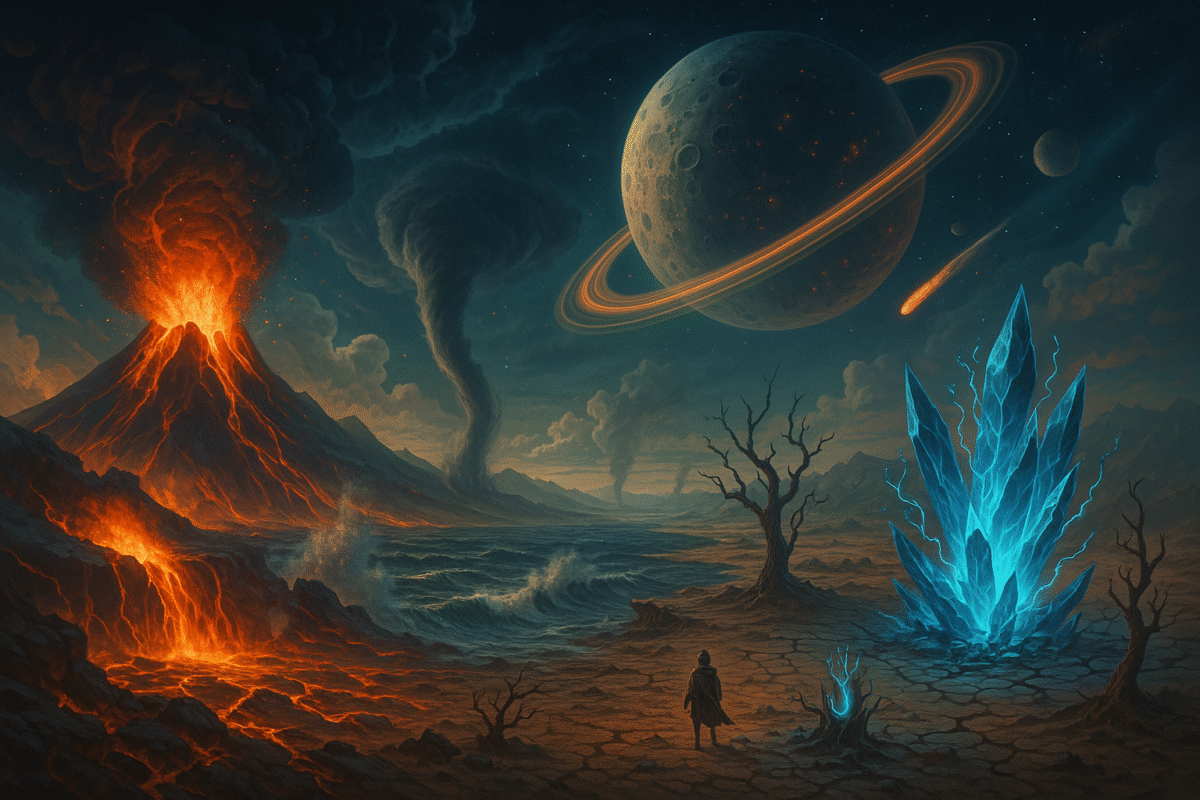
While volcanoes, hurricanes, tsunamis, and earthquakes are familiar phenomena, in a science fantasy setting, you can twist them to reflect your world’s unique physics or geography.

Creative Ideas:

Plasma Storms: On a planet with high magnetic interference, lightning storms might crackle with radioactive energy or distort time.

Floating Quakes: In a world with floating continents or anti-gravity zones, tectonic shifts could cause entire landmasses to crash or drift into space.

Crystal Quakes: If your world grows magical crystals underground, mining them could lead to crystalline eruptions or shattering “glass-quakes.”

Tips:

Use disasters to spark political intrigue (e.g., nobles blame each other for the collapse of a floating city).

Show how cultures adapt—nomadic groups may follow the path of migrating safe zones between fire swells or acid rains.

🔮 2. Magical Disasters: When the Arcane Backfires

Magic isn’t always a benevolent force. Like nuclear energy, it can be wildly unstable. Consider how the misuse, corruption, or over-harvesting of magical power might devastate your world.

Magical Catastrophes:

Spellquakes: Magical aftershocks ripple from failed rituals, tearing through the weave of reality and altering gravity or biology.

Ley Line Eruptions: Areas saturated in magical energy can “erupt” like volcanoes, releasing raw chaos that mutates wildlife or corrupts minds.

Mana Blight: A form of magical pollution where excessive spellcraft drains the life force from an area, turning it into a barren gray zone.

Narrative Uses:

The aftermath of a magical war might include wastelands where time doesn’t flow or where illusions are permanent.

A cult could attempt to summon a god by destabilizing the ley grid, causing regional arcane storms.

🌌 3. Space Hazards: Celestial Threats and Cosmic Dread

If your science fantasy world includes orbital colonies, deep space travel, or gods who dwell in the stars, cosmic hazards add drama and scale.

Potential Hazards:

Radiation Rings: After a failed planetary defense shield collapsed, dangerous radiation rings now orbit the planet and must be navigated carefully.

Void Flares: Stars blink in and out of existence, creating reality-tearing pulses that shatter space stations.

Graviton Anomalies: Invisible wells of warped time-gravity that trap ships or bring forth ancient relics from collapsed timelines.

Story Hooks:

A city on a ring-world may be at risk from solar storms every few decades, creating a ritualized mass migration called the Sun Flight.

An asteroid infected with “living dark matter” may crash into your planet, spreading madness and dimensional instability.

🌱 4. Ecological Issues: Magic and Tech Meet Nature

Whether you’re drawing inspiration from climate change, invasive species, or toxic industries, ecological challenges can mirror real-world issues through a fantastical lens.

Possible Ecological Scenarios:

Magical Overfarming: A society that harvests spells from magical plants might cause magical deserts or “arcane famines.”

Terraforming Gone Wrong: A planet partially terraformed now features clashing ecosystems—desert lizards in lush rainforests, or deep-sea fish in mountaintop lakes.

Living Machines: Ancient bio-tech constructs, once dormant, begin to consume forests to rebuild themselves—shifting the balance of life.
Long-Term Impacts:

Class divisions might emerge between those who live in “Green Zones” protected from corruption and those exiled to poisoned lands.

Entire faith systems could develop around restoring the natural balance, with druids or eco-engineers viewed as prophets or heretics.

🌀 5. Blending Themes: Use Environmental Conflict to Drive Story

Environmental hazards shouldn’t just be background noise—they can actively shape your narrative.

Conflict Generation:

Characters: A mage suffering from Mana Sickness after exposure to blight. A space pilot traumatized by a Graviton Rift collapse.

Cultures: Nomads worshipping a volcano as a god. Sky cities hoarding clean air while surface dwellers suffocate.

Factions: Technocrats exploiting nature vs. mystics seeking harmony. Terraformers vs. Preservationists.

Moral Questions:

Is it right to colonize a new world if the indigenous species are sentient—but silent?

Should a society continue using magic if it heals people but causes slow decay to the environment?

Can magic be “cleaned up” with tech—or should it be banned?

⚙️ 6. Practical Integration: Making It All Fit

Here’s how to seamlessly integrate these elements:

History: Tie disasters to past events. Maybe a ruined empire fell because of a ley line rupture 500 years ago.

Geography: Let the landscape reflect its history—rivers glowing with residual magic, forests shaped by ancient storms.

Religion/Myth: Build lore around environmental cataclysms. Perhaps certain beasts only emerge before a void quake.

Technology: Let tech evolve as a response—arcane weather prediction devices, magic-purifying fungi, or mech suits that withstand solar flares.
Magic Rules: Establish clear mechanics for magical pollution or overuse. Consistency makes even the strangest environments feel real.

🌍 Conclusion: Your World Is Alive—So Make It Breathe

Environmental challenges are more than just spectacle—they shape civilizations, define conflict, and mirror timeless struggles between power and balance. Whether you’re crafting a world ruined by magic or struggling to survive a dying sun, these environmental tensions give your science fantasy setting depth, urgency, and meaning.

Build your world like it’s a character: give it scars, tempers, cycles, and breath. Let readers feel the heat of solar storms, the chill of void winds, and the ache of a world on the edge of collapse—and watch your narrative come to life.

Sign up for my Newsletter Here

Get Curse of Kredaria for free

Support Me on Patreon

Creating Life – By Ralph Ellefson

The Art of World Building Workbook – By Ralph Ellefson

Fantasy World Building: A Guide To Developing Mythic Worlds and Legendary Creatures – By Mark Nelson