Frolm Jobs and Occupations

Frolm are generally given jobs that they have a talent for. There are various jobs among the frolm that keep their society going. To become a warrior is often the most sought-after position, and a frolm has to be 30 years old to go on a Warrior’s quest to prove their worthiness. However, warriors aren’t always at war, and many fulfill other duties in times of peace. Here are some of the jobs that they can do:

Bogkeepers – These frolm protect the water sources and make sure that ponds, streams, and sacred pools stay clean and undisturbed. They may sometimes clean the water with nets to help the water remain fresh.

Mud Architects – Most frolm homes are made from the use of mud, so mud architects are set to build homes and other important places with mud, woven reeds, and bioluminescent fungi. They tend to make very sturdy and long-lasting homes.

Tree Hollow Carvers – They help to shape living trees into storage spaces or ceremonial sites. They are experts at doing this so they don’t harm the trees. This is usually done with larger trees because they supply more room.

Glowmoss Tenders – These are frolm who cultivate luminescent moss that provides natural lighting. This natural lighting is usually put on village paths and homes. It is very decorative in appearance.

Marsh Navigators – These are frolm experts who chart the safest water routes through the forest’s twisting rivers and floating islands. This helps people who are traveling through the forest. These frolm often put up symbols signifying the safest paths.

Defenders & Warriors

Swamp Guardians – These are trained fighters that protect the jungle. They also protect their communities from predators, cave trolls, and those who might attack the Great Frolm Forest.

Leapblades – These are elite warriors, and they use their powerful legs to launch themselves at enemies, with sharp blades or weapons. A frolm must be able to jump at least 25 feet in the air in order to become a Leapblade.

Mist Trackers – These are frolm who hunt enemies by trailing them through the thickest of fogs. Their eyes are tested before they become one of these, and they are generally young frolm because young frolm have sharper sight.

Shadow-Fins – These frolm often remain underwater and are warriors that guard the sacred pools and river passages. They are good at silently swimming and stealth attacking.

Venom Harvesters – This force of the frolm army is specialized in gathering dangerous venom from animals and plants and using it to put on their weapons. Some harvesters focus on finding venoms that can heal frolm.

Nature-Based Roles

Raincallers – These are shaman-like frolm that perform ritual chants and dances that cause it to rain.

Frogspawn Caretakers – These are protectors of young frolm eggs and tadpoles. They ensure their survival in the hatchery pools.

Moss Weavers – These are frolm that focus on growing and weaving moss-based fabrics to be used for clothing, bedding, and insulation.

Root Healers – These are herbalists who use such things as jungle plants, fungi, and minerals to create healing pastes and tonics.

Mist Farmers – These frolm grow fog-dependent plants and bioluminescent crops. They often tend to floating gardens on ponds.

Cultural & Spiritual Occupations

Croak Singers – These frolm perform and use resonating vocal harmonies to tell stories, teach history, and soothe those in ill health.

Echo Dancers – These are acrobatic warriors who leap and tumble through the air. This mimics the movements of forest creatures. They can sometimes access frolm prey that can otherwise be difficult to catch.

Spiritwalkers – These frolm are priests and/or mystics who act as mediators between the frolm and the spirits of water, jungle, and ancestors. They sometimes mediate between frolm clans when there is a serious disagreement.

Water Oracle – This is a rare frolm that claims to see visions in the ripples of sacred pools and helps those in leadership positions. There are some frolm who pretend to see these visions, which can cause a disruption in the clan. If it is found out that the frolm is pretending to see a vision, it could lead to that frolm being exiled.

Ritual Painters – These are artists who tattoo or paint symbols on warriors who are preparing for battle or for coming of age events.

Food & Trade

Glowfruit Foragers – These are frolm that gather bioluminescent fruit that only grows under certain moons and moon phases.

Insect Farmers – These are breeders of crickets, glowworms, and beetles. This helps give the frolm a protein-rich food source for the inhabitants.

Mudbrew Masters – These are creators of fermented mushroom drinks. Depending on the kind of mushroom, this drink can have two effects: one is to help with deep relaxation, and the other is for heightened awareness.

Spore Traders – These are merchants who deal in rare and enchanted spores. They have medicinal and alchemical properties.

Pond-Fisher – These are fishers who catch, breed, and release rare amphibious critters into marsh pools that are carefully controlled.

Crafting & Artisanship

Reed Flute Makers – Just as the name suggests, they are carvers of musical instruments that produce soft and haunting melodies through the jungle air.

Shellsmiths – These are crafters who make armor and tools from the hardened shells of creatures within the forest.

Mudmask Artisans – They are artists who create ceremonial masks with colorful clay and enchanted swamp water.

Poison Ink Masters – These are scribes who write sacred texts and secret messages with ink made from non-lethal toxins that only the frolm can handle safely.

Biolume Dye Makers – These are extractors of glowing pigments which are from plants and fungi. They are used for body paint, ritual decorations, or even regular clothing.

Leadership & Diplomacy

Chief Elder – This is an elder who presides over a frolm Hamlet. He often leads councils on deciding if someone is guilty or innocent and what the punishment is if guilty.

Prophecy Interpreter – There are some frolm hamlets with a prophecy interpreter who is specialized in understanding prophecies that have been written down. They can also act as dream interpreters.

Elder Croakers – These are council members who help to resolve disputes and pass down wisdom and knowledge through traditional storytelling.

Trade Froggers – These are traveling merchants who barter exotic goods with neighboring races. They are often required to navigate through dangerous jungle paths.

Bog Emissaries – These are diplomats who are sent to speak with rival clans and outsider settlements.

Ceremonial Judges – These are respected figures who oversee rituals, trials, and punishment ceremonies. They usually serve the role of a chief elder if none are available.

Unique Jobs Based on Their Frog-Like Physiology

Leap-Couriers – These are high-speed messengers who jump across vast distances in order to deliver urgent messages.

Rain Harvesters – These are collectors of purified rainwater. This rainwater is used in potions and sacred ceremonies.

Echo Locators – These are scouts who use croaks and clicks to map out such things as tunnels, underwater ruins, and hidden caves.

Jungle Wall Climbers – These are specialists who use their sticky hands and feet to scale along cliffside temples and treetop villages.

Mud Camouflage Experts – These are guides who train warriors how to blend in with swamp terrain using natural pigments.

How These Jobs Shape Their Society

These jobs give them a deep connection to water – Many of these roles focus on preserving water, protecting sacred pools, and controlling rainfall.

They give them symbiosis with nature – Different from industrialized civilizations, the frolm depend on biodegradable materials and sustainable farming.

These jobs puts a emphasis on community – Many of the jobs involve group effort rather than individual effort, which reinforces communal Survival.

They keep cultural storytelling and rituals alive – Several roles include song, body paint, spiritual practices, and dance to honor their ancestors and the forest.

Frolm Heroes

Sign Up For My Newsletter on the right

Get Curse of Kredaria for free

Just as we have well-known people in our history, frolm also has those whom they consider heroes. Here they are:

Groktul the First Croaker

He carries the title Voice of the Deep Marsh and is from the First Age. He was the first great spiritual leader among the frolm. He is the first known frolm to speak with the marsh spirits. He is the developer of the language spoken among the frolm. According to legend, his staff is buried beneath the Stillwater Tree.

Tarka Shellbreater

He was the warlord of the Four Rivers and lived in the later part of the First Age. Tarka’s was a warrior and military leader. He was born with stone-hard skin, which gave him extra strength. He used this strength to unite feuding Frolm clans. His armor was made from the shells of giant swamp crabs and was known and feared for being able to smash the shields of his enemies with his bare hands.

Oomathi Light-Skimmer

She was known as the Mist-Dancer of the Moon Pools and lived during the Second Age. Oomathi was a renowned hunter. She could glide across the water and barely cause a ripple. She was good at capturing spirit fish, which are semi-ethereal beings that grant dreams. There is a constellation of stars named after her.

Wobbak of the Blooming Eye

He was considered the Shaman of Seasons and was around during the Second Age. Wobbak was a nature priest and healer. He was able to predict floods, volcanic mist bursts, and insect migrations. He even invented the first herbal codes that were passed down through bioluminescent tattoos.

Zelgur Mudwrestle

He is considered the champion of the Pit Rites and was around during the Fourth Age. Zelgur was known as a gladiator and folk hero. He came from a low-caste fishing village and became the undefeated champion in sacred wrestling rites. Later in life, he led a rebellion against the corrupt priest-lords who worked for the gnonows. This made him a symbol of the common Frolm’s power.

Ronaqua the Hollow Song

She was known as the Croakless Prophetess and was alive during the Fourth Age. Even though she couldn’t speak, she was a prophet and visionary. She was born without a voice, so she communicated through gestures and rhythmic drumming. During the Great Battle of the Fourth Age, she warned of a great attack that later struck the southern marshes. Every ten years, the frolm reenact her pilgrimage.

Varrik Snapjaw

He was known as the Breaker of Chains and lived during the Third Age. He was a revolutionary general. When he was captured and enslaved by invading sky-sailors, Varrik gnawed through his own bindings and went on to free hundreds of Frolm captives. He also led them to overthrow an entire sky fortress. At a later age, his jaws were enchanted and preserved as relics of freedom.

Lumphi Rainspeake

She was known as the High Speaker of the Rain Chorus and was around in the Fifth Age. Lumphi was a diplomat and orator. She was known to have ended the Long War of Mud and Flame when she composed and performed a rain chorus powerful enough that it caused torrential downpours for seven straight days. It was a symbol of renewal and became the cornerstone of a new peace accord.

Kreeja the Brightspawn

She is known as the Starborn Seer of the Reeds in the Fourth Age. She is known as a mythic being or time traveler. Rumors say that she was born from a falling star, and she glows with ambient magic and can travel between eras. There are some frolm who believe in a prophecy that she is yet to come and will lead them to the “Shining Grove Beyond the Sky.”

Boombik Leafcloak

He is known as the Forest Shadow and Spy who existed during the Third Age. The frolm give him credit for ending the War of Fungal Thrones by impersonating the enemy king for three weeks, sowing confusion and halting troop movement. He wears a cloak that is made of living leaves and changes color to match emotion and terrain.

See Also:

Sign Up For My Newsletter on the right

Get Curse of Kredaria for free

Frolm Deities

Sign up for my Newsletter Here

Get Curse of Kredaria for free

Support Me on Patreon

1. Mossara – Mother of the March

She is known as the Goddess of life, wetlands, and motherhood. She is also the supreme goddess among several of the frolm tribe. Mossara is said to have given the Creatrix the idea to create frolm aas a race and that she would watch over them. The frolm were shaped from mud, reeds, and rainwater. Her symbols are the lily pad, green spiral, and three cattails. She is often followed by midwives, farmers, and village elders.

2. Krovak – Lord of the Croaking Chorus

Krovak is known as the god of music, communication, and unity. The frolm believe that every frog call carries meaning with it. He has taught them how to sing to one another across swamps. Frolm priests communicate important messages through a variety of ceremonial chants.

3. Velnora – Keeper of Still Waters

Velnora is known as the goddess of wisdom, meditation, and reflection. Many frolm believe that quiet ponds are places where she speaks. Those who are seeking guidance, even by non-frolm travelers, sit beside still water for days waiting for the answer. She often takes a while to answer.

4. Gruth – The Great Toad

Gruth is known as the god of endurances, patience, and survival. He is said to be an humongous ancient toad said to sleep beneath the oldest swamp. He also teaches the frolm patience. Frolm warrior may gather together before partaking in a long campaign.

5. Xalassa – Lady of Rain

Xalassa is the goddess of rain, storms, and cleansing. In fact, every rainstorm is seen as one of her blessings. These rains often get frolm into the mood to be festive and sometimes parties are thrown at random with the heavy rains. However, droughts are seen as signs that something has disturbed nature.

6. Nythra – The Lady of Mist

Nythra is the goddess of mystery, hidden paths, dreams. The morning fog is said to hide spirits. Those traveling through a thick mist often leave offerings before enterting. She may protect travelers or lead them astray if they have ill will.

7. Thurog – Guardian of the giant beast

Thurog is said to be the god of animals and balance. Frolm believe that every giant swamp creature belongs to him including the great beasts who dwell in the Great Frolm Forest. Hunters will ask him for permission before killing. However, if one takes more than what is needed, his anger will be stirred.

8. Selka – Weaver of Reeds

Selka is the goddess of family, homes, and craftsmanship. She is the inventor of weaving and builders often dedicate the first beam of every home to her.

9. Brakkor – The Rotten King

Brakkor is the god of decay, fungi, rebirth. Some think he is the strangest deity. The frolm do not fear rot, rot feeds mushrooms which feeds animals, and animals feed the swamp. Death leads to life. He represents this endless cycle.

10. Othrin – The Fire that should never burn

Othrin is the god of wildfire and destruction. Unlike woodland elves, the frolm fear fire that isn’t controlled. Othrin is not evil, but necessary. Sometimes a part of the swamp may have to burn for new life to begin.

11. Ilyssa – Mother of Eggs

Ilyssa is the Goddess of birth and children. Every egg receives her blessing. Parents leave polished stones near the nests in honor of her.

12. Kethun – The Leaping One

Kethun is the God of courage and exploration. He is considered the first frolm to cross impossible distances. Those who are young adventurers seek his blessing before they leave for their quest.

13. Marruk – Lord of Insect

Marruk is the god of insects and pollination. While many people in Zalonia hate insects, the frolm recognize that without them, the swamp dies. Some of his priests breed sacred dragonflies and insects.

14. Hessa – The Moon Frog

Hessa is the goddess of the night, stars, and navigation. She is known to paint silver paths across the marshes and hunters use her moonlight as guidance.

15. Zorath – The Devouring Bog

Zorath is the god of natural justice. He represents dangerous bogs. There is the belief that those who exploit nature eventually disappear into his marches. He’s more an inevitable force of balance than he is a villian.
Religious Philosophy

The frolm don’t see the world as a struggle between good and evil. Instead, they believe that everything exists in cycles like life becomes death, death becomes the soil, the soil feeds plants, plants feed insects and some animals, insects feed animals, and animals feed the people. The people eventually return to death. There is nothing that is wasted and there is nothing that truly dies.

The Four Sacred Principles of the Frolm
Their four main teachings are summarized like this

1. Only take what the swamp willingly gives to you.
2. Leave every place in better condition from which you found it.
3. Honor decay because it creates tomorrow
4. Think and listen before you speak, even the marsh has a voice

Some believe that the swamp is the true god and that the gods are merely voices.

Sign up for my Newsletter Here

Get Curse of Kredaria for free

Support Me on Patreon

Frolm Food

Sign up for my Newsletter Here

Get Curse of Kredaria for free

Support Me on Patreon

Insect & Small Creature-Based Foods

(Because they are frog-like, they often enjoy such things as protein-rich insects, crustaceans, and amphibious creatures)

Maple-Covered Grasshoppers

This is their favorite treat and is often used at festivals. It is a sweet and crunchy food made from roasted grasshoppers glazed with maple syrup

Bogshrimp Skewers

These are large, juicy freshwater shrimp, typically found in jungle pools. They like to grill it over mosswood fires and then brush it with citrus-infused nectar.

Firefly Larvae Dumplings

These are soft, glowing larvae that are wrapped in edible lily leaves. They are steamed which gives off a faint golden hue.

Rainmoth Caterpillar Stew

This is a slow-cooked dish made with large caterpillars that absorb the flavors of jungle broth and swamp spices.

Flicker Beetle Jerky

This is where beetles are dried and marinated with juices that are sweet or sour. They create a chewy, tangy snack that store well for long journeys. They are the frolm’s equivalent to the mede seeds.

Moss Crab Legs

This is a soft-shelled crab which grows near the Frolm’s water habitats. It is boiled with fermented reeds and spicy rivergrass.

Glowing Spider Eggs

These are a delicacy of spider egg sacs that are mixed with honeydew sap and crushed flower petals. They are generally eaten raw or fermented for added flavor.

Fruits, Seeds, and Plant-Based Foods

Because the frolm live in a jungle, their diet includes such things as exotic fruits and energy-packed plants.

Glowfruit Chunks

This is a bioluminescent fruit with a tart-sweet taste. These are usually eaten raw or dried into chewy strips.

Swamp Melon

This is a large watery fruit with a jelly-like interior. It is sometimes fermented into a mildly alcoholic drink.

Lily Pad Wraps

These are large edible leaves that are filled with several nuts, seeds, and spiced mushroom paste.

Sticky Vine Pods

These are soft, nutty pods which ooze a caramel-like sap when they are cracked open. They are often chewed like gum or as a topping on food.

Rainberry Soup

This is a thick, purple berry soup. It is served cold and mixed with fermented swamp nectar.

Mistnut Paste

This is a high-energy nut better made from ground jungle nuts. They are sometimes spread on roasted insect legs or can be used as a dip.

Marsh Fungus Loaf

This is a dense, spongy bread made from combining wild mushrooms and tree-root flour

Swamp & Water-Based Dishes

Being amphibious, frolm eat food from rivers, lakes, and marshes

Bogfish Stew

This is a rich, slow-cooked fish stew which is infused with jungle spices and thickened with crushed fern roots.

Mudslime Noodles

This is a gelatinous, translucent noodle. It is made from algae and fermented swamp moss and served in a hot broth.

Saltwater Eel Fillets

These are tender slices of eel that are smoked over an aromatic wood and dipped in fermented fruit sauces.

Bubblefruit Ferment

This is a fizzy, plant-based drink which is made from soaking swamp berries until they are naturally fermented and become mildly alcoholic

Riverweed Salad

This is a cold dish made from such things as crunchy river plants, lotus roots, and edible swamp flowers

Driftwood Clams

These are a shellfish that grows on floating logs. It is harvested and steamed with tangy flower nectar.

Desserts & Treats

Moss-Honey Tarts

These are soft pastries usually made from crushed nuts and honey from the swamp. They are baked and contain edible leaves.

Frogspawn Pudding

This is a jelly-like dish that is made from small floating seed that look like frog eggs. They are generally served with berry syrup.

Sizzlefruit Crisp

These are dried, spiced fruit slices which crackle and tingle a bit when eaten due to their natural effervescence.

Dewdrop Jellies

These are crystal-clear rainwater-based jellies made with floral nectar and served in costly cups.

Glazed Mushroom Caps

These are sweet, chewy mushroom heads that are dipped into a caramelized sap. They are often sprinkled with dried moss flakes, depending on the frolm’s taste.

Cultural Notes on Frolm Eating Habits

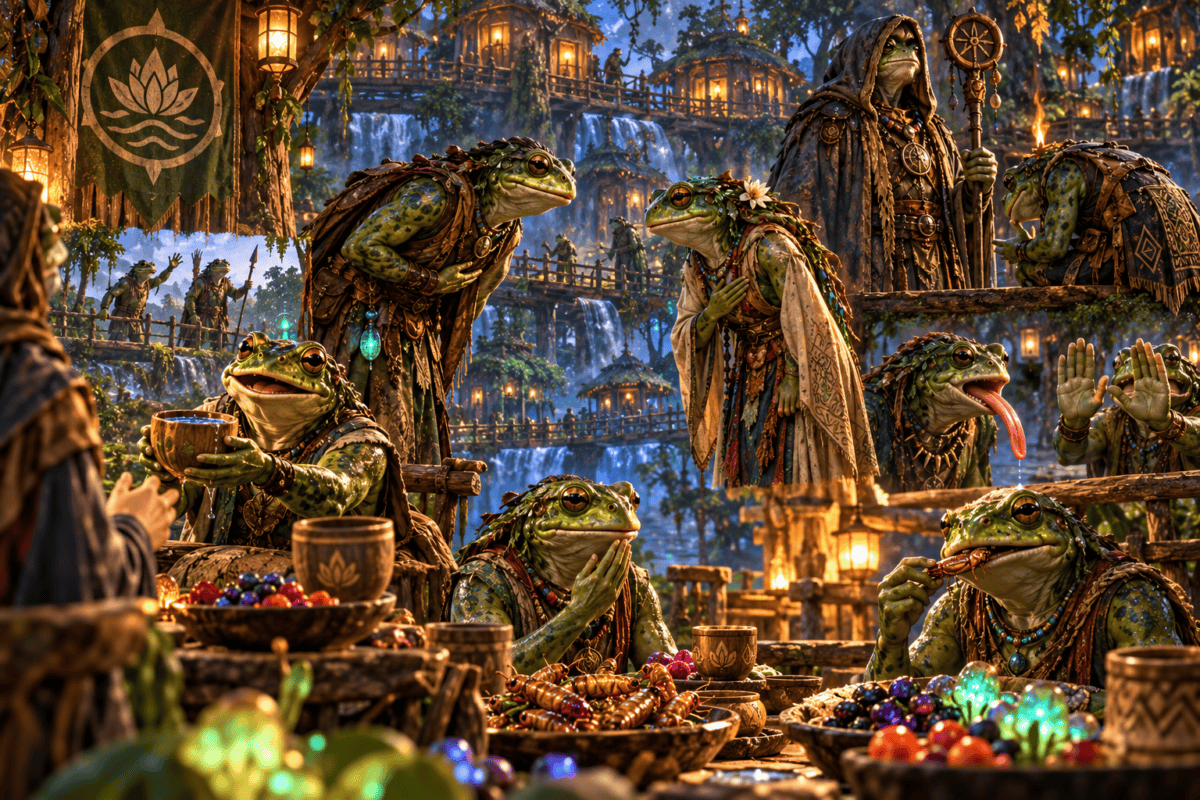
Because they only eat every few days, their meals are generally high in fats and proteins. There are some foods, such as the glowing fungi, that have magical properties to them and are sometimes used in rituals. Some frolm fast before certain ceremonies, which creates a more symbolic feel around the feast. There are certain feasts that are communal, depending on the celebration
Frolm only use knives for cutting; otherwise, they eat with their tongues, which can stretch a couple of feet.
Frolm generally don’t consume alcohol because it is unhealthy for them, more so than other species.
The water within the forest is usually drinkable unless it is around where the water trolls live, since they pollute the water. Frolm generally stay away from this part of the forest.
Frolm generally use rectangular tables that are made from the wood they gather in certain places of the forest. They often use dead wood to build them.
Frolm won’t eat anything that is frog-like because they feel like they are connected with the frogs. In fact, it is considered a severe crime in some areas within the Great Frolm Forest. They are also allergic to bread products, and can even break out in hives if they touch anything that has to do with bread.
Frolm like sweeten bugs as their favorite, and sometimes they like them with spices and homemade sauces. They don’t use salt at all because they react poorly to salt. It is almost like a poison to them because it will dehydrate them, and frolm are dependent on staying moist.

Flowers of the Great Frolm Forest

Sign up for my Newsletter Here

Get Curse of Kredaria for free

Support Me on Patreon

Moonveil Blook

This is a large, luminescent flower. It has soft blue petals which glow faintly under the moonlight from any of the three moons. It only opens at night and attracts nocturnal pollinators such as moths and fireflies. The frolm use it to make potions which strengthen night vision or calm the mind. It symbolizes guidance in the dark.

Stormcall Lily

This is a tall flower with petals that shimmer like lightning during a thunderstorm. It has a stem that pulses with a faint, crackling energy. This flower attracts electric insects that feed on its nectar. The stormcall lily’s petals are sometimes used in rituals to call for rain or to fight off droughts. It is believed to be a gift from the storm spirits.

Bloodvine Blossom

These are deep red flowers that grow on twisting vines. They appear as if they “bleed” a crimson sap. The sap attracts some predators and keeps the smaller bugs in check. Its sap can be used for healing things like rashes. However, when it is refined, it is toxic to ingest. It is a symbol of strength and sacrifice, and is often used in warrior ceremonies.

Glowthorn Bell

These are small, bell-shaped flowers that hang on vines. They emit a golden glow at dusk. It helps to guide pollinators like small bats and glowing insects. Sometimes the glow is harvested to create floating lanterns. They are associated with the guiding spirits of ancestors.

Whispering Bloom

This is a delicate, translucent flower. Its petals hum softly when there is a wind. The humming vibrations attract some pollinators while it scares off certain predators. Some use the petals to create sound spells or amplify voices. They are often used in storytelling circles, where the humming adds to the intensity of the power of spoken tales.

Starshade Lotus

This is a massive, floating flower. It has silvery petals that look like stars. The fl also has a dark, reflective center. It is known for the shade and shelter it gives to aquatic creatures in jungle ponds. Some use the petals to purify water, and some use them for elixirs to cleanse toxins. They are representative of tranquility and the balance of nature. The sharshade lotus is used in ceremonies.

Veilang Orchid

This is a rare orchid with shifting colors depending on nearby emotions. They range from deep red for anger to a soft green for peace and calmness. It emits a calming scent that softens the aggressive behavior in animals. Its petals can be used in magic that both reveals truth and conceals thoughts. The veilang orchid is highly prized when it comes to meditation and conflict resolution rituals.

Fireplume Vine

This is a climbing vine with blossoms that look like small, flickering flames. They attract creatures that feed on its heat-producing nectar. The nectar can be used to create fireproof materials and enhance heat-based spells. It is often used in rites related to courage and endurance, especially for warriors and hunters.

Dreamspinner Bloom

This is a swirling, spiral-shaped flower that has soft pastel hues that change as the day goes by. It attracts creatures that are sensitive to light patterns, aiding pollination. This pollen is often used at the Temple of Dreams and is used in prophetic rituals, or even just as a sleep aid. Many shamans and dreamweavers use this flower to gain insight.

Mosslight Clusters

These are small glowing flowers which grow in tight clusters on moss-covered trees. They resemble small constellations. They are used to provide light to forest creatures at nighttime. This helps in navigation. Their glow can be harvested to craft bioluminescent dyes or enchanting powders. They symbolize interconnectedness and a guiding light for the frolm.

The frolm use these flowers for various activities. A lot of flowers hold symbolic meanings and are woven into things that people wear. They can also be used for healing and magic. Parts of the flowers, such as petals and sap, are used as ingredients for potions and magical rituals. Some are used for tools and art. Flowers such as bromeliads and glowthorn bells are used for decoration or as natural tools. They are also used for trade and bartering.

Sign up for my Newsletter Here

Get Curse of Kredaria for free

Support Me on Patreon

Creating Life – By Ralph Ellefson

The Art of World Building Workbook – By Ralph Ellefson

Fantasy World Building: A Guide To Developing Mythic Worlds and Legendary Creatures – By Mark Nelson