
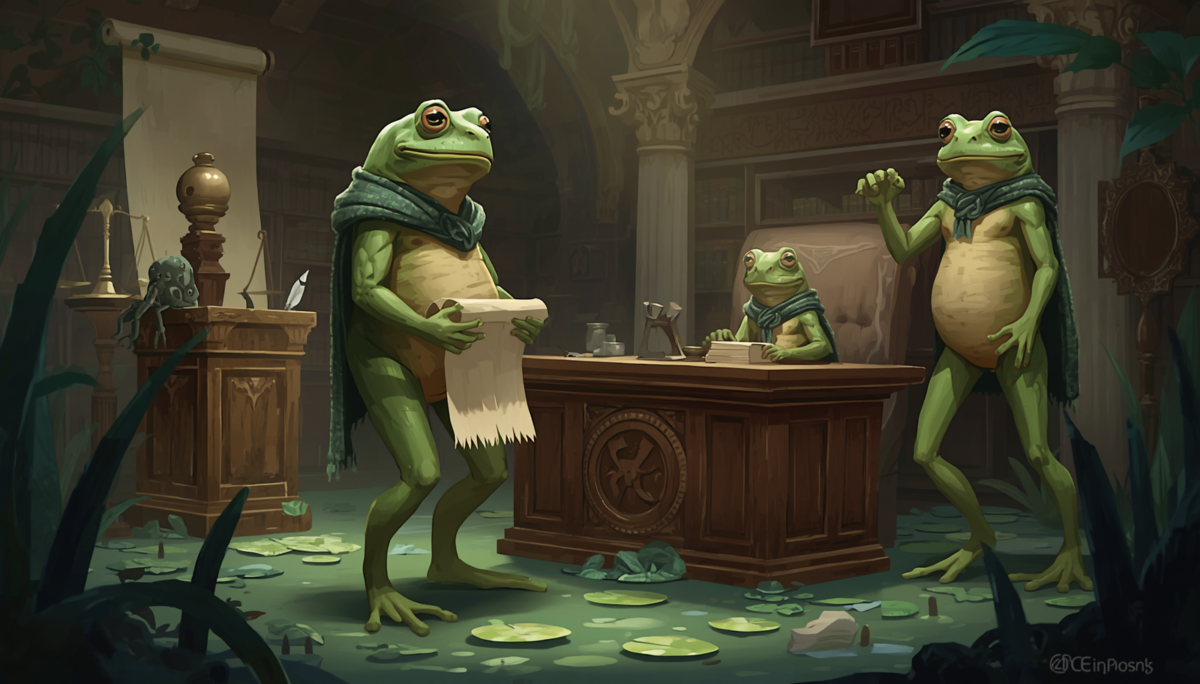
Frolm: Lesser Laws

Support Me On Patreon

Sign up for my Newsletter on the right side

Get Curse of Kredaria for Free

Warrior’s Age

A warrior must be 30 or over to go to war, but under 400. This keeps younger and inexperienced frolm from joining at a young age.

The Glowfruit Rule

Glow fruit, which is a rare and bioluminescent delicacy, can only be harvested during the Festival of Sacred Bloom. Only limited quantities are allowed to be gathered. If someone harvests too many, they may get banned from the next festival and be required to plant and nurture new glowfruit trees.

The Silence of the Moonlit Marsh

When the regular moon is full, frolm aren’t permitted to make loud noises in the Moonlit Marsh because they may disturb nocturnal spirits. If someone breaks this law, they must offer a symbolic gift, such as rare insects or glowing moss, to the march spirits during a special ritual. This law keeps the frolm respectful of the forest.

The Pact of the Great Trees

Frolm are not permitted to cut down a living green without permission being granted by the Forest Elders, and they usually only approve of this if the tree poses a threat or is diseased. Breaking this law will require the offender to plant at least ten saplings and take care of them until they are fully grown

The frogspawn covenant

Anything related to a frog, such as tadpoles and frogs themselves, is protected at all costs. They are symbols for the future of the frolm. This offense is punished with banishment from breeding pools for one season. This law is in place for the frolms’ survival.

The Leap of Passage

Frolm youth are required to do a ceremonial leap from a special tree into a deep pond. This is a rite of passage to adulthood. If they don’t make this leap then they may not have the right to participate in certain community decisions. This is meant to strengthen cultural

The Law of Shared Spoils

Anything caught from a successful hunt or a foraging expedition, must be shared with the entire village. There must be special portions that are received by the elderly and sick. Those who refuse to acknowledge this may be temporarily banned from hunting or foraging. On top of that, the offender must make an offering to the community. This insures that no one in the village goes hungry and also supposed communal well-being.

The Guardian’s Vow

Frolm warriors, also known as Bogkeepers, need to swear to protect their territory from outsiders. This helps to ensure the safety of the hamlet. If one neglects his duty, the warrior must undergo a purification ritual and then spend an entire season patrolling the outskirts of the swamps alone. This helps to reinforce the importance of vigilance and protection of the frolm.

The Glowstone Edict

Glowstones are magical crystals that illuminate the forest. They are only allowed to be mined during specific lunar phases with the supervision of an elder miner. If someone is caught mining without permission, it can result in the confiscation of the crystals and a mandatory month of service in the mines to restore balance. This law makes sure that overmining doesn’t happen and retains the preservation of glowstones.

The Ritual of Rain

During times of drought, it is mandatory for all the frolm to participate in a community-wide raid-calling ritual which is led by a Raincaller. A Raincaller is a highly respected shaman who often oversees a territory and has more authority than hamlet leaders. If someone doesn’t attend without a good reason, this will result in a symbolic “thirsting day” where the individual isn’t allowed to drink from the sacred water. This law helps to strengthen unity and ensures collective effort during droughts.

The Boundary Accord

Frolm aren’t allowed to cross the boundaries of their territory without special permission from the council. These risks could expose their location to possible threats. If a frolm breaks this law, he must endure a period of isolation and reflection in a guarded section of the marsh. The purpose of this is that it protects frolm from outer dangers and ensures the secrecy of their homeland.

The Feast of First Fruits

The first fruits of the harvest season must be offered to the forest and tree spirits during a feast before any of it is consumed or stored. Those who break this law must fast for a day and make reparations by preparing the feast itself. This law honors the forest and tree spirits and shows thankfulness for the land’s bounty.

The Marchlight Law

This law requires travelers to carry marshlights (bioluminescent lanterns) during the night so they don’t disturb nocturnal predators or step into dangerous bogs. If one breaks this law, then it is mandatory to provide service as a night guide for the village for eight days (A week in Zalonia). The purpose of this law is to ensure the safety of travelers and maintain harmony with the nocturnal ecosystem.

The Pack of the Croaking Chorus

During certain parts of the year, the frolm must join in the Croaking Chorus to call for rain or to celebrate the changing of seasons. If one refuses to participate without a good reason, they are required to care for the village’s elder frogs for a season. This helps to strengthen cultural identity and reinforces their bond with the Great Frolm Forest and weather cycles.

The Spirit Grove Prohibition

It is strictly forbidden for one to enter the Spirit Grove without permission from the elders. The Spirit Grove is a sacred part of the forest where powerful spirits and ancient trees reside. Someone who disobeys this law results in a purification ritual along with a year of service as a caretaker of the grove. The purpose of this law is to protect the most sacred area of their territory and maintain the balance between the frolm and the spirits.

The conflict of oaths

If two oaths come in conflict, they must bring it before the leader of that community, and if things aren’t resolved, it is voted on by 13 frolm randomly selected. The majority wins.

Asking permission

Theft is unusual to the frolm since they believe that everything is collectively owned. However, it is respectful to ask someone if they need something rather than just taking it unexpectedly.

Voting laws

Frolm can vote for the area’s council once they turn 23 and can vote for the leader at the age of 31. At 22 frolm are considered adults even though their life has basically just begun.

Campaigning is prohibited

Frolm leaders don’t campaign for a position of power like we are used to in our society. Instead, voters discuss among themselves who should be nominated. No more than nine frolm can be nominated at a time. After they vote for the nine, they choose the top three and then vote between them on who the leader is going to be. The council has many more nominees, and the top thirteen are chosen.

Frolm Discussion

There are mostly friendly discussions among the frolm as to who to vote for and about religion and the gods. Frolm don’t mind being silent in the midst of others. It doesn’t get awkward as it does with humans. Sometimes there can be debate on the interpretation of the thirteen main laws. Sometimes they discuss laws that should be implemented.

A Warning for Lesser Crimes

Frolm who don’t follow the rules often get a warning the first time if it is a minor offense. The second time, some action is taken, such as the frolm’s right to visit other villages. A third offense could cause the frolm to be thrown in one of their prisons for a few days to try to teach the rebellious frolm a lesson. Frolm typically aren’t that rebellious and are good at keeping to frolm traditions.

See Also

Overview of the Frolm

Frolm Holidays and Ceremonies

Support Me On Patreon

Sign up for my Newsletter on the right side

Books to Read(Affiliate Links)

Creating Life – By Ralph Ellefson

The Art of World Building Workbook – By Ralph Ellefson

Fantasy World Building: A Guide To Developing Mythic Worlds and Legendary Creatures – By Mark Nelson
Creating Government Systems in Fantasy Worlds


Aliens and the Government in a Fantasy World

Sign up for my Newsletter Here

Get Curse of Kredaria for free

Support Me on Patreon

Creating Government Systems in Fantasy Worlds

Introduction

In both fantasy and science fiction, world-building goes beyond geography, magic systems, and character development. A well-crafted government structure adds realism, depth, and intrigue to your world, shaping everything from political alliances and social hierarchy to how characters navigate power and justice. In this blog, we’ll explore ideas for building government systems in fictional worlds, touching on monarchy, councils, alien influence, and more.

Whether your world has monarchs, elected councils, or mysterious alien overlords, government structures can deeply impact your story. Let’s delve into how to create these systems and explore ways they might interact with the inhabitants of your world.

1. Establishing the Government in Your Alien Species

If you’ve created an alien species, consider their government setup. Is it similar to earthly governments, or does it operate on principles that are uniquely alien? Perhaps their governance style reflects their cultural values or physical traits. Alien governments might be:

Centralized Empires: An authoritarian regime where one powerful leader or council controls vast regions and subjugates various planets or races. Such a government might have a strict hierarchy, with each level monitoring the loyalty and obedience of the levels below it.

Collective Councils: A decentralized government where each member has a say in decisions, perhaps casting votes as part of a planetary or interstellar council. These aliens might have a council made up of representatives from different regions or factions, balancing power and unity.

Manipulative Shadow Leaders: Some alien species may have infiltrated other civilizations, subtly guiding or controlling their governments for their own purposes. These aliens might present themselves as deities or trusted advisors, using their advanced technology or wisdom to steer the native population.

In your world, aliens could influence or manipulate the existing governments, whether through overt control or covert guidance. In some cases, they might even establish a puppet government, presenting themselves as “benevolent overseers” while subtly enforcing their own agenda.

2. Crafting Governments in Fantasy Worlds: Kingdoms, Councils, and Beyond

When creating governments in a fantasy world, consider the structures that best fit the society, geography, and technology level. In a medieval-inspired setting, you might use monarchies, councils, or tribal leadership. In other cases, a more democratic or council-based approach might fit. Let’s explore some options.

Monarchies and Nobility

In many fantasy worlds, monarchies remain a popular choice, with kings, queens, and their nobility ruling over kingdoms. Monarchies can be structured in various ways:

Absolute Monarchies: The king or queen has complete control, with all laws and policies stemming from their rule. Nobles may play a role but are ultimately subservient to the monarch.

Constitutional Monarchies: A council or parliament shares power with the monarch. This creates a political dynamic where the monarch’s influence is checked by a governing body, adding complexity to the system.

Noble Hierarchies: In some worlds, regional nobility plays a significant role in governance, ruling over towns or provinces. These nobles may pledge loyalty to the crown but have autonomy in their territories, creating opportunities for alliances, betrayals, and rivalries.

For example, in my world of Zalonia, there are kings and queens who oversee their realms, but many cities and villages have their own councils of twelve members who handle local governance. Larger councils, such as those in major cities, sometimes influence smaller councils in nearby villages, creating a tiered system of authority.

Councils and Village Governance

In smaller communities or democratic regions, councils may be the governing body. Councils are ideal for settings where decisions are made collectively, reflecting the needs and values of each community. Councils can operate differently depending on their structure:

Local Councils: Small villages may have a council that deals with everyday issues, representing the people’s voices. In Zalonia, the village of Kredaria has a council of twelve that manages local affairs, although it is influenced by a larger council in the nearby city of Mhea. Kredaria’s council can address minor issues, but it consults Mhea’s council for larger decisions, such as law changes.

City Councils with Regional Influence: In larger cities, councils may extend their power beyond city borders, influencing nearby towns or villages. This setup could lead to power struggles between councils, especially if smaller communities resist city-imposed decisions.

Federations of Councils: Some fantasy settings use a federation of councils, where each town or city has its own governing body, and representatives meet for important regional decisions. This setup allows for diverse perspectives and fosters alliances.

Direct Democracy: In some societies, every individual may have a voice in every major decision. In Zalonia, the eagle-like medes operate under a direct democracy. All medes cast individual votes on issues, including sensitive topics like reproduction. Given their millennia-long lifespans, this policy prevents overpopulation by limiting reproduction to maintain balance.

3. Exploring Unique Alien Government Systems

Aliens bring a chance to create truly original government systems. An alien society could be governed in ways we would find unusual or even incomprehensible. Here are a few examples:

Social Collectivism: Some aliens may have a highly cooperative, collectivist society without centralized leadership. They could make decisions through consensus, valuing collective well-being over individual authority.

Technological Rule: Aliens might rely on advanced artificial intelligence or predictive technology to govern. This AI-driven system could analyze data to predict outcomes and make decisions, leaving minimal human or alien intervention in daily governance.

4. Alien Influence on the Governments of Your Fantasy World

Your alien species might secretly manipulate the local governments in your fantasy world, using them as proxies to control resources or populations. Alternatively, the aliens might offer guidance, teaching the locals new technologies or social systems to improve their governance. Here are some possibilities:

Secret Manipulation: The aliens could work behind the scenes, controlling the rulers of different kingdoms through mind control, technological bribes, or even magic. The rulers, believing the aliens to be gods, might carry out their will without question.

Beneficial Rule: Alternatively, the aliens could be genuinely benevolent, offering assistance to the local rulers. They might help to avert wars, heal the sick, or teach the locals advanced knowledge. These aliens could even be welcomed as wise rulers in some regions, gaining the trust of the people.

5. Government Dynamics and Laws: Handling Crime and Justice

How does your government handle crime and justice? The structure of your judicial system can add realism and intrigue to your world.

Court Hierarchies: Some governments have a tiered court system where smaller crimes are handled locally, while more severe offenses go to a higher court. For example, Zalonia has smaller courts for minor issues, but serious crimes are judged by the central council or even by the king.

Juries and Trials: If your world has a legal system with juries, consider who serves and how they’re selected. Are juries drawn from the nobility, or are they common people? Do certain cases call for a larger jury, or can serious cases lead to a gathering of wise leaders?

Cross-Jurisdictional Law: If your world has different kingdoms or territories, it’s possible that criminals fleeing one jurisdiction might be protected by another. This could create tension, with rulers threatening war over extradition rights or treaty breaches.

6. Magic and Governance: Are Leaders Required to be Magical?

In a fantasy world, magic may influence leadership. Perhaps rulers are required to possess magical abilities, or maybe magic is forbidden among the governing class.

Magic as a Requirement: In some societies, magical ability could be a prerequisite for leadership. This would make rulers both political and magical authorities, balancing both spheres of power.

Magic-Free Zones: In other cases, magic might be outlawed within government circles, with rulers relying solely on logic, tradition, or military power. Such a ban on magic could stem from past abuses of power, where magic led to tyranny or unrest.

Magicians as Defenders: Some worlds could establish an order of magicians specifically tasked with protecting the realm from external threats, including aliens or otherworldly creatures. These magicians could act as an elite force, blending politics and mystical guardianship.

Conclusion

Creating a government system in your fantasy or science fiction world brings richness and realism to the setting, providing context for social dynamics, conflict, and alliances. From alien manipulators to local councils, each type of government structure offers new story opportunities and adds depth to your world.

When building a government system, think about how it shapes the daily lives of your characters, the flow of power, and the potential conflicts that arise from these structures. Whether it’s a kingdom ruled by magic-wielding monarchs or a society influenced by alien overseers, a well-developed government will add depth and intrigue to your world. Have fun creating government systems in a science fantasy world.

Sign up for my Newsletter Here

Books (Affiliate Links)

Creating Life – By Ralph Ellefson

The Art of World Building Workbook – By Ralph Ellefson

Fantasy World Building: A Guide To Developing Mythic Worlds and Legendary Creatures – By Mark Nelson

Support Me on Patreon

By my book, “Curse of Kredaria” for free at various websites.