
Sign Up for My News Letter on the right
Get Curse of Kredaria for free
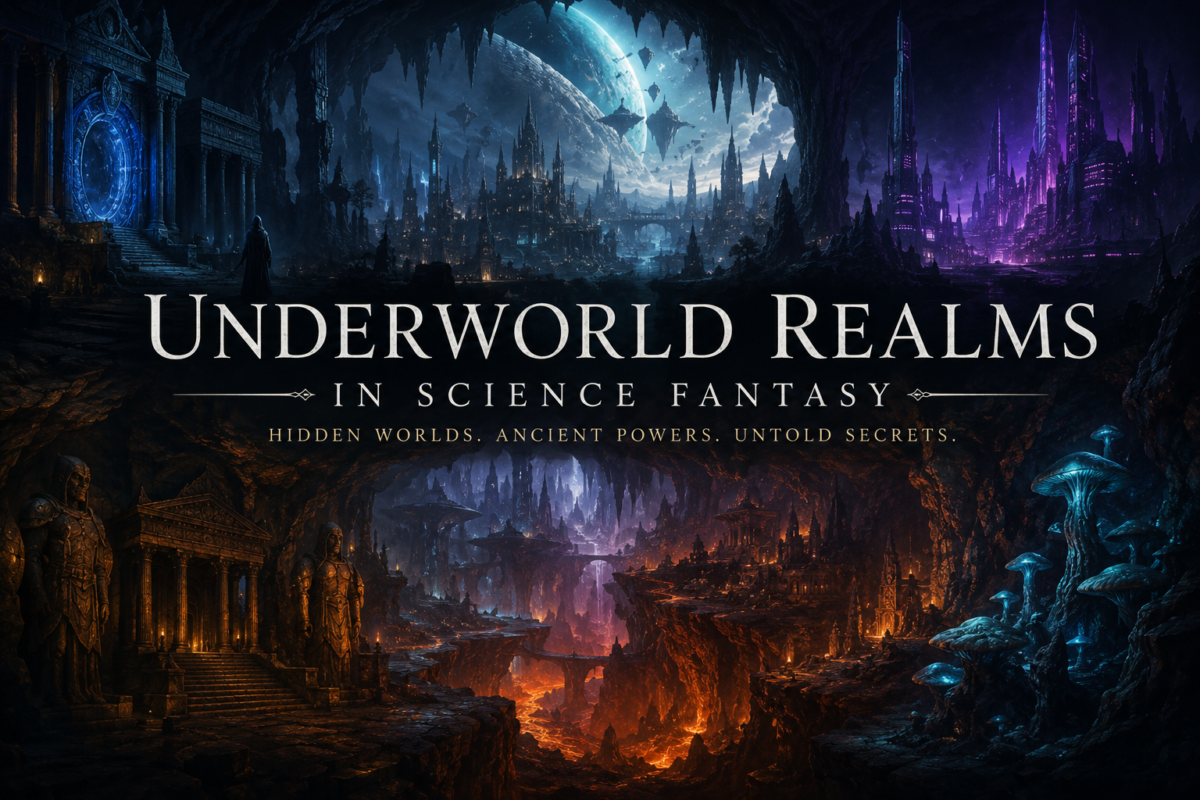
Underworld realms are some of the most powerful settings in science fantasy. They tap into primal human instincts—fear of darkness, awe of the unknown, reverence for what lies beneath—while also offering immense creative freedom. Whether your characters descend into endless caverns, navigate buried civilizations, or discover an entire hollow planet, these settings can become more than locations: they can shape culture, technology, religion, and myth.
This guide walks you through designing underworld realms that feel vast, alien, and believable—without sacrificing wonder.
1. Caverns as Living Systems, Not Empty Spaces
The biggest mistake in underground worldbuilding is treating caverns like empty dungeons. Real underworlds should feel alive.
Think in layers
Instead of one massive cave, imagine a vertical ecosystem:
Upper Caverns – Near-surface tunnels with airflow, fungi, insects, scavengers, and early settlements.
Mid-Depth Zones – Reduced oxygen, strange fauna, mineral forests, bioluminescent organisms, and ancient ruins.
Abyssal Depths – Extreme pressure, alien physics, sentient darkness, energy fields, or reality distortions.
Each layer should:
- Have its own resources
- Support different species
- Pose unique dangers
- Shape cultures differently
In science fantasy, you can justify this with geothermal gradients, alien biology, or exotic energies instead of strict realism.
2. Light as a Resource (and a Weapon)
Light is everything underground—and that gives you storytelling leverage.
Sources of light
Bioluminescent flora/fauna (fungal forests, glowing insects, living crystal reefs)
Artificial suns powered by ancient tech or magic-reactors
Energy veins running through the rock like glowing blood
Reflected surface light channeled through massive shafts or mirrors
Cultural consequences
- Light may be sacred, taxed, hoarded, or weaponized
- Darkness-dwelling species may see light as blinding or corruptive
- Some civilizations may never experience total darkness—or total light
- Ask yourself: Who controls illumination, and what happens when it’s taken away?
3. Subterranean Civilizations: Adaptation Shapes Culture
- Life underground forces evolution—biological, technological, and philosophical.
- Physical adaptations
- Pale or translucent skin
- Enlarged eyes—or no eyes at all
- Echolocation or vibration-based perception
- Symbiosis with glowing organisms
Societal differences
- Architecture carved vertically instead of horizontally
- Cities grown from crystal, fungus, or living stone
- Trade based on minerals, spores, heat, or energy rather than food
- Time measured by geothermal pulses, machine cycles, or ritual events
Underground cultures often value stability, memory, and tradition, because collapse is always one earthquake away.
4. Hollow Planets: The Ultimate Underworld
Hollow planets push science fantasy into mythic territory—and that’s a good thing.
Structural concepts
- A shell world with civilizations living on the inside surface
- A central artificial sun or gravity core
- Vast inner skies filled with floating continents
- Oceans clinging to the inner crust due to gravity manipulation
Why hollow planets work
You don’t need hard science perfection—just internal consistency. Possible explanations include:
Ancient megastructures built by extinct godlike beings
- Gravity-altering materials
- Reality-bending cosmic phenomena
- A planet that is actually an engineered habitat
Narrative potential
- Surface dwellers unaware of the world beneath
- Inner civilizations believing they live on the “true surface”
- Wars over access shafts or planetary engines
- The fear that the shell is cracking
A hollow planet isn’t just a setting—it’s a cosmic secret.
5. The Underworld as a Psychological Space
Underworld realms often mirror internal journeys.
- Descending underground can represent:
- Loss of innocence
- Confrontation with buried truths
- Separation from gods, stars, or authority
- A test before rebirth or transformation
Science fantasy excels when:
- Technology replaces myth, but symbolism remains
- Ancient machines are worshipped as gods
- Data vaults replace ancestral memory
- AI guardians take the role of underworld judges
If your world has myths, religions, or forbidden knowledge—put it underground.
6. Hazards Beyond Monsters
Monsters are expected. Environmental danger is more interesting.
Consider:
- Cave collapses triggered by sound or emotion
- Reality distortions caused by exotic minerals
- Time behaving differently at extreme depths
- Sentient geology that reacts to thought or blood
- Fungal plagues that rewrite DNA
The underworld should feel hostile but purposeful, as if it doesn’t want intruders—but tolerates those who adapt.
7. Making It Feel Vast
Scale is everything underground.
Use:
- Endless vertical shafts instead of flat tunnels
- Cities stacked like stalactites
- Ancient elevators descending for days
- Maps that are incomplete, contradictory, or forbidden
- Characters should never be certain how deep they truly are.
Final Thought: The Underworld Is a Worldbuilder’s Playground
Caverns, depths, and hollow planets let you blend:
- Myth and machinery
- Horror and beauty
- Ancient pasts and far futures
In science fantasy, the underworld isn’t just below—it’s beneath understanding. Design it with intention, and it will become one of the most memorable parts of your world.
Sign up for my Newsletter on the right side
Books to Read (Affiliate Links)
Creating Life – By Ralph Ellefson
The Art of World Building Workbook – By Ralph Ellefson
Fantasy World Building: A Guide To Developing Mythic Worlds and Legendary Creatures – By Mark Nelson
Get Curse of Kredaria for free