Building a Science Fantasy World Map From Star Systems to Magical Realms

Tips for mapping planets, space routes, and interdimensional realms

Creating a map is one of the most immersive ways to ground your science fantasy setting. But unlike traditional fantasy maps of kingdoms and mountains, science fantasy opens the doors to planetary systems, space lanes, dimensional rifts, and magical ley networks—all of which need to be visualized creatively.

This guide walks you through how to conceptualize and construct a map that encompasses stellar navigation and mystical terrain, giving your readers a sense of place across both time and dimension. I personally like the website Inkarnate to create maps, but I’m sure there are plenty of other map makers out there.

🌌 1. Start with the Macrocosm: Star Systems and Cosmic Geography

Before detailing continents or empires, zoom out.

  • How many star systems does your world span?
  • Are there major planets, moons, asteroid belts, or artificial satellites that matter to the plot? In my Zalonia books, there are five planets and three moons that orbit the main planet. There is also a space-like station floating around where a certain species is high tech and operate from.
  • What is the political and economic relationship between systems?
  • Use terms like: Coreworlds: Old, technologically advanced hubs of civilization.
    Frontier Systems: Lawless or uncharted space.
  • Void Corridors: Safe or dangerous navigable regions through hyperspace or aether.
  • Worldbuilding Tip: Create an astronavigational chart where trade routes, pirate ambush zones, and ancient ruins are mapped along space currents or magic-tides that flow between systems like oceanic currents.

🌍 2. Planetary Mapping: From Biospheres to Biomes

Once you define your key planets or moons, determine:

  • How big are they? For example, there is one planet closer to the sun that appears for the Zalonians. It is approximately the same size as the home planet but is much too hot for life. The fourth planet out is a little bigger than jupitar. The fifth planet out is about have the size of Aztharian (The home planet for Zalonia).
  • Are they terraformed or wild?
  • Do they follow normal laws of physics or are they magically altered?
  • You might include:
    • Floating continents powered by crystal levitation
    • Ring-shaped worlds orbiting mystic black holes
    • Tectonic ley lines that divide magic into hemispheres
    • Consider a hexagonal or radial map instead of the traditional rectangular layout if the planet is non-Euclidean or has warped gravity.

🌀 3. Mystical Realms and Interdimensional Territories

In science fantasy, magic may bleed into geography.

Questions to ask:

  • Are there planes of existence, dreamscapes, or mirror realms that overlap?
  • Do people travel through portals, spacefolds, or arcane gates?
  • Is time consistent across locations?
  • These could appear on maps as:
    • Dimensional rifts marked with ancient symbols
    • Magic “knots” where ley lines converge or intersect with dark matter
    • Eclipse Zones, where multiple realities overlap temporarily
    • Add color-coded dimensional overlays, showing boundaries that change depending on cosmic alignment.

🚀 4. Space Routes and Interplanetary Navigation

Time to chart the roads between stars.

Ideas:

  • Wormhole Beacons: Anchors for stable teleportation lanes
  • Startrails: Routes powered by magical propulsion
  • Pulse-Gates: Planet-sized machines that blink ships across space
  • Travel between worlds may depend on:
  • Aetheric Winds that blow through space
  • Solar tides generated by dying stars
  • Covenant Zones: Areas where ancient treaties forbid space magic
  • Use icons or trails to mark danger zones, “slipstreams,” and protected sectors.

🏛️ 5. Cultures, Factions, and Mythic Landmarks

Maps are political and cultural tools.

Include:

  • Capitals, ruins, academies, and forbidden zones
  • Temples aligned with constellations or magical fields
  • Cosmic nexuses controlled by rival empires or ancient beings
  • Layer mythological geography: places that exist only when moons align, or which appear once every century. These could be represented with fading glyphs or temporal grids.

🧭 6. Design and Artistic Style

Your map style should reflect your world’s tone.

Style choices:

  • Digital Holographic Grid: For sleek tech-magic hybrid settings
  • Astrological Star Charts: If your setting ties fate to the stars
  • Ancient Scrolls or Codices: For magical realms remembered by myths
  • Stone-carved Circular Maps: If your cultures view time cyclically
  • Include a legend for:

Dimensional zones

Types of transport routes (magic vs tech)

Symbols for guilds, empires, and anomalies

✍️ 7. Practical Uses in Storytelling

  • A good map does more than look cool—it serves narrative functions.
  • Let characters refer to it when planning a quest or jump
  • Use it as a mystery (an old version reveals a long-forgotten gate)
  • Create conflicting maps based on cultural perspective or secrecy
  • Drop clues on map margins: coordinates to a rogue moon, or a warning in an extinct language

Support Me on Patreon

Return To Home

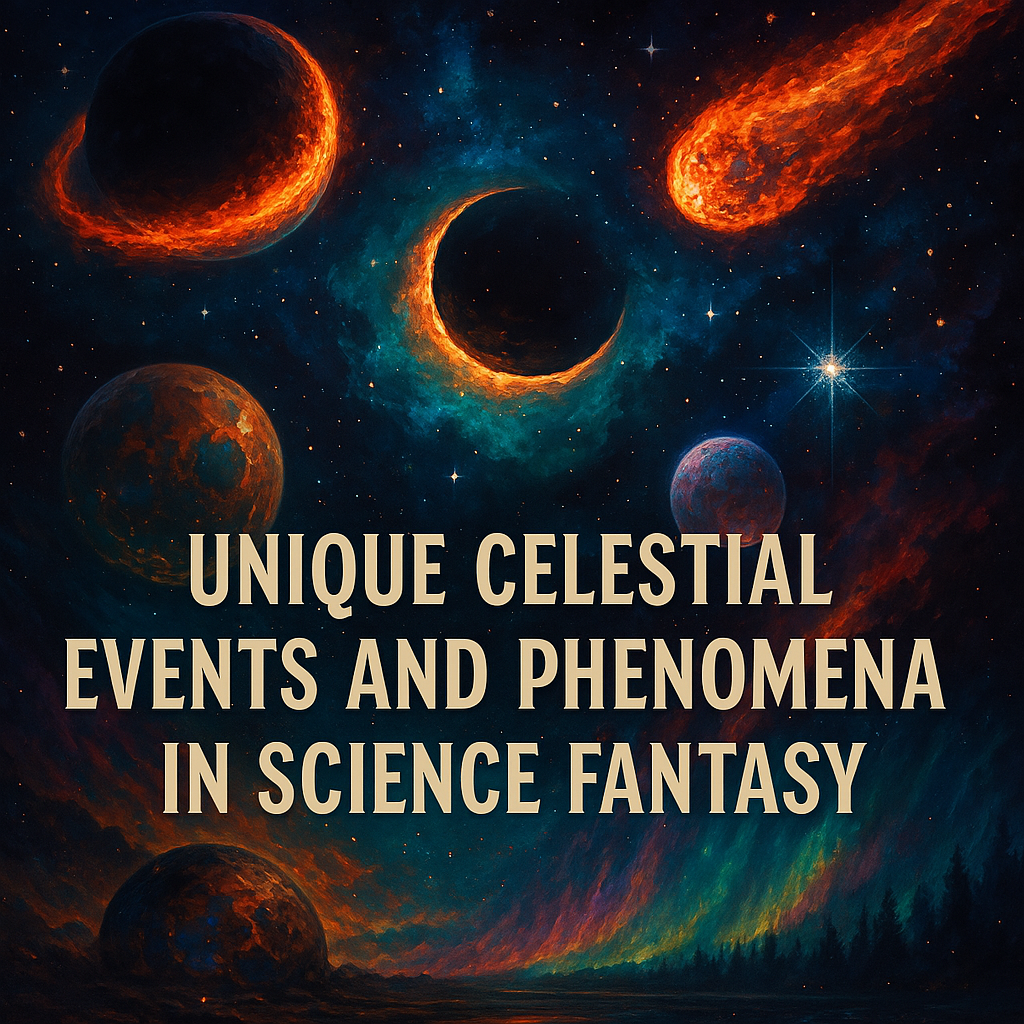
Unique Celestial Events and Phenomena in Science Fantasy

Unique Celestial Events and Phenomena in Science Fantasy

Brainstorming Ideas for Rare Cosmic Events and How They Impact Your World
In science fantasy, the cosmos is not just a backdrop—it’s a living, breathing participant in the drama of your story. Unlike hard science fiction, where astronomy sticks close to physics, science fantasy gives you the freedom to mix magic with astrophysics, mysticism with orbital mechanics, and divine prophecy with planetary alignment.

Here’s your guide to crafting rare, awe-inspiring, and deeply impactful celestial events—plus ways to let them shake your world to its core.

🌠 1. The Eclipse of Memory

Description: Once every thousand years, two moons overlap during an eclipse. Anyone caught under its shadow forgets one deeply held memory—random or otherwise. This is what happens in Zalonia every 163 years when the red moon eclipses the blue moon. Neutral magic is the most powerful while this is happening.

Impacts: Societies build “Memory Vaults” to protect knowledge and identity. The medes in Zalonia use this method when gaining knowledge that can be lost easily. Their magic users will often write certain amounts of history in a memory fault.

Secret cults intentionally expose themselves, believing forgetting is a divine rebirth.

Wars pause during the eclipse to avoid commanders forgetting critical strategies. An eclipse of the blue moon can cause memory lapses, and often soldiers will not fight during an eclipse like this because they will forget their strategy.

Prophecies suggest that when the eclipse causes the same person to forget the same thing twice, a forgotten god returns.

🌌 2. The Blood Comet

Description: A deep-red comet that appears only during planetary alignments, believed to be the egg of a cosmic serpent. In Zalonia, it represents one of the great beasts, the Lupian Gnawer. There are a total of 99 great beasts according to legend, and the lupian gnawer is bound to appear when this red comet is seen.

Impacts: The red comet’s passing can cause mutation in unborn children—sometimes blessed, sometimes cursed.

Cults believe drinking water touched by the comet’s light grants visions of the future or madness, or even both.

Alchemists harvest rare “comet dust” that temporarily enhances magic. The magical aspect weakens as time goes by and is usually unworkable within a week, so it has to be used quickly. Those who keep track of the red comet do so, so they can have magic users ready for when the comet appears.

Entire cities shut off their lights, fearing the comet might “choose” souls for abduction.

🌑 3. The Hollow Moon

Description: A seemingly normal moon occasionally opens like a flower, revealing an ancient spaceborne citadel within. It stays open for 13 days before sealing shut again. This is what the golden moon in Zalonia does every 45 years.

Impacts: Certain alien races and smugglers attempt to enter the citadel before it closes.

Arcane scholars such as medes believe the citadel is the last ark of a forgotten race. Some Zalonians think it leads to a universe that leads to our Earth.
Sometimes, people disappear during the event—and reappear decades later, unchanged.

Religious sects call it the “Womb of the Stars” and believe it’s the source of all magic.

🔮 4. Starfall Chorus

Description: Every few centuries, a rain of musical meteorites falls across the land. The stones sing in alien harmonies and are believed to be fragments of a dead god’s soul.

Impacts: In Zalonia, Bards, mystics, and sound-mages flock to the event to record the melodies, which are said to alter reality when performed. They can heal the sick and strengthen the magical abilities of magic users.

Pieces of the meteorites can power music-based spells or be forged into instruments that manipulate emotion.

Rival cities race to collect the most “songs” to gain cultural and magical supremacy.

There’s also a dark legend: if all meteor melodies are played at once, the god might be resurrected—or awaken something worse.

Perhaps Meteorite shows signify something in your world.

🪐 5. The Planetary Veil

Description: In Zalonia A rare alignment of the planets causes the magical fields of several planets to connect and form an invisible web, altering magic and gravity. This alignment generally happens every 1043 years.

Impacts: Gravity weakens or strengthens depending on location—allowing for floating cities or plummeting terrain. In fact, the celestial realm of Zalonia originated when this alignment happened, combined with the use of magic, it was able to continually float in the sky.

Spellcasters suddenly find their powers inverted or magnified. This can be both beneficial or harmful, depending on the mage. Sometimes, mages lead the way in a battle if they know the planets will align. This is because in battle their offensive magic can be enhanced.

A new form of magic—Webweaving—emerges, allowing manipulation of the cosmic threads. This is good for defensive magic because webs can be used for shielding.

Political factions blame each other for exploiting the veil, leading to tensions, revolutions, or war. These have led to smaller wars within Zalonia, but not with either of the great battles.

☄️ 6. The Reverse Supernova

Description: Instead of exploding outward, a star collapses in reverse, absorbing nearby light and energy, creating a sphere of “unlight.”

Impacts: Time slows down or even reverses near the event. The medes in Zalonia believe that this happened at some point in the distant pass and are afraid it could happen again. They have no way of predicting if and when it will happen. They are always concerned about this happening to their own sun.

An entire civilization is said to have “fallen in,” to the star, and their voices still echo across time. The medes try to record their voices when they echo but it is difficult to make out what they are saying.

“Unlight crystals” can be harvested from the region are used in temporal magic, black-market espionage tools, and anti-divination spells.
The Church of Chronos considers it a holy womb of rebirth, sending pilgrims in hopes of ascending.

🌟 7. The Wandering Star

Description: A rogue star drifts through space and communicates telepathically with sentient beings as it passes. Only the Sxions can hear it, which is frustrating for others around them because they have a difficult time elaborating on the whole communication. The Sxions are at the bottom of the pole when it comes to explaining stuff. They often find themselves frustrated and not being able to express what they witnessed.

Impacts: Those who hear its voice gain temporary cosmic knowledge, often going mad or ascending to become star-priests. A Sxion who hears these voices makes them go mad because they don’t know how to get rid of them.

Empires try to weaponize the star’s whisper, capturing it in psychic resonators. Many of those who want to go to battle believe that when a sxion hears voices believe that it is a good omen for them to go into battle.

Some beings are chosen as Starborn, marked by glowing skin and alien tongues. Perhaps in your world, one of the people gain extra power by hearing these voices. This could be especially interesting for a villian gaining power because of this.

Perhaps it is in the Prophecies that say the star is seeking a host, a vessel to become mortal. You could create a being who is almost invincible because they have gained the star’s power, which makes them hundreds or thousands times as strong.

8. The Lunar Migration

Description: Every 999 years, one of your world’s moons slowly detaches from its orbit and drifts across the sky to a new location.

Impacts: Cultures tied to lunar cycles experience chaos—rituals fail, gods fall silent, tides go wild. You could invent unique whether patterns from this chaos. Perhaps a pebble becomes unattached to the moon and hits your planet like a rainstorm. However, it would be much more dangerous than a rainstorm because the small rockets would have the power of a bullet shot out of a gun.

Moon-based civilizations go to war to prevent or accelerate the migration. Perhaps one civilization sees it as a good omen and figures that it might be a good time to go to battle. Others may believe it is bad luck, so they stay in their homes, too afraid to go anywhere.

The New Moon Orbit passes over uncharted lands, activating ancient relics or reawakening buried horrors.

Myths suggest that the moon is fleeing something… this could be used as a reason that it is going across the sky. Perhaps it is being chased by a mighty bird that wants to swallow it, but it is never fast enough to catch it.

✨ 9. The Aurora of Becoming

Description: A magical aurora, visible across multiple planets, that reshapes reality based on collective dreams. In my world of Zalonia, there is a Temple of Dreams that people go to to have their dreams interpreted. They have to close down the temple when beings such as dream wraiths start manifesting in the temple outside the dream. Sometimes people have collective dreams at the temple, which means something significant. For example, two people might have the dream of getting married, which may mean that they are supposed to marry each other. The dream world in Zalonia goes beyond the planet. It isn’t unusual for a dreamer at the Temple of Dreams to have a dream about another species on another planet. Sometimes these problems can only be solved in the dream itself because they can’t go to other worlds in the physical realm.

Impacts: For one night, everyone’s desires can subtly shift the world—for better or worse. Leaders often have these kinds of dreams at the Temple of Dreams, where they can shift the course of the world.

The “Dreamguard” exists to keep nightmares from becoming real. While I don’t have these at the Temple of Dreams, there are dream interpretors who stand by and may wake someone up if they appear to be having a distressful dream.

Criminals try to infiltrate dreamspaces, influencing events or implanting psychic weapons. Sometimes in Zalonia, a criminal will pretend to be a dream interpreter, but they use magic to get into the minds of the dreamer. They then can bend the dreamer to their will whether they want to steal someone or have someone murdered, but the crime not being associated with them.
Some claim the aurora is not a natural event, but a test from a higher plane—or the last defense of reality.

🧭 10. The Astral Drift

Description: The entire galaxy temporarily enters an “astral sea,” where souls, thoughts, and magic manifest in physical form. While to a smaller extend with the Temple of Dreams in Zalonia, especially for warriors with good fighting skills. They can dream of being on another planet and helping fight in a battle. The warrior often has to stay at the Temple of Dreams for several nights before the battle is over. Sometimes, more warriors will be called to the Temple of Dreams to help with battles in another world.

Impacts: Dreams become real, ghosts re-enter the world, and thoughts take shape. It’s not unusual in Zalonia for a dream to come true, especially among elves who seem to often get advice in dreams. In the Elements Penalogy, Xandria often has dreams that give guidance.

Space travel becomes impossible—ships sail through ideas instead of coordinates.

Pirates and prophets ride this wave to raid or reshape new realities.
The gods are silent—some say they are being reshaped by the minds of the living.

 Final Thoughts: Make Your Celestial Events Matter

Rare cosmic phenomena shouldn’t just look cool—they should affect people, belief systems, governments, and natural laws. A single event can:

  • Reshape the economy (think magic-meteor harvests).
  • Set off a cultural revolution.
  • Mark the rise or fall of empires.
  • Give birth to entire religions or mythologies.
  • Be the trigger for your entire plot.

The best celestial events blend mystery, danger, awe, and opportunity. Let them inspire wonder—and make sure your characters, cultures, and conflicts respond in meaningful ways.

Give birth to entire religions or mythologies.

Be the trigger for your entire plot.

The best celestial events blend mystery, danger, awe, and opportunity. Let them inspire wonder—and make sure your characters, cultures, and conflicts respond in meaningful ways.

Sign up for my Newsletter Here

Creating Life – By Ralph Ellefson

The Art of World Building Workbook – By Ralph Ellefson

Fantasy World Building: A Guide To Developing Mythic Worlds and Legendary Creatures – By Mark Nelson
Support Me on Patreon

Religion in Science Fantasy

Building Religions and Spiritual Beliefs in Science Fantasy: A World-Builder’s Guide

Religion and spirituality are powerful elements that shape civilizations, inspire conflict, and provide a sense of meaning in any world—whether real or fictional. In science fantasy, where technology and magic intertwine, belief systems can be even more complex, blending gods with cosmic forces, faith with science, and divine beings with interstellar travelers.

Crafting religions in a science fantasy setting allows for endless possibilities, from celestial deities ruling from deep space to mystical energy guiding civilizations. This episode explores how to create compelling religious structures, spiritual beliefs, and divine figures that enrich your world while maintaining internal logic. At times, I will use my own world of Zalonia.

1. The Foundations of Religion: Why Do They Exist?

Before diving into temples, rituals, or gods, consider why religion exists in your world. In both our world and fictional settings, religions typically arise to:

Explain the Unknown – People seek answers to life’s mysteries: Where did we come from? What happens after death? Why do celestial phenomena occur? In my Zalonia series, a race called the medes (eagle-like humanoids) are very interested in this aspect of religion. They want to have an explanation of everything, including how life came to be in the first place. While there is no set religion among the medes, they are still driven by curiosity.

Provide Moral Guidance – Religion often dictates ethics, laws, and customs, shaping societal structures. Another race called the frolm in my book are very tribal-like. They often have religious ceremonies that are customary for them. They also have laws that are based on religious ideas and acknowledge many gods.

Offer Comfort and Community – Faith can provide hope in dark times and unite followers under shared beliefs. In my world, Teh Sxion are very drawn to religion. While they are often a species that sometimes are homeless and without food, they pray to the gods to help them out. They often gather together for religious purposes and give each other support. They are taught to be peaceful creatures, unlike some of the frolm deities who like war.
Serve Political or Social Control – Religious institutions might wield power, influence kings, or act as ruling bodies themselves. In Zalonia, some of the human rulers use religion as a way to rule over people. There are also aliens called gnonows that disguise themselves as gods in order to manipulate the population.

Bridge Science and Mysticism – In science fantasy, a religion might attempt to explain natural phenomena using magic, divine intervention, or lost technology. The magic system of Zalonia is complex, but there are some people who pay homage to the gods in order to channel their powers through that god. Some of the medes use religion as a way to explain things that seem unexplainable.

How This Translates into Science Fantasy:


A post-apocalyptic civilization might worship ancient AI systems as gods.
A spacefaring empire could see black holes as divine entities consuming sinful souls. In Zalonia, black holes can’t be seen, but white holes sometimes show themselves as an explosion. The medes are aware of he possibility of black holes but can’t prove their existance.

A planet-bound species may believe in spirits that guide their evolution, using psionics (refers to the use of psychic abilities, such as telepathy and telekinesis instead of prayer. Some of the magic user in Zalonia use this method to get things done.

2. Types of Religions in Science Fantasy

There are many ways to structure a fictional religion, each with its own implications for your world.

1. Monotheism – One Supreme Being

A single god or force oversees the universe. There are some monotheists within the world of Zalonia. One of the most popular deities is referred to as the Creatrix. Some only pay homage to her, but others worship other individual gods. Some believe in an all-encompassing deity that is the center of attention. Some people think their god is the only one.

Example: A futuristic religion that worships the “Prime Light,” an ancient supernova that birthed their galaxy.

Questions to Ask:

Is this god distant or actively involved in daily affairs? Are the god(s) personal, even if there isn’t much evidence of their existence? Or perhaps they have no trouble showing themselves and are heavily involved in your world. There might be a universal belief that accompanies all the species, or perhaps different territories acknowledge different gods.

Does the god have prophets, chosen ones, or avatars? In the land of Zalonia, there are a few prophets, but they may or may not get their information from gods. In a lot of places, it is illegal to give a prophecy, but catastrophic consequences can come just upon knowing something is going to happen.

There is the story of a prophet warning the Creatrix that the child she would bear would cause her great problems. Upon hearing this, she tried to abort the child but failed, and the child escaped. Later, the child returned to take vengeance upon the Creatrix. If the Creatrix hadn’t been given the prophecy in the first place, she might not have tried to abort the child.

Does technology challenge or support this belief? Some people believe that modern science contradicts religion. As your world progressive, so some turn away from the idea of god and trust in their technology more. In Zalonia, many of the medes (An eagle-like person) often doesn’t put trust into any deity.

2. Polytheism – A Pantheon of Gods

Multiple deities exist, each governing different aspects of life.

Example: A celestial pantheon where each god is an ancient alien race that shaped different worlds. In my Pentalogy series the elves and most of the people believe that there are several Gods and Goddesses often connected to Celtic Mythology. The Celtic Gods only appear in the Fifth Age. In the Fourth \ge many people were polytheistic, but the gods often appeared to people which accounts for their beliefs. The frolm generally have their own set of gods that they acknowledge.

Questions to Ask:

Do these gods interact with mortals, or are they abstract forces? In Zalonia, the gods communicate with certain people if they want to send a message. Whether or not this message is received depends upon how much the people believe in the gods. If they don’t believe in the gods, then they usually ignore the messages. Many of the gods have their own agendas and aren’t exactly trustworthy.

Do rival deities cause conflict, mirroring real-world polytheistic mythologies? In Zalonia, there are rival deities, often some follow the Creatrix while others follow the Soul Chaser. There is also Syvania who remains by herself and isn’t really for or against other deities.

Are gods linked to real celestial bodies, like stars or planets? In Zalonia, the 9 ancient ones are seen in the primary nine constellations seen in the night sky. A few gods related to some of the planets and the stars depending on which culture you’re talking about.

3. Animism – Spirits in Nature

Every tree, river, or animal has a soul or a guiding force. In some ways, the frolm are animist because they believe their gods are connected with their trees, ponds, and rivers. They believe all these things bring them life and are gifts from their gods. The Quintum often view the sea as a type of deity that can be calm or wrathful. They pay homage to this god often when they are going to explore the seas. The quintum are a race in Zalonia with four arms who build the best ships in the world. They have gills and can remain underwater for a long time.

Example: A jungle-dwelling species believes spirits inhabit massive bioluminescent fungi that provide wisdom.

Questions to Ask:

Can people communicate with these spirits? In Zalonia, some of the races can speak with spirits. For example, elves can talk to animals and certain humans can communicate with the trees. The trees only seem to speak with the less fortunate of people.

Are spirits good, neutral, or dangerous? It’s likely that all three types are present. In Zalonia, it is often believed that those who follow the Creatrix are good, those who follow Syvania are neutral, and those who follow the Soul Chaser are bad. However, this is too much of a simplification of how things work, especially when it comes to the Soul Chaser. The Soul Chaser is only bad during the First Age due to his anger at the Creatrix.

4. Ancestor Worship – The Power of the Past

The souls of the dead influence the living, offering guidance or punishment.
Example: Space travelers seek blessings from ancient “Stellar Elders,” the digital consciousness of their ancestors stored in vast databases. The frolm often pay homage to their ancestors as they are a very tribal species.

Questions to Ask:

Are ancestors truly present (as AI, spirits, or ghosts), or is it just cultural tradition? The frolm in Zalonia give a high importance to ancesters and will communicate with them throughout their forest.

Can they intervene in mortal affairs?

Are certain bloodlines considered divine?

5. Cosmic Energy & The Force-Like Belief System

A universal force or energy connects all living things, shaping reality itself. Some of the eagle-like medes believe this, but not all, as many medes are atheists.

Example: The “Astral Stream,” an energy field that lets trained individuals channel power through meditation.

Questions to Ask:

Is this force sentient, or just an energy to be manipulated? In Zalonia wizards often believe their magic comes from a universal source. They don’t exactly understand it, but they believe their magic comes from somewhere.
Can anyone access it, or is it limited to an elite few?
Does science recognize its existence, or is it dismissed as superstition?

3. Religious Structures: Temples, Priests, and Rituals

Religions aren’t just beliefs; they come with places of worship, spiritual leaders, and daily practices that define a culture.

Temples and Sacred Spaces

Are places of worship cathedrals of glass and metal, or living trees infused with magic? In the Fifth Age of Zalonia there are temples raised to acknowledge the various gods.

Do temples float in orbit around gas giants, or are they hidden underground? In Zalonia, this is something that the medes are curious about when it comes to other planets. With their sharp eyes combined with telescopes they can see the moons of the two gas giants and believe that there is a possibility for life on a few of them. They aren’t absolutely sure, but it does seem like one of the moons has some kind of station.

Are sacred spaces tied to natural phenomena, like eclipses, planetary alignments, or magnetic fields? In Zalonia, the quintum have a gathering when there is a full eclipse in the middle of the day. They dance and sing and thank the gods for what they have.

Priests and Religious Leaders

Are there scholars, mystics, cyborgs, or warrior-monks? There are many of these in Zalonia. The medes are often seen as scholars and know a lot about religion, whether they believe it or not. There are mystics who seem to keep to themselves most of the time.

Do they possess divine powers, cybernetic implants, or lost technological knowledge? Some magic users in Zalonia rely on the divine to cast their magic spells, while others rely on a universal energy.

Is the priesthood open to all, or is it inherited through noble bloodlines? The priesthood in Zalonia, especially in the Fifth Age are often chosen by the people and have to go to the magic school in Magdad to learn how to connect with the deity that they are going to access this power from.
Common Religious Rituals

Pilgrimages – Followers must visit a sacred place to achieve enlightenment. Some religions in Zalonia believe that everyone must at least try to visit the Temple of Dreams within their life time.

Sacrifices or Offerings – Gifts to the gods range from blood rituals to energy donations. In the early ages, the frolm sacrificed their children to the God of War, but when one of the frolm stood up against it, they found it to be a pointless act and banned sacrifices.

Prophecy & Visions – Certain individuals foresee the future through divine intervention or genetic enhancements. In Zalonia, giving prophecies is generally frowned upon. This is because they could have a self-fulfilling prophecy if they know their future. The story of the Creatrix and the Soul Chaser reflect upon this some. The Creatrix was given a prophecy when was with child that the child would bring about great destruction. Because of this warning, she attempted to abort the child. However, the child came out alive and escaped. Later, when the Creatrix created everything, her child, known as the Soul Chaser came to her creation and reeked havoc. He wanted to get revenge on the Creatrix for trying to abort him. This story tells of why most prophets don’t give away their prophecies.

Rites of Passage – Coming-of-age ceremonies involving tests of faith, combat, or intellectual pursuit. In Zalonia, the frolm have coming of age ceremonies, especially when one becomes a warrior when they turn thirty.

4. Religion and Conflict: Holy Wars, Schisms, and Taboos

Religious belief often leads to division, conflict, and change.

Holy Wars & Religious Crusades

Do spacefaring empires wage war over divine mandates?
Do religious extremists seek to exterminate non-believers?
Is faith used to justify colonization of new planets?

In Zalonia there are some religious that teach that non-believers should exterminate non-believes. Fortunately, only a minority of people follow religions like this.

Schisms & Heresies

Has a prophet or rogue AI challenged the existing order?

Do certain sects see technology as divine, while others see it as blasphemy?
Have rebel priests formed underground movements to oppose religious corruption?

In Zalonia there have been prophets who have gone rogue, especially during the Great Battle of the First Age when the Soul Chaser was trying to get people on his side to stand up against the Creatrix. There are also rebel priests who have formed underground movements to oppose religious corruption, especially if these religions promote such thing as killing others for their gods. There have been minor conflicts where this has happened on Zalonia.

Sacred Taboos and Laws

Are certain sciences forbidden because they intrude upon divine realms?
Do people refuse to set foot on a planet because it is “holy ground”?
Are specific numbers, colors, or symbols considered lucky or cursed?
In Zalonia, the sciences are generally not forbidden, especially with the medes who want to use science in order to gain knowledge. The number 9 is considered a holy number in Zalonia. It took 99 days for the Creatrix to create the world. There are 99 cards in the Mystic Prophecy Cards. Nine appears in various other places too.

5. The Role of Religion in Everyday Life

A well-integrated religion influences:

Government & Law – Is it a theocracy? Does the ruling class claim divine authority? In Zalonia it generally depends on where a person lives. In certain areas, there are people who claim divine authority. The most notable one was when King Etan had taken over most of the continent in the Second Age. He thought it was his divine right to rule and convinced many to follow him because he offered great rewards do those that enforced his rule of law.

Technology & Science – Are advancements seen as holy, or heretical? Most medes see advancements as good things. However, there are people in Zalonia who think technology can build better weaponry so they don’t see technology as a good thing.

Daily Life & Superstitions – Are people expected to pray at sunrise, avoid flying ships on certain days, or carry religious artifacts? In Zalonia, it generally depends on where a person lives and the prominent religion of that area. In the grand city of Tarvon, it is a tradition for the people their to face west in prayer during sunrise and east during sunset. This may seem like the opposite of what they should do, but in Zalonia the sun rises in the west and sets in the east.

6. Unique Science Fantasy Religion Ideas

The Celestial Shepherds

A species of sentient beings believes their souls are reincarnated into stars.
Astronomers act as priests, reading constellations as messages from their ancestors.

In Zalonia, there are nine constellations that can be seen, and they aren’t made of the same material as stars are made of. Some people believe they are signs of certain things, such as prosperity and healing. Even the medes find them fascinating because they don’t sparkle like stars generally sparkle. They are also symbols of the Nine Ancient Ones, the deities that people believe everything came from.

The Biotech Cult

You could have Worshipers believe in “genetic purity”, bio-engineering their bodies to mimic divine forms.

Elders splice their DNA with “godly” genes harvested from ancient alien remains.

The Eternal Code

Perhaps there’s a religion based on sacred digital texts left behind by an ancient AI.

Or the faithful embed scripture into their neural implants and recite prayers in binary.

Final Thoughts: Crafting a Living Religion

A well-designed religion isn’t just a backdrop—it’s an active force in your world. It influences characters, cultures, conflicts, and progress. Ask yourself:
How does this religion shape daily life? In Zalonia, the frolm often recite prayers in the morning, midday, and at night. Some of the people pray at random times if they believe in any of the deities. The medes are known not to pray at all; even the ones who do believe in a god of some sort usually don’t pray to them.

What role does science or magic play in its beliefs? Some in Zalonia believe that the magic comes from the gods. This is sometimes true depending on the magic. There are religious studies at the school in Magdad that teach about the gods but these studies are not a requirement for graduation. The school believes it is up to the people for what they believe in.
Does faith bring people together, or divide them?

By blending science, spirituality, and culture, your world will feel richer, more immersive, and truly alive.

What unique religious beliefs exist in your science fantasy world? Share your ideas below!

Sign up for my Newsletter Here

Creating Life – By Ralph Ellefson

The Art of World Building Workbook – By Ralph Ellefson

Fantasy World Building: A Guide To Developing Mythic Worlds and Legendary Creatures – By Mark Nelson
Support Me on Patreon


Essential Writing Tools For Authors: A Comprehensive Guide

Writing Tools for authors Laptop

As a writer, having the right tools can significantly streamline your creative process, help you stay organized, and ultimately improve your writing. In today’s digital age, the variety of tools available can feel overwhelming. This post provides an overview of my personal toolkit, along with additional writing, editing, and design tools to consider. Whether you’re a novelist, screenwriter, or blogger, these tools offer diverse functionalities to help you accomplish your writing goals more efficiently.

1. Scrivener: A One-Stop Solution for Writers

Scrivener is my favorite tool when it comes to large-scale projects like novels and extensive world-building. Unlike most writing software, Scrivener is a one-time purchase, making it a cost-effective option. It excels in helping writers organize complex projects, from keeping track of characters and plot notes to structuring chapters and scenes. Scrivener’s corkboard feature allows you to visualize your work, giving you an overview of sections like chapters or scenes in a layout that resembles index cards pinned on a board. This feature is especially useful for writers who enjoy outlining or need to track multiple storylines.

Another standout feature of Scrivener is its publishing capabilities. When your book is ready, Scrivener can help format it for self-publishing platforms such as Amazon and Barnes & Noble. While it has a bit of a learning curve, the software is worth it for the extensive organizational and editing tools it provides.

Purchase Scrivener [affiliate link].

2. Microsoft Word: The Classic Choice

Microsoft Word is a staple in any writer’s toolkit and a versatile choice for various writing tasks. It’s particularly useful for short-form writing like essays, articles, and short stories, where extensive organization isn’t necessary. The Navigation Pane feature allows you to organize your content quickly, a helpful tool for longer documents.
One advantage of Microsoft Word is its compatibility with cloud storage via OneDrive, giving you 1 TB of space for automatic backups and easy access across devices. I started my writing journey with Word, and while I’ve since moved most of my projects to Scrivener, I still find Word invaluable for drafting and editing shorter pieces.

3. Google Docs: Collaboration Made Easy

Google Docs is an excellent choice for writers who collaborate with others or work across multiple devices. Its real-time editing and commenting features allow for seamless collaboration, making it perfect for co-authoring projects or receiving feedback. Additionally, Google Docs is cloud-based, meaning your work is automatically saved and accessible from anywhere with internet access.

While I am still exploring all Google Docs offers alongside Scrivener and Microsoft Word, I find it to be a valuable addition to my toolkit. For writers looking to share drafts or work with beta readers and editors, Google Docs’ collaborative features make the process smooth and efficient.

4. Additional Writing Programs to Explore

Beyond Scrivener, Microsoft Word, and Google Docs, several other writing programs cater to specific needs or budgets:

Apple Pages: A user-friendly, feature-rich option for Mac users.

LibreOffice Writer: An open-source, budget-friendly alternative to Word.

Final Draft: The industry standard for screenwriters, with specialized features for script formatting and scene management.

Ulysses: Another excellent tool for Apple users, particularly novelists, with a clean interface and distraction-free writing environment.

Evernote: A powerful tool for organizing research and notes, ideal for writers who need to track multiple sources or ideas in one place.

Each of these tools provides unique features tailored to various aspects of the writing process, from research to formatting. Trying a few of them can help you find the one that aligns best with your workflow and creative needs.

5. Inkarnate: Bringing Maps to Life

For fantasy writers and world-builders, maps can be a critical storytelling tool. Inkarnate is my go-to software for map-making, offering both free and paid versions with a wide range of features. Whether you’re creating a world overview, a city map, or the interior layout of a building, Inkarnate’s user-friendly interface and design options make it easy to bring your fictional worlds to life visually.

Other map-making tools to explore include:

Wonderdraft: Known for its detailed textures and stylized maps, perfect for fantasy worlds.

Campaign Cartographer 3: A professional-level tool with extensive customization for tabletop role-playing game maps.

Azgaar’s Fantasy Map Generator: A free, browser-based option for creating random maps with customizable elements.

6. World Anvil: Structured World-Building

World Anvil is an online tool designed for world-building, offering a structured way to organize your fictional universe. This tool helps you categorize elements like character biographies, histories, geographical features, and cultural details, making it invaluable for writers developing intricate worlds. World Anvil also offers tutorials to guide you through the world-building process, sparking new ideas and providing inspiration.
While not essential, World Anvil can add depth and coherence to your writing, helping you keep track of the complex details that make a world feel real. For writers creating expansive worlds with unique histories, World Anvil is an excellent organizational aid.

7. Grammarly: Your Editing Companion

Grammarly has become an essential tool in my writing process. It goes beyond simple grammar and spell-checking by suggesting improvements for tone, style, and clarity. Grammarly’s plagiarism checker is also beneficial, particularly for non-fiction writers, to ensure originality. I find Grammarly helpful during the self-editing phase before submitting drafts to an editor, as it catches errors I might have overlooked.

Grammarly offers a free version with basic editing tools, while the paid version provides advanced style suggestions and additional checks, making it well worth the investment.

8. ChatGPT: Your AI Writing Assistant

ChatGPT is an incredibly versatile tool for modern writers, providing support in areas ranging from brainstorming ideas to query letter preparation and overcoming writer’s block. The AI can help you outline stories, generate character backstories, or even draft marketing content like synopses. Both free and paid versions of ChatGPT offer unique benefits, allowing you to leverage AI to streamline your creative process.
In addition to writing assistance, ChatGPT can be used for research, asking questions, or clarifying concepts, making it an invaluable addition to any writer’s toolkit.

9. Image Editing Tools for Authors

For authors looking to create book covers, social media graphics, or promotional materials, image editing software is essential. Here are some popular tools:

Photoshop: Ideal for those with graphic design skills, Photoshop offers extensive customization and editing options. However, it can be expensive, with a subscription-based payment model.

GIMP: A free alternative to Photoshop, GIMP provides many of the same tools, making it a good choice for authors on a budget.

Canva: Canva is a user-friendly online tool with both free and paid versions. It offers templates and easy-to-use tools for creating social media graphics, promotional images, and even book covers. Canva’s library of stock photos and design elements makes it accessible to beginners and a great choice for quick projects.

10. Video Editing Software for Book Promotions

If you’re looking to create video ads or trailers for your books, video editing software can be a powerful asset. Some top choices include:

Adobe Premiere Pro: A professional-grade video editor with extensive features, though it requires a subscription.

Final Cut Pro X: A high-quality video editing tool for Mac users, known for its user-friendly interface and advanced editing capabilities.

DaVinci Resolve: Offers a free version with robust editing features, ideal for authors new to video production.

Lightworks: A lesser-known option with both free and paid versions, offering professional-grade video editing on a budget.

11. Pixabay and Free Stock Resources

For authors seeking free, high-quality images for book covers, blog posts, or promotional material, stock photo sites like Pixabay and Unsplash are invaluable. These sites offer royalty-free images that you can use without worrying about licensing fees, making them a practical choice for budget-conscious writers. Many of these images are also compatible with Canva and other design tools, simplifying the process of creating cohesive promotional content.

Conclusion

The right writing tools can greatly enhance your writing, editing, and publishing processes. From Scrivener’s robust organizational features to Grammarly’s editing support, each tool serves a unique purpose, allowing you to focus more on your creativity and less on logistics. Exploring different options is key to finding what suits your workflow best. My personal preferences lean towards Scrivener and Grammarly for the bulk of my work, but every writer has their own toolkit. Embrace the process of finding yours, and let these tools help bring your stories to life.

Sign up for my Newsletter Here

Books (Affiliate Links)

Creating Life – By Ralph Ellefson

The Art of World Building Workbook – By Ralph Ellefson

Fantasy World Building: A Guide To Developing Mythic Worlds and Legendary Creatures – By Mark Nelson
Support Me on Patreon

By my book, “Curse of Kredaria” for free at various websites.

Fantasy Science World Building Introduction

Welcome to the Wondrous World of Science Fantasy World Building!

Hello, fellow dreamers, creators, and world-builders! Welcome to Nate Foy’s Fantasy blog, a sanctuary where imagination meets science to craft the most mesmerizing realms you’ve ever ventured into. Whether you’re an aspiring writer, a seasoned world-builder, or simply a fan of fantasy, this blog aims to be your ultimate guide in creating worlds that are not just magical but also scientifically plausible.

Why Science Fantasy World-Building?

Fantasy world-building is an art and a science. It’s the canvas where we paint dragons soaring through crystalline skies; enchanted forests whisper secrets and civilizations of mythical beings thrive. But have you ever wondered how these fantastical elements interact with the laws of physics, astronomy, geology, and biology? That’s where this blog comes in. We’ll delve into the nitty-gritty of how to make your world not just fantastical but also believable.

What to Expect?

Here, we’ll explore a plethora of topics that will elevate your world-building skills to new heights:

Physics in Fantasy: How do the laws of physics bend when magic comes into play? What happens to gravity in a world with floating islands?

Astronomical Wonders: From designing celestial bodies to understanding the significance of cosmic events, we’ll make your world’s sky as intriguing as its land.

Geological Marvels: Learn how to create landscapes that are as diverse as they are magical. Think enchanted forests, volcanic terrains, and more!
Species and Ecology: Crafting the flora, fauna, and sentient beings that inhabit your world is no small feat. We’ll discuss how to make them biologically plausible yet utterly captivating.

However, with science fantasy, you can have an old-fashioned world full of swords, mythological creatures, etc. There can be people who live like they are in the 1800s but simultaneously have aliens and other science fiction creatures in their world.

Why Should You Listen to Me?

As a fiction author with a penchant for speculative fiction, I’ve spent years crafting my own science fantasy world. And now, I want to share all these insights with you. Each blog post will offer not only theoretical knowledge but also practical examples from my own world-building journey. I have spent a lot of time building my world and still have a long way to go. However, I have studied the idea of creating a science fantasy world.

Join the Adventure into the art of Science Fantasy World Building!

So, if you’re ready to embark on this exciting journey, make sure to subscribe and never miss an update. Together, we’ll explore, create, and, most importantly, dream. Because in fantasy world-building, the only limit is your imagination.

Welcome aboard, and let the world-building begin!

Sign up for my Newsletter on the right side

Books to Read(Affiliate Links)

Creating Life – By Ralph Ellefson

The Art of World Building Workbook – By Ralph Ellefson

Fantasy World Building: A Guide To Developing Mythic Worlds and Legendary Creatures – By Mark Nelson

Support Me on Patreon