Sign up for my Newsletter Here
Get Curse of Kredaria for free
Support Me on Patreon
Building Religions and Spiritual Beliefs in Science Fantasy: A World-Builder’s Guide
Religion and spirituality are powerful elements that shape civilizations, inspire conflict, and provide a sense of meaning in any world—whether real or fictional. In science fantasy, where technology and magic intertwine, belief systems can be even more complex, blending gods with cosmic forces, faith with science, and divine beings with interstellar travelers.
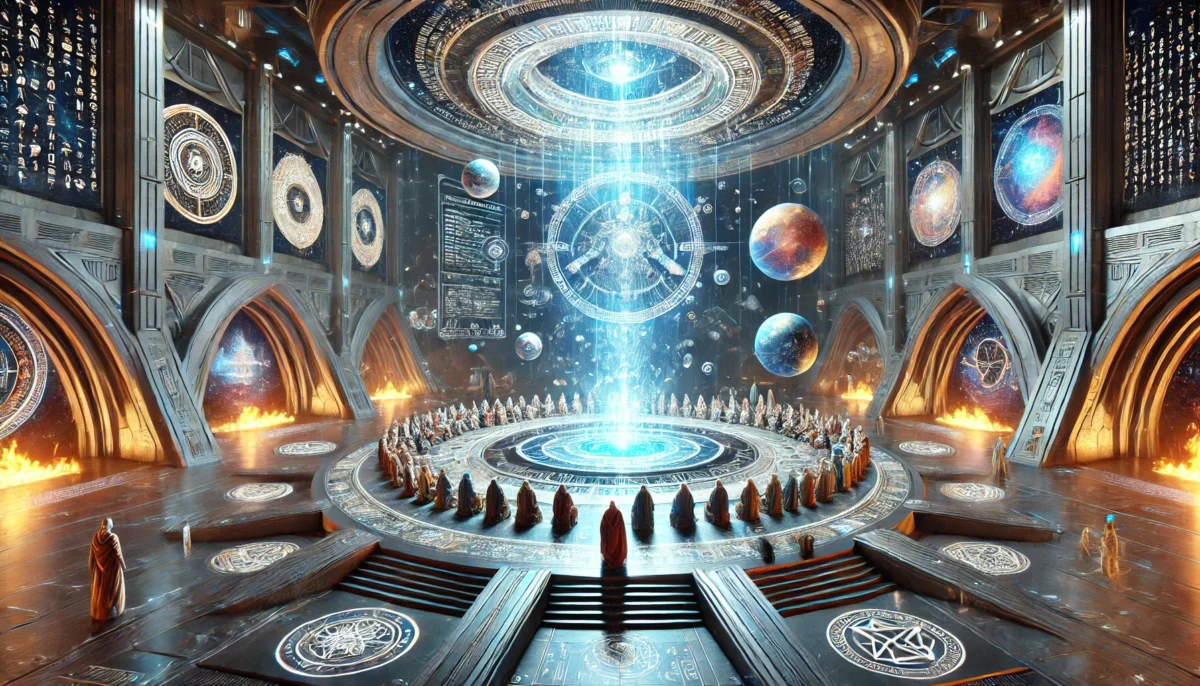
Crafting religions in a science fantasy setting allows for endless possibilities, from celestial deities ruling from deep space to mystical energy guiding civilizations. This episode explores how to create compelling religious structures, spiritual beliefs, and divine figures that enrich your world while maintaining internal logic. At times, I will use my own world of Zalonia.
1. The Foundations of Religion: Why Do They Exist?
Before diving into temples, rituals, or gods, consider why religion exists in your world. In both our world and fictional settings, religions typically arise to:
Explain the Unknown – People seek answers to life’s mysteries: Where did we come from? What happens after death? Why do celestial phenomena occur? In my Zalonia series, a race called the medes (eagle-like humanoids) are very interested in this aspect of religion. They want to have an explanation of everything, including how life came to be in the first place. While there is no set religion among the medes, they are still driven by curiosity.
Provide Moral Guidance – Religion often dictates ethics, laws, and customs, shaping societal structures. Another race called the frolm in my book are very tribal-like. They often have religious ceremonies that are customary for them. They also have laws that are based on religious ideas and acknowledge many gods.
Offer Comfort and Community – Faith can provide hope in dark times and unite followers under shared beliefs. In my world, Teh Sxion are very drawn to religion. While they are often a species that sometimes are homeless and without food, they pray to the gods to help them out. They often gather together for religious purposes and give each other support. They are taught to be peaceful creatures, unlike some of the frolm deities who like war.
Serve Political or Social Control – Religious institutions might wield power, influence kings, or act as ruling bodies themselves. In Zalonia, some of the human rulers use religion as a way to rule over people. There are also aliens called gnonows that disguise themselves as gods in order to manipulate the population.
Bridge Science and Mysticism – In science fantasy, a religion might attempt to explain natural phenomena using magic, divine intervention, or lost technology. The magic system of Zalonia is complex, but there are some people who pay homage to the gods in order to channel their powers through that god. Some of the medes use religion as a way to explain things that seem unexplainable.
How This Translates into Science Fantasy:
A post-apocalyptic civilization might worship ancient AI systems as gods.
A spacefaring empire could see black holes as divine entities consuming sinful souls. In Zalonia, black holes can’t be seen, but white holes sometimes show themselves as an explosion. The medes are aware of he possibility of black holes but can’t prove their existance.
A planet-bound species may believe in spirits that guide their evolution, using psionics (refers to the use of psychic abilities, such as telepathy and telekinesis instead of prayer. Some of the magic user in Zalonia use this method to get things done.
2. Types of Religions in Science Fantasy
There are many ways to structure a fictional religion, each with its own implications for your world.
1. Monotheism – One Supreme Being
A single god or force oversees the universe. There are some monotheists within the world of Zalonia. One of the most popular deities is referred to as the Creatrix. Some only pay homage to her, but others worship other individual gods. Some believe in an all-encompassing deity that is the center of attention. Some people think their god is the only one.
Example: A futuristic religion that worships the “Prime Light,” an ancient supernova that birthed their galaxy.
Questions to Ask:
Is this god distant or actively involved in daily affairs? Are the god(s) personal, even if there isn’t much evidence of their existence? Or perhaps they have no trouble showing themselves and are heavily involved in your world. There might be a universal belief that accompanies all the species, or perhaps different territories acknowledge different gods.
Does the god have prophets, chosen ones, or avatars? In the land of Zalonia, there are a few prophets, but they may or may not get their information from gods. In a lot of places, it is illegal to give a prophecy, but catastrophic consequences can come just upon knowing something is going to happen.
There is the story of a prophet warning the Creatrix that the child she would bear would cause her great problems. Upon hearing this, she tried to abort the child but failed, and the child escaped. Later, the child returned to take vengeance upon the Creatrix. If the Creatrix hadn’t been given the prophecy in the first place, she might not have tried to abort the child.
Does technology challenge or support this belief? Some people believe that modern science contradicts religion. As your world progressive, so some turn away from the idea of god and trust in their technology more. In Zalonia, many of the medes (An eagle-like person) often doesn’t put trust into any deity.
2. Polytheism – A Pantheon of Gods
Multiple deities exist, each governing different aspects of life.
Example: A celestial pantheon where each god is an ancient alien race that shaped different worlds. In my Pentalogy series the elves and most of the people believe that there are several Gods and Goddesses often connected to Celtic Mythology. The Celtic Gods only appear in the Fifth Age. In the Fourth \ge many people were polytheistic, but the gods often appeared to people which accounts for their beliefs. The frolm generally have their own set of gods that they acknowledge.
Questions to Ask:
Do these gods interact with mortals, or are they abstract forces? In Zalonia, the gods communicate with certain people if they want to send a message. Whether or not this message is received depends upon how much the people believe in the gods. If they don’t believe in the gods, then they usually ignore the messages. Many of the gods have their own agendas and aren’t exactly trustworthy.
Do rival deities cause conflict, mirroring real-world polytheistic mythologies? In Zalonia, there are rival deities, often some follow the Creatrix while others follow the Soul Chaser. There is also Syvania who remains by herself and isn’t really for or against other deities.
Are gods linked to real celestial bodies, like stars or planets? In Zalonia, the 9 ancient ones are seen in the primary nine constellations seen in the night sky. A few gods related to some of the planets and the stars depending on which culture you’re talking about.
3. Animism – Spirits in Nature
Every tree, river, or animal has a soul or a guiding force. In some ways, the frolm are animist because they believe their gods are connected with their trees, ponds, and rivers. They believe all these things bring them life and are gifts from their gods. The Quintum often view the sea as a type of deity that can be calm or wrathful. They pay homage to this god often when they are going to explore the seas. The quintum are a race in Zalonia with four arms who build the best ships in the world. They have gills and can remain underwater for a long time.
Example: A jungle-dwelling species believes spirits inhabit massive bioluminescent fungi that provide wisdom.
Questions to Ask:
Can people communicate with these spirits? In Zalonia, some of the races can speak with spirits. For example, elves can talk to animals and certain humans can communicate with the trees. The trees only seem to speak with the less fortunate of people.
Are spirits good, neutral, or dangerous? It’s likely that all three types are present. In Zalonia, it is often believed that those who follow the Creatrix are good, those who follow Syvania are neutral, and those who follow the Soul Chaser are bad. However, this is too much of a simplification of how things work, especially when it comes to the Soul Chaser. The Soul Chaser is only bad during the First Age due to his anger at the Creatrix.
4. Ancestor Worship – The Power of the Past
The souls of the dead influence the living, offering guidance or punishment.
Example: Space travelers seek blessings from ancient “Stellar Elders,” the digital consciousness of their ancestors stored in vast databases. The frolm often pay homage to their ancestors as they are a very tribal species.
Questions to Ask:
Are ancestors truly present (as AI, spirits, or ghosts), or is it just cultural tradition? The frolm in Zalonia give a high importance to ancesters and will communicate with them throughout their forest.
Can they intervene in mortal affairs?
Are certain bloodlines considered divine?
5. Cosmic Energy & The Force-Like Belief System
A universal force or energy connects all living things, shaping reality itself. Some of the eagle-like medes believe this, but not all, as many medes are atheists.
Example: The “Astral Stream,” an energy field that lets trained individuals channel power through meditation.
Questions to Ask:
Is this force sentient, or just an energy to be manipulated? In Zalonia wizards often believe their magic comes from a universal source. They don’t exactly understand it, but they believe their magic comes from somewhere.
Can anyone access it, or is it limited to an elite few?
Does science recognize its existence, or is it dismissed as superstition?
3. Religious Structures: Temples, Priests, and Rituals
Religions aren’t just beliefs; they come with places of worship, spiritual leaders, and daily practices that define a culture.
Temples and Sacred Spaces
Are places of worship cathedrals of glass and metal, or living trees infused with magic? In the Fifth Age of Zalonia there are temples raised to acknowledge the various gods.
Do temples float in orbit around gas giants, or are they hidden underground? In Zalonia, this is something that the medes are curious about when it comes to other planets. With their sharp eyes combined with telescopes they can see the moons of the two gas giants and believe that there is a possibility for life on a few of them. They aren’t absolutely sure, but it does seem like one of the moons has some kind of station.
Are sacred spaces tied to natural phenomena, like eclipses, planetary alignments, or magnetic fields? In Zalonia, the quintum have a gathering when there is a full eclipse in the middle of the day. They dance and sing and thank the gods for what they have.
Priests and Religious Leaders
Are there scholars, mystics, cyborgs, or warrior-monks? There are many of these in Zalonia. The medes are often seen as scholars and know a lot about religion, whether they believe it or not. There are mystics who seem to keep to themselves most of the time.
Do they possess divine powers, cybernetic implants, or lost technological knowledge? Some magic users in Zalonia rely on the divine to cast their magic spells, while others rely on a universal energy.
Is the priesthood open to all, or is it inherited through noble bloodlines? The priesthood in Zalonia, especially in the Fifth Age are often chosen by the people and have to go to the magic school in Magdad to learn how to connect with the deity that they are going to access this power from.
Common Religious Rituals
Pilgrimages – Followers must visit a sacred place to achieve enlightenment. Some religions in Zalonia believe that everyone must at least try to visit the Temple of Dreams within their life time.
Sacrifices or Offerings – Gifts to the gods range from blood rituals to energy donations. In the early ages, the frolm sacrificed their children to the God of War, but when one of the frolm stood up against it, they found it to be a pointless act and banned sacrifices.
Prophecy & Visions – Certain individuals foresee the future through divine intervention or genetic enhancements. In Zalonia, giving prophecies is generally frowned upon. This is because they could have a self-fulfilling prophecy if they know their future. The story of the Creatrix and the Soul Chaser reflect upon this some. The Creatrix was given a prophecy when was with child that the child would bring about great destruction. Because of this warning, she attempted to abort the child. However, the child came out alive and escaped. Later, when the Creatrix created everything, her child, known as the Soul Chaser came to her creation and reeked havoc. He wanted to get revenge on the Creatrix for trying to abort him. This story tells of why most prophets don’t give away their prophecies.
Rites of Passage – Coming-of-age ceremonies involving tests of faith, combat, or intellectual pursuit. In Zalonia, the frolm have coming of age ceremonies, especially when one becomes a warrior when they turn thirty.
4. Religion and Conflict: Holy Wars, Schisms, and Taboos
Religious belief often leads to division, conflict, and change.
Holy Wars & Religious Crusades
Do spacefaring empires wage war over divine mandates?
Do religious extremists seek to exterminate non-believers?
Is faith used to justify colonization of new planets?
In Zalonia there are some religious that teach that non-believers should exterminate non-believes. Fortunately, only a minority of people follow religions like this.
Schisms & Heresies
Has a prophet or rogue AI challenged the existing order?
Do certain sects see technology as divine, while others see it as blasphemy?
Have rebel priests formed underground movements to oppose religious corruption?
In Zalonia there have been prophets who have gone rogue, especially during the Great Battle of the First Age when the Soul Chaser was trying to get people on his side to stand up against the Creatrix. There are also rebel priests who have formed underground movements to oppose religious corruption, especially if these religions promote such thing as killing others for their gods. There have been minor conflicts where this has happened on Zalonia.
Sacred Taboos and Laws
Are certain sciences forbidden because they intrude upon divine realms?
Do people refuse to set foot on a planet because it is “holy ground”?
Are specific numbers, colors, or symbols considered lucky or cursed?
In Zalonia, the sciences are generally not forbidden, especially with the medes who want to use science in order to gain knowledge. The number 9 is considered a holy number in Zalonia. It took 99 days for the Creatrix to create the world. There are 99 cards in the Mystic Prophecy Cards. Nine appears in various other places too.
5. The Role of Religion in Everyday Life
A well-integrated religion influences:
Government & Law – Is it a theocracy? Does the ruling class claim divine authority? In Zalonia it generally depends on where a person lives. In certain areas, there are people who claim divine authority. The most notable one was when King Etan had taken over most of the continent in the Second Age. He thought it was his divine right to rule and convinced many to follow him because he offered great rewards do those that enforced his rule of law.
Technology & Science – Are advancements seen as holy, or heretical? Most medes see advancements as good things. However, there are people in Zalonia who think technology can build better weaponry so they don’t see technology as a good thing.
Daily Life & Superstitions – Are people expected to pray at sunrise, avoid flying ships on certain days, or carry religious artifacts? In Zalonia, it generally depends on where a person lives and the prominent religion of that area. In the grand city of Tarvon, it is a tradition for the people their to face west in prayer during sunrise and east during sunset. This may seem like the opposite of what they should do, but in Zalonia the sun rises in the west and sets in the east.
6. Unique Science Fantasy Religion Ideas
The Celestial Shepherds
A species of sentient beings believes their souls are reincarnated into stars.
Astronomers act as priests, reading constellations as messages from their ancestors.
In Zalonia, there are nine constellations that can be seen, and they aren’t made of the same material as stars are made of. Some people believe they are signs of certain things, such as prosperity and healing. Even the medes find them fascinating because they don’t sparkle like stars generally sparkle. They are also symbols of the Nine Ancient Ones, the deities that people believe everything came from.
The Biotech Cult
You could have Worshipers believe in “genetic purity”, bio-engineering their bodies to mimic divine forms.
Elders splice their DNA with “godly” genes harvested from ancient alien remains.
The Eternal Code
Perhaps there’s a religion based on sacred digital texts left behind by an ancient AI.
Or the faithful embed scripture into their neural implants and recite prayers in binary.
Final Thoughts: Crafting a Living Religion
A well-designed religion isn’t just a backdrop—it’s an active force in your world. It influences characters, cultures, conflicts, and progress. Ask yourself:
How does this religion shape daily life? In Zalonia, the frolm often recite prayers in the morning, midday, and at night. Some of the people pray at random times if they believe in any of the deities. The medes are known not to pray at all; even the ones who do believe in a god of some sort usually don’t pray to them.
What role does science or magic play in its beliefs? Some in Zalonia believe that the magic comes from the gods. This is sometimes true depending on the magic. There are religious studies at the school in Magdad that teach about the gods but these studies are not a requirement for graduation. The school believes it is up to the people for what they believe in.
Does faith bring people together, or divide them?
By blending science, spirituality, and culture, your world will feel richer, more immersive, and truly alive.
What unique religious beliefs exist in your science fantasy world? Share your ideas below!
Sign up for my Newsletter Here
Get Curse of Kredaria for free
Support Me on Patreon
Creating Life – By Ralph Ellefson
The Art of World Building Workbook – By Ralph Ellefson
Fantasy World Building: A Guide To Developing Mythic Worlds and Legendary Creatures – By Mark Nelson