Other Space Phenomena

Aetherlites

Aetherlites are other objects that can be seen using instruments like telescopes. The medes can see them with their eyes, which are seven times the strength of the human eye. They are light objects that orbit around the sun. They have a short lifespan of about 3,000 years for a really large one, to about 500 years for a small one. There is fear among medes that these objects could collide with Aztharian. In fact, some medes have predictions as to when one will hit. However, no one knows for sure because it is hard to tell where they are coming from, and each has a different orbit. They produce their own light source, and if one comes near the planet, even humans can see them with their naked eyes.

Glimmerglobes

These are objects that glow, but are smaller than the stars and planets. They are part of the solar system, but do not follow a particular path. There is some fear among the medes that one of these can collide with Aztharian and destroy the planet. However, the glimmerglobes have an antigravity aspect to them which is how they seem to avoid colliding with large bodies such as planets.

Skygleams/Shineliths

Skygleams/Shineliths are objects in the sky that appear similar to stars. However, they are low in gravity. Legend has it that the Nine Ancient Ones put them there as constellations to help give people directions. They do not twinkle like stars but hold a solid look. They are larger than the sun, but are at least a few light-years from the solar system. They are called both shineliths and skygleams, depending on which culture is talking about them.

Celestiorbs

Merging “celestial” with “orbs,” this term emphasizes their heavenly, spherical nature. They are beautiful if peering through an instrument. They are almost like crystals, and they give off their own light. They are different from the stars and are typically diamond-shaped. There are only three or four that can be seen in the night sky. It is believed to hold certain magical meaning, such as it is good to focus on a celestiorb when it is in the sky. The main magic it produces is that of healing. There are temples that have open ceilings so people can be healed through these space objects. Some high priests and priestess can access their magical properties, especially if their magical strength is in healing others.

Luminarocks:

A simple combination of “luminous” and “rocks,” indicating their glowing appearance and possibly lower density compared to normal stars. They can only be told apart from the stars due to their behavior. They are in the solar system, and while small, they have a strong glow to them. Once in a while, they will crash onto the planet, and magic users often grab the remnants. While the remnants can be used for magical purposes, the luminarocks have no magical qualities while they are up in the sky.

The dust gathered from them can enhance many magical abilities. It is often used in times of war, whether it is a defensive or an offensive war. A laser-like beam can be produced by the particles of luminarocks, and the laser is typically deadly. It is a great advantage to have luminarocks in war, but they are very hard to find.

Ethereospheres

Combining “ethereal,” which conveys a light, airy quality, with “spheres,” indicating their shape. They are the largest objects found in space, and there aren’t any in the same galaxy in the stories. They are bigger than galaxies, but they are so far away that their influence is minimal. They are not close enough to be able to work with in a magical sense. However, they appear in various shapes like triangles and circles. They are too far away to see with the naked eye, but the medes have found them using their devices to stretch how far they can see.

Radiant Stones

A more literal name that directly describes their appearance and nature. They are asteroids that glow, and they have their own irregular belt that is typically between Onog and Anohpmi, but they sometimes come closer. Sometimes, a Radiant Stone can go off course and crash on either. There are magical properties that give one the ability to temporarily disappear. They can also make one quieter when sneaking up on someone, so they can be used for this in times of war. They also work as lie detectors. The one accused of lying has to come before the stone, and if he is lying, then the stone glows. The larger stones, about 9 inches in diameter, can sometimes help a person teleport to a different part of Zalonia.

Sign up for my Newsletter Here

Creating Life – By Ralph Ellefson

The Art of World Building Workbook – By Ralph Ellefson

Fantasy World Building: A Guide To Developing Mythic Worlds and Legendary Creatures – By Mark Nelson

Support Me on Patreon

Wormholes in Zalonia

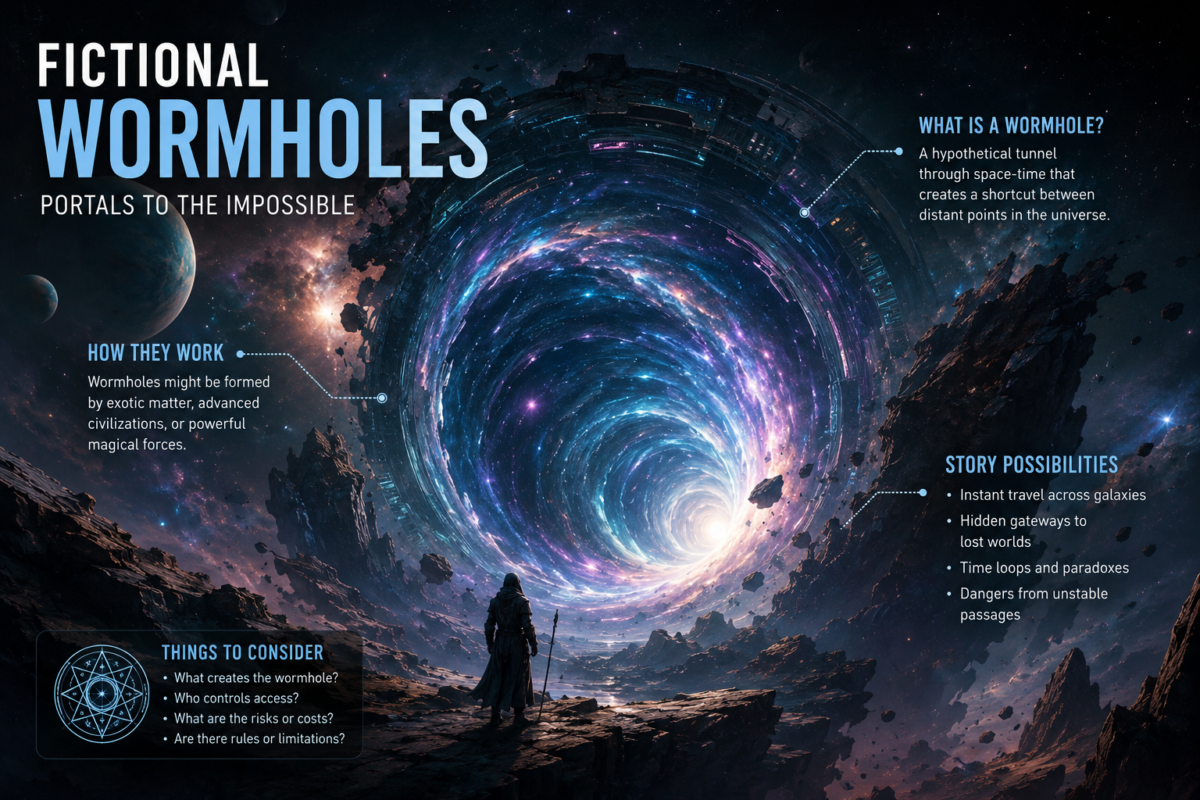
Wormholes are an important concept because they connect our world with the universe that the world Azthanian is part of. Apparently, they can only be held open by exotic matter. The Soul Chaser is the only one capable of creating a wormhole to our realm. There are alien races that can create wormholes to Zalonia, but not to Earth. Wormholes happen when two sheets of spacetime are joined together. A wormhole closes because of gravity, so there would be a need for “negative energy” to hold them open. Negative energy is behind the acceleration of the universe’s expansion. Some believe they may exist at the center of very bright galaxies. Matter coming out of one side of the wormhole would collide with matter going in, and this would cause a spectacular display of gamma rays.

Unlike a black hole, a wormhole would leak some of the gravity from the other side. There are weird “odd radio circles” in the sky. Some believe that black holes are a type of wormhole that leads to a white hole.

Exotic matter does not behave like gases, liquids, or solids. Extremely cold helium is one example of exotic matter. It is called superfluid helium, which is a liquid that can climb walls. It might be a key ingredient in making wormholes. Exotic matter that could be related to wormholes is matter with negative mass. Matter with negative mass would push other matter away from it. ‘

In Zalonia, there is an alien race known as the gnonows. They have a base on one of the satellites that float around the planet of Aztharian. In the back of this satellite, there is a wormhole that is consistently open, which allows the Gnonows to return to their home planet at will.

There are sometimes wormholes that open for other alien species, but they don’t stay open for long. They are usually made because the alien was experimenting around. They have to leave quickly because the wormhole won’t last long. There have been some aliens who have gotten trapped in Zalonia for not returning to the wormhole in time.

Sign up for my Newsletter Here

Creating Life – By Ralph Ellefson

The Art of World Building Workbook – By Ralph Ellefson

Fantasy World Building: A Guide To Developing Mythic Worlds and Legendary Creatures – By Mark Nelson

Support Me on Patreon

Inventing Tectonic Logic for a Science/Fantasy World

A science-fantasy worldbuilding guide

If your world has mountains, volcanoes, floating continents, shattered lands, or impossible geography, there’s an invisible question readers feel even if they don’t ask it:

Why does the world look like this? That’s where tectonic logic comes in.
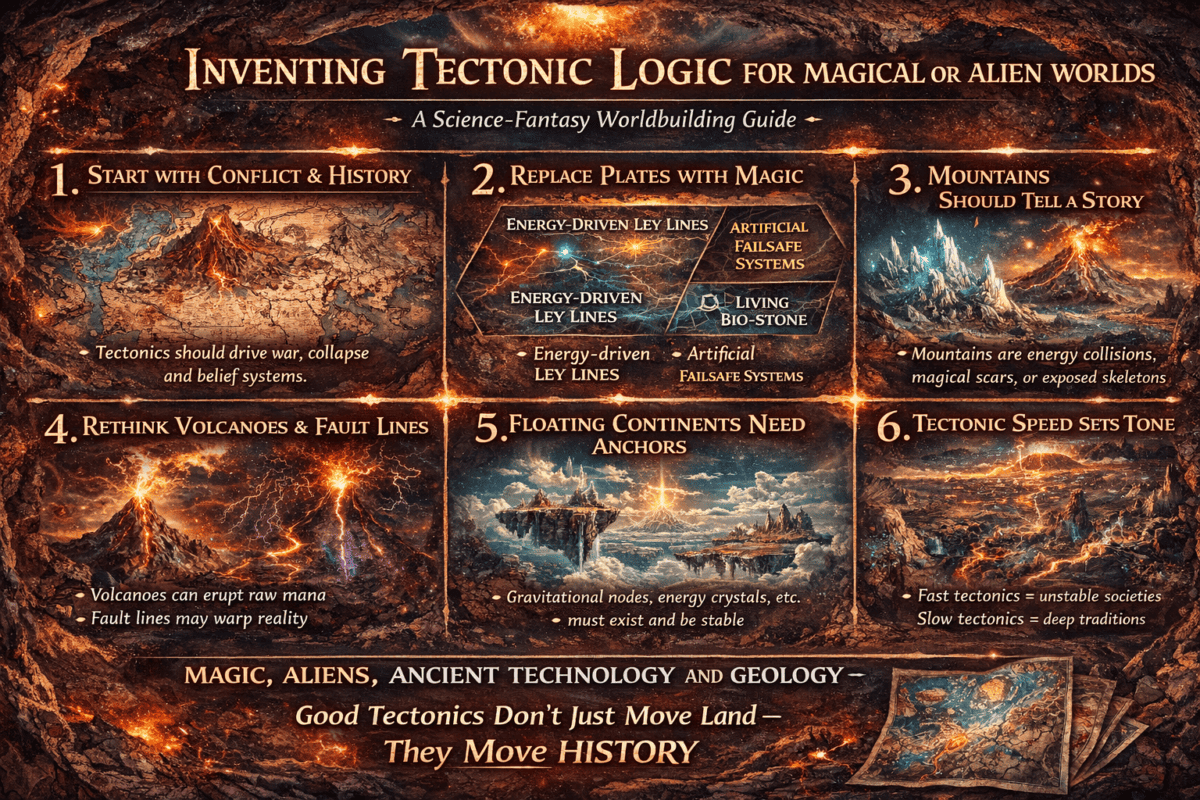
You don’t need Earth-style plate tectonics—but you do need an internal system that explains how landforms form, move, collide, break, or heal. In science fantasy, tectonics can be magical, alien, artificial, or alive. What matters is that they shape history, cultures, disasters, and myths in a consistent way.

This guide shows you how to invent tectonic logic that feels grounded—even when physics is optional.

1. Start with the Role Tectonics Play in Your Story

Before mechanics, ask a narrative question:

What problems does your planet’s geology create?

Tectonic systems are engines of conflict:

  • Earthquakes that destroy empires
  • Continents drifting apart culturally and politically
  • Volcanic zones powering civilizations
  • Sacred fault lines dividing belief systems

If tectonics don’t affect history, trade, religion, or war, they’ll feel decorative instead of foundational.

2. Replace Plates with Something More Interesting

Earth uses rigid plates floating on a molten mantle. Your world doesn’t have to.

Here are alternative tectonic frameworks that work especially well in magical or alien settings:

A. Energy-Driven Tectonics

Instead of heat and pressure, movement is caused by:

  • Ley lines
  • Planetary mana currents
  • Exotic particles or cosmic radiation
  • Where energy converges:
  • Mountains rise
  • Reality thins
  • Cities flourish—or collapse
  • Where energy drains:
  • Land sinks
  • Deserts spread
  • Civilizations die

This lets geology respond to magic usage, not just time.

B. Living Tectonics

The planet itself is alive—or hosts something that is.

Examples:

  • A world-beast whose muscle shifts continents
  • Crust made of regenerative bio-stone
  • Fault lines acting like nerves
  • Earthquakes become:
  • Pain responses
  • Immune reactions
    Signs of illness or awakening

This turns geology into a character, not a background system.

C. Artificial or Engineered Tectonics

Ancient builders may have shaped the planet intentionally.

Possibilities:

  • Planetary stabilizers holding continents in place
  • Gravity anchors buried beneath landmasses
  • Failsafe collapse systems
  • Over time:
  • Maintenance fails
  • Knowledge is lost
  • “Natural disasters” are actually system errors

This is especially effective for hollow worlds, ringworlds, or post-precursor settings.

3. Mountains Should Tell a Story

Mountains aren’t random. They’re scars, pressure points, or growths.

Ask:

  • Do mountains form where energies collide?
  • Are they crystallized magic overflow?
  • Are they the exposed skeleton of the planet?
  • Different origins create different cultures:
  • Mountain peoples near energy convergence may develop mysticism
  • Volcanic societies may worship renewal and destruction
  • Floating mountain chains imply unstable gravity zones

A good rule: If you move the mountains, history must change.

4. Rethink Volcanoes and Fault Lines

In science fantasy, volcanoes don’t need magma.

They might erupt:

  • Raw mana
  • Living crystal
  • Nanotech ash
  • Reality-distorting energy
  • Alien spores
  • Fault lines could be:
  • Borders between dimensions
  • Zones of time distortion
  • Magical pressure valves
  • Civilizations would:
  • Build temples there
  • Harvest energy
  • Avoid them entirely
  • Weaponize eruptions
  • A “Ring of Fire” might be a Ring of Power, fiercely contested and mythologized.

5. Floating Continents Need Anchors

If land floats, something holds it there.

  • Possible anchors:
  • Gravitational nodes
  • Magnetic crystal lattices
  • Orbital resonance points
  • Planetary consciousness
  • These anchors become:
  • Strategic military targets
  • Religious pilgrimage sites
  • Points of catastrophic failure

Floating tectonics should still obey rules. Islands drift, collide, decay, or fall—just on different timescales.

6. Geological Time Doesn’t Have to Be Slow

Earth’s tectonics work over millions of years. Yours don’t have to.
In magical or alien worlds:

  • A century can reshape continents
  • Wars can crack the crust
  • Rituals can raise islands overnight
  • But consistency matters:
  • Fast tectonics = unstable societies
  • Slow tectonics = deep traditions and long memory
  • Match geological speed to narrative tone.

7. How Tectonics Shape Belief Systems

People explain geology long before they understand it.

  • Tectonic logic naturally creates:
  • Earth gods and sky gods
  • Myths of punishment or blessing
  • Sacred mountains and forbidden rifts
  • Prophecies tied to seismic events

Even if some characters know the truth, most won’t—and that tension is powerful.

8. Maps Should Reflect Your Logic

When drawing maps, ask:

  • Why are these continents shaped this way?
  • Why is this desert here?
  • Why does this ocean exist?

If you can explain every major feature using your tectonic system, your world will feel cohesive, not accidental.

You don’t need realism—you need cause and effect.

Final Thought: Tectonics Are Invisible Worldbuilding Muscle

Readers may never consciously analyze your planet’s geology—but they’ll feel when it’s missing.

  • Invented tectonic logic:
  • Grounds fantastical visuals
  • Generates organic conflict
  • Makes worlds feel ancient and alive

In science fantasy, tectonics don’t just move land. They move history.

Support Me on Patreon

Return to my Home Page

Balancing High-Tech and Low-Tech Cultures in Your World

A guide to creating societies that vary in technological advancement and magical reliance.

In science fantasy worldbuilding, few things are more fascinating than the collision of worlds: spacefaring civilizations wielding advanced AI-powered technology alongside mystic clans who divine truth through runes and spirit walks. The tension between high-tech and low-tech cultures can create dynamic storytelling, rich conflict, and layered world development—but it requires careful balance.

In this guide, we’ll explore how to design technologically varied cultures that coexist (or clash) within your universe.

⚙️ 1. Define the Axes of Advancement: Technology vs. Magic

Start by imagining two major axes that define the civilizations in your world:
Technological Advancement: From stone tools to quantum computing

Magical Reliance: From completely non-magical to fully mystic-dependent

Not every high-tech society needs to dismiss magic—and not every tribal group needs to be ignorant of it. In fact, some of the most interesting cultures exist in the overlap, like:

  • A tribal caste that binds spirits into energy weapons
  • A planetary empire with hyperdrives fueled by ley-line energy
  • A monastic society that controls nanotech through ceremonial chants

This allows for a spectrum of development that keeps things nuanced and compelling.

🧭 2. Geographic and Cosmic Distribution

Just like on Earth, the level of technological or magical advancement in a society may be influenced by:

Geography: Isolated societies may rely more on spiritual knowledge and oral traditions, while trade-hub cities develop tools, machines, or weaponry.

Cosmic Conditions: Some planets may block magical fields, while others are steeped in arcane energies that fry electronics.

Historical Events: Was there a techno-magical war that caused some civilizations to retreat to simpler ways of life?

Think about resource availability, climate, and interplanetary relations to explain disparities.

🧙‍♂️ 3. Cultural Identity Through Tech or Magic
Societies often define themselves through their dominant toolset:

Culture Type: High-Tech Rationalists
Description: Distrust magic; value logic, science, computation
Example: A planetary government run by a central AI council

Culture Type: Mystical Guardians
Description: Protect ancient magical sites; reject machines
Example: A forest realm ruled by druids who manipulate time

Culture Type: Hybrid Cultures
Description: Blend ancient rites with future-tech                                          Example: A desert tribe that channels sand spirits through nano-glass tablets

Culture Type: Post-Apocalyptic Mystics
Description: Use scavenged tech as relics in sacred rituals
Example: Wasteland nomads who “worship” a satellite array as a divine voice

Culture isn’t just about tools—it’s about beliefs, values, and fears. Use these as your foundation.

⚔️ 4. Sources of Tension and Cooperation

Creating conflict (or uneasy alliances) between different levels of development adds drama:

Possible Conflicts:

High-tech invaders seek to “uplift” low-tech societies, causing spiritual and ethical unrest

Low-tech zealots see machines as corrupting forces and sabotage them
A magical caste controls information flow to keep others in check, resisting “progress”

Possible Collaborations:

A technomage who studies both runes and circuitry

A low-tech society that possesses a forgotten superweapon, requiring outsiders to seek their guidance

Shared enemies that force alliances between clashing worldviews

This tension allows you to explore themes of colonialism, spiritual preservation, innovation, and mutual misunderstanding.

🧩 5. Communication and Misinterpretation

Different levels of advancement mean different ways of speaking, thinking, and perceiving the world:

  • A shaman may interpret starship exhaust as divine smoke
  • A scientist may dismiss an enchantment as “localized anomaly”
  • A translator may mistranslate a simple greeting into a declaration of war

You can use these gaps in understanding to create rich scenes full of dramatic irony, confusion, and unexpected bonding.

🪐 6. Story Hooks and Worldbuilding Opportunities

Here are some ideas to spark inspiration:

The Code That Casts Spells: A civilization discovers that programming language accidentally taps into magical currents.

The Last Spellsmith: A lost low-tech people hold the only key to reawakening a starmap long thought dead.

Ascension Divide: An empire of high-tech immortals outlaws magic, driving sorcerers into rebellion.

Magical Conduits: A low-tech society lives on a ley-line hub that powers faster-than-light ships, giving them political leverage.

🛠️ 7. Tips for Balancing Believability

Give both sides strengths and flaws: Don’t make high-tech = superior and low-tech = primitive. Each should shine in its own way.

Avoid stereotypes: Tribal doesn’t mean ignorant. Scientific doesn’t mean soulless.

Design trade networks: Let these societies need each other—maybe one offers alchemical ingredients while the other provides medical bots.

Let characters bridge the gap: Introduce people who straddle both worlds—a hacker who became a druid, a golem-tamer who joins a space crew, etc.

Support Me On Patreon

Buy “Creating Life” – Affiliate Link

Return to Home

Building a Science Fantasy World Map From Star Systems to Magical Realms

Tips for mapping planets, space routes, and interdimensional realms

Creating a map is one of the most immersive ways to ground your science fantasy setting. But unlike traditional fantasy maps of kingdoms and mountains, science fantasy opens the doors to planetary systems, space lanes, dimensional rifts, and magical ley networks—all of which need to be visualized creatively.

This guide walks you through how to conceptualize and construct a map that encompasses stellar navigation and mystical terrain, giving your readers a sense of place across both time and dimension. I personally like the website Inkarnate to create maps, but I’m sure there are plenty of other map makers out there.

🌌 1. Start with the Macrocosm: Star Systems and Cosmic Geography

Before detailing continents or empires, zoom out.

  • How many star systems does your world span?
  • Are there major planets, moons, asteroid belts, or artificial satellites that matter to the plot? In my Zalonia books, there are five planets and three moons that orbit the main planet. There is also a space-like station floating around where a certain species is high tech and operate from.
  • What is the political and economic relationship between systems?
  • Use terms like: Coreworlds: Old, technologically advanced hubs of civilization.
    Frontier Systems: Lawless or uncharted space.
  • Void Corridors: Safe or dangerous navigable regions through hyperspace or aether.
  • Worldbuilding Tip: Create an astronavigational chart where trade routes, pirate ambush zones, and ancient ruins are mapped along space currents or magic-tides that flow between systems like oceanic currents.

🌍 2. Planetary Mapping: From Biospheres to Biomes

Once you define your key planets or moons, determine:

  • How big are they? For example, there is one planet closer to the sun that appears for the Zalonians. It is approximately the same size as the home planet but is much too hot for life. The fourth planet out is a little bigger than jupitar. The fifth planet out is about have the size of Aztharian (The home planet for Zalonia).
  • Are they terraformed or wild?
  • Do they follow normal laws of physics or are they magically altered?
  • You might include:
    • Floating continents powered by crystal levitation
    • Ring-shaped worlds orbiting mystic black holes
    • Tectonic ley lines that divide magic into hemispheres
    • Consider a hexagonal or radial map instead of the traditional rectangular layout if the planet is non-Euclidean or has warped gravity.

🌀 3. Mystical Realms and Interdimensional Territories

In science fantasy, magic may bleed into geography.

Questions to ask:

  • Are there planes of existence, dreamscapes, or mirror realms that overlap?
  • Do people travel through portals, spacefolds, or arcane gates?
  • Is time consistent across locations?
  • These could appear on maps as:
    • Dimensional rifts marked with ancient symbols
    • Magic “knots” where ley lines converge or intersect with dark matter
    • Eclipse Zones, where multiple realities overlap temporarily
    • Add color-coded dimensional overlays, showing boundaries that change depending on cosmic alignment.

🚀 4. Space Routes and Interplanetary Navigation

Time to chart the roads between stars.

Ideas:

  • Wormhole Beacons: Anchors for stable teleportation lanes
  • Startrails: Routes powered by magical propulsion
  • Pulse-Gates: Planet-sized machines that blink ships across space
  • Travel between worlds may depend on:
  • Aetheric Winds that blow through space
  • Solar tides generated by dying stars
  • Covenant Zones: Areas where ancient treaties forbid space magic
  • Use icons or trails to mark danger zones, “slipstreams,” and protected sectors.

🏛️ 5. Cultures, Factions, and Mythic Landmarks

Maps are political and cultural tools.

Include:

  • Capitals, ruins, academies, and forbidden zones
  • Temples aligned with constellations or magical fields
  • Cosmic nexuses controlled by rival empires or ancient beings
  • Layer mythological geography: places that exist only when moons align, or which appear once every century. These could be represented with fading glyphs or temporal grids.

🧭 6. Design and Artistic Style

Your map style should reflect your world’s tone.

Style choices:

  • Digital Holographic Grid: For sleek tech-magic hybrid settings
  • Astrological Star Charts: If your setting ties fate to the stars
  • Ancient Scrolls or Codices: For magical realms remembered by myths
  • Stone-carved Circular Maps: If your cultures view time cyclically
  • Include a legend for:

Dimensional zones

Types of transport routes (magic vs tech)

Symbols for guilds, empires, and anomalies

✍️ 7. Practical Uses in Storytelling

  • A good map does more than look cool—it serves narrative functions.
  • Let characters refer to it when planning a quest or jump
  • Use it as a mystery (an old version reveals a long-forgotten gate)
  • Create conflicting maps based on cultural perspective or secrecy
  • Drop clues on map margins: coordinates to a rogue moon, or a warning in an extinct language

Support Me on Patreon

Return To Home