Sign Up For My Newsletter on the right
Get Curse of Kredaria for free
BASIC
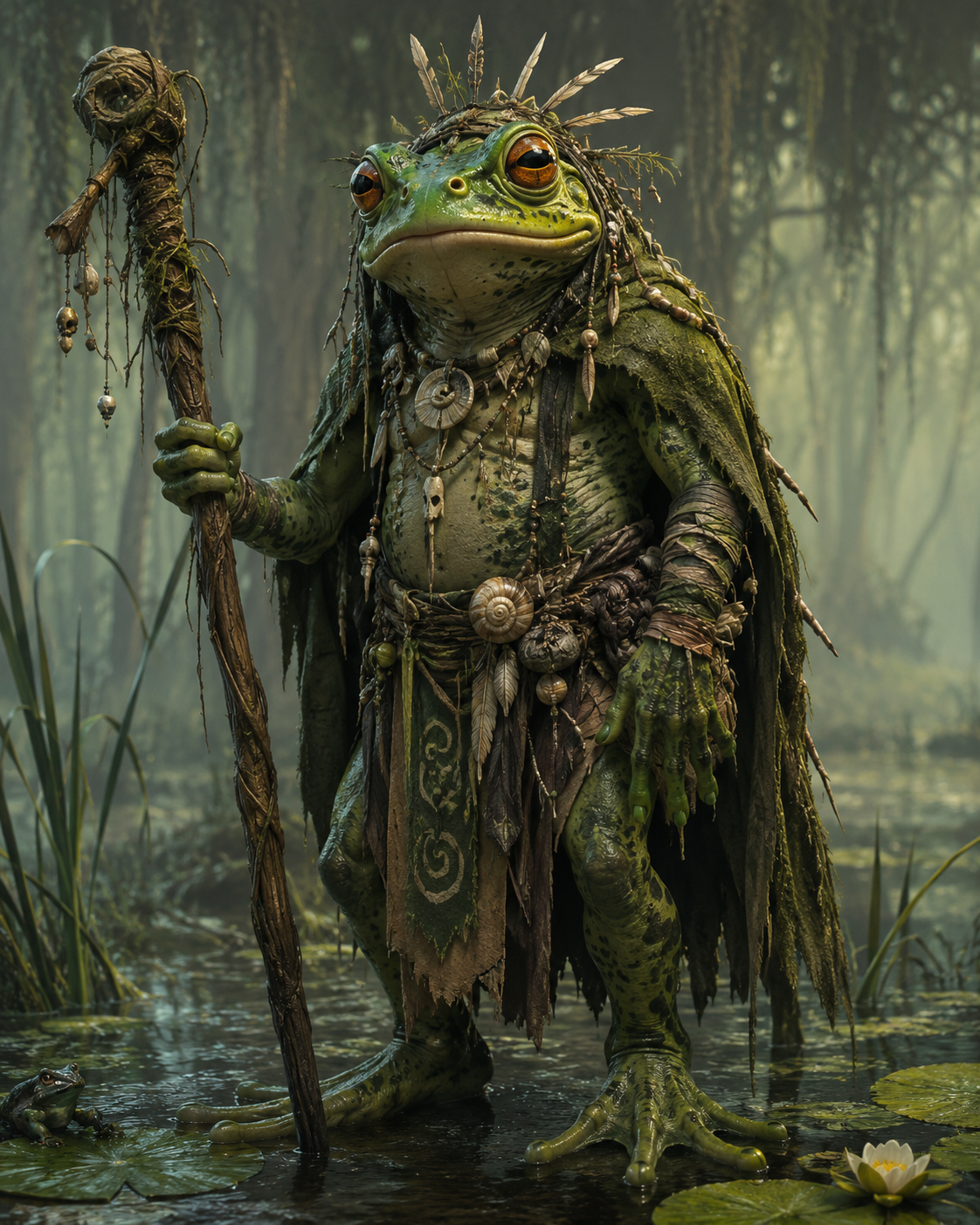
The frolm are Frog/human like creatures that live among the Great Frolm Forest and sometimes in tall trees. They can leap 20 feet into the air on average and have no problem climbing trees because they can easily leap up to the branches. The highest one has ever jumped is about 30 feet. They use many strange rituals in worshiping their gods. They blend in with their surroundings giving them much advantage against enemies.
Their skin is green and scaly like a frog. The men can grow beards when they get older and many of the frolm leaders grow them.
CHILDREN
In normal times, each frolm couple is allowed to have two children. There are exceptions given to have three to help keep the population even as some don’t have any or one. Pregnancy usually lasts about five months. Frolm are considered children until they are about thirty. Children are not allowed to leave the Great Frolm Forest due to the dangers on the outside. They often play with toys made of wood such as figurines. Some children treat these figurines like they are sacred. A child’s opinion is generally respected among the frolm, as their children are fast learners and smart.
FOOD
Frolm eat vegetables and large bugs, and their favorite snack is maple-covered grasshoppers cooked over a fire. They only need to eat every two or three days. They can go without eating for weeks and survive, perhaps up to 80 days with no food. They need water, though, and can’t survive for long if they are not well hydrated. The Great Frolm Forest provides them with the hydration that they need in order to survive. It is difficult for the frolm to survive outside of the forest for more than three months, so not many leave the forest for prolonged periods of time.
SLEEP
Frolm have a way of not stressing about future things too much and can fall asleep easily like they do when traveling with the elves. They generally require about five hours of sleep and usually go to bed around midnight. They sleep in beds made of hay, which has been padded down for comfort. Frolm don’t tend to have vivid dreams while sleeping. They also wake up very fast and don’t deal with grogginess like many humans.
CUSTOMS
- Say “Will you welcome me into your home?” when you want to enter a frolm home.
- They offer guests the most comfortable chair.
- They try not to know the names of those who they go to war with.
- Crossing one’s heart with their arm when meeting someone new.
LEADERSHIP
They have various tribes, and there is usually a leader and a council. The leader and the council preside over about 200-400 frolm a piece. There are many frolm hamlets throughout the forest. They rarely have disagreements with other tribes and like to live in peace.
WARRIOR FROLM
There are generally 20-30 warrior frolm in each Hamlet. They are often sent out to the edge of the forest to make sure that nothing dangerous enters
There is a ritual done when a frolm becomes a warrior. There is usually a big celebration with a few frolm at a time becoming a warrior. They will have festivals that last about 3 days with dancing and partying. The new warriors are announced and honored. Frolm only allow men to become warriors, as women don’t really have that desire as they would rather do things like attend a garden.
MARRIAGE
.
BIRTHDAYS
The frolm celebrate birthdays in groups where the entire Hamlet comes together and feasts. This is done about six times throughout the year and is often celebrated on days that are not the actual birthday of the frolm. They give treats as gifts. Once a frolm turns thirty, their birthdays are no longer celebrated.
There is generally a small celebration when a new frolm enters the world. This celebration usually lasts a day, and the family is showered with gifts that will help raise the new frolm. Frolm often look out for one another and help each other out. At the birth itself, usually the mother, father, and the person who is delivering the frolm is present. Birth is a lot less painful for frolm women than human women. However, usually up to their 4th cousins attend the celebration after the birth, which is usually scheduled for the next day unless it interferes with one of their other celebrations.
Generally, the whole family that lives in the household helps with raising a child.
CLIMATE CELEBRATIONS
The climate often plays a role in the celebrations and customs of the frolm. They generally take shade as best as possible on really hot days so they don’t die of dehydration. They generally love the rain the most when it comes to the weather. This is because they are amphibian-like creatures. It does rain a lot in the Great Frolm Forest, which has a very moist atmosphere.
CROPS
Most of the frolm crops are taken from what naturally grows in the forest. They eat fruit, vegetables, insects, and sometimes small prey. They are careful about balancing out their small prey so they don’t kill too many, which would make the small prey species become extinct.
LIVING SITUATIONS
Frolm often live in the same house as their uncles, aunts, and grandparents. When the family becomes big enough, some will move out to make room for more frolm. Frolm keep track of their family to the 4th cousin because they are a family-oriented species. Even when frolm move out of their homes, they generally don’t move far from where they originally were. Frolm are also good at keeping the population even, so they don’t have to deal with overpopulation. Therefore, a lot of families are typically found in the same community.
GROWING UP
Many of the boy frolm go into training for a warrior, while others train for other things, such as a trade, for instance becoming a blacksmith. They do most of their learning through family and don’t have formal teaching unless the frolm wants to learn magic in Magdad. They do have a damp place in Magdad made especially for the frolm since they have difficulty surviving without the moisture found in their forest. The only training that is formal is for those who want to be warriors. However, math, reading, and history are all informally taught as the frolm grows.
DRESS
Frolm usually dress lightly and use forms of skin for armor rather than metal. They can’t fight that well when wearing metal armor because it is heavy, and frolm aren’t built with as much strength as a human. They usually make sure they are dressed light and often wear shorts and a vest-like coat.
Funerals
FUNERALS
The funeral of one passing is observed in the utmost seriousness. Those close to the dead often cry, and the funeral ceremony can last up to three days. Mourning the loss can last up to 30 days. They usually offer the dead up with flames to the gods that they acknowledge. This happens on the first day of the funeral, while the next two days frolm come together to eat and comfort each other. The ones who handle the dead bodies are generally leaders of the area, such as the council members.
One reason they use cremation is so the dead will not rise, as this has happened before, so they take precautions against it. They believe that if the body is burned, the soul will move on to its next journey. There have been near-death experiences where frolm believe they have entered an afterlife of some sort, but they can’t explain it using mere words. The dead are generally revered when it comes to the frolm, and the dead body is treated as if it were sacred. They don’t keep the ashes of the dead because they believe they should move on without continually mourning the dead.
WEAPONS
The weapons used most by the frolm are bows and arrows, light-weight swords, and daggers. Because they have better eyesight than humans, they are generally better with the bow. However, they are generally frailer and therefore don’t typically use the heavier weapons. Usually, it is just the frolm warriors who carry weapons unless there is an attack on the forest itself; then many more frolm will take up weapons to defend their homes. The frolm are generally trusting of one another and feel that there is no purpose in carrying weapons within their communities. There are many warrior frolm who gather on the edge of the forest to keep it protected. Each guard spends about a week at a time on the edge of the forests, but is allowed to return to their family for 3 weeks at a time.
HOLIDAYS
A commune of the frolm generally gather together during popular holidays and feast together for celebration. Since there are no servant frolm, all the frolm eat together and each takes responsibility for getting the food, cooking the food, and serving the food. Even the leader frolm partakes in the chores necessary for the gathering. There is no special seating for those who are higher up.
VISITORS
It’s rare to have visitors unless the frolm live near the main path that cuts through the Great Frolm Forest. In these places, they are usually prepared for guests of different species who are traveling through. Most of the travelers are human or medes. They have beds that can be used for medes and their large wings. They usually don’t have to worry about the medes food-wise because medes carry mede seeds with them when they leave their territories to explore the world.
WORDS FOR FOREST
They have fifteen or so words for a forest, including woodland, barkle, leafton, etc. The forest is very important to their lives, so they have many words for it. The most valuable thing for the frolm is the forest itself. They have a deep reverence for nature.
THIRTEEN LAWS
They have a scroll of their thirteen most important laws that some are supposed to swear by. Swearing by it, but not being honest about it can result in a curse, or they may exile the one who dishonestly swore.
OTHER
They also love candles. Frolm are typically left handed which can throw some people off when it comes to dueling.
Frolm don’t keep a written history and everything is told by mouth. Only the medes who do research write down what they are taught by the frolm. The frolm have no trouble giving information to the medes since the species are generally at peace with each other.
Frolm believe that everything is owned collectively and often borrow from each other without needing permission. This can throw some people off who are from other cultures. However, the frolm only do this from within their communities and wouldn’t “borrow” things from a non-frolm.
Most frolm want to grow up in peace and want families. A small commune is ideal for them. They don’t like crowded spaces and like to move about without hindrances. Some do desire to serve in the military, but they are allowed to retire when they hit 400 and can typically spend the rest of their lives the way they want whether it is sitting by a pond with their spouse, or exploring the Great Frolm Forest. Frolm often have individual wants.
FIGHTING
They are tribal like and are extremely talented with the bow, often matched with the elves accuracy. They are good at ax throwing and climbing trees as well.
Frolm are not supposed to know the personal names of their enemies so they don’t sympathize with them.
Frolm use leather armor because their body structure doesn’t allow them to move well in metal armor. The armor is green and brown which makes it hard to see them in the forest.
It is custom for frolm warriors to be required to go on a quest in order to prove themselves worthy of being a warrior. These quests vary depending on the frolm. Some are simple quests such as getting a book from one of the mede libraries. Then they can be dangerous like protecting someone who needs to go on a journey through dangerous territory. The frolm are required to be 30 years old to become an official warrior.
They are also good with spears and many of their guards are required to use one. They generally don’t throw them but use them by thrusting and stabbing. Only in a dire situation do they throw them. They have relatively big heads, about 5 times the size of the blade of an arrow.
HOMES
They have houses in the trees and on the ground. There are roped bridges in the trees and in some cases, swirling staircases that lead up to the trees and homes
They live in large rectangular houses which fit extended family such as uncles and grandparents. Their homes often consist of a large table, for example, Trinya’s table can seat up to sixteen frolm. Households generally eat dinner together unless there is a celebration where they will eat publicly with the rest of the frolm.
PRIMARY HUTS
Before the shadow thieves, there were various sections of the woods where an elder would be in charge. There is one of those remaining. However, each frolm section could have been said to have one of these. The meeting place would be a large hut that seemed to be built from fallen trees and sheltered with hay. It was a large building, perhaps thirty feet wide and twenty feet tall. The doorway was in the shape of a half-opened mouth. Three steps to the door entrance, where two frolm guards stood with powerfully built spears, with spearheads five times the size of the arrowheads.
No weapons are allowed inside besides the guards at the entrance
The elder sits at the far end from the entrance and is usually the oldest in a group of frolm. The elder can be a male or female. There are certain things that can disqualify a frolm becoming an elder, such as previous crimes and injuries that would hinder their performance.
Frolm proceedings are very formal. There is a leading scholar, usually a prophecy interpreter – who is present during the day along with the elder frolm at the primary hut. He is usually aware of things like prophecy and what prophecy interpreters have said and tends to work as an advocate for those who are being accused. He knows the laws and will help those in trouble if he sees fit. He acts as a guide to the elder. He is the only democratically elected frolm; however, to qualify for an election, the leading scholar has to pass certain tests to demonstrate that they are knowledgeable enough for the position.
COUNCILS and PROPHECY
A total of ten to sixteen frolm are part of the council. They are usually elected by an agreement between the elder and the leading scholar.
Frolm Prophecies – The Frolm keep written prophecies that are related to their race specifically. They also have frolm interpreters. Frolm prophets are generally quite rare. The prophecy regarding the woodland elves and frolm uniting to defeat the shadow thieves was given fifteen years prior. However, these prophecies are generally vague, and therefore there is a need for prophecy interpreters. Even the prophets themselves don’t understand their prophecies.
The prophecy interpretation of the elves coming, “They said that the frolm are doomed and that the shadow thieves shall overthrow us. However, only in humility will we survive. Aine will send among you what you hate, and it is up to the frolm to do as they wish. However, this decision will determine the frolm’s fate.”
It is rare for the frolm to have a formal high-court dinner, but if there is going to be a change in the legal system, those who are the highest authority will meet together which is often a council of 15. There are generally about 400-1000 frolm that live in each of their divisions.
During a formal meeting of the higher ups, the head frolm of the area sits at one of the table’s end. If the interpretor of prophecy is present, they usually are seated at the other end.
See Also:
- Frolm Holidays and Ceremonies
- The 13 Laws of the Frolm
- Frolm Lesser Laws
- Frolm Deities
- Frolm Food
- Flowers of the Great Frolm Forest
- Frolm Heroes
- Frolm Jobs and Occupations
- Frolm Language: Speech Variation in Frolm Society
Sign up for my Newsletter on the right side
Books to Read (Affiliate Links)
Creating Life – By Ralph Ellefson
The Art of World Building Workbook – By Ralph Ellefson
Fantasy World Building: A Guide To Developing Mythic Worlds and Legendary Creatures – By Mark Nelson
Get Curse of Kredaria for free