Science in Zalonia

Dark Energy

Dark Energy can be used for magical purposes. It is generally used for vital healings to save someone who is dying. This type of magic doesn’t work on age related decay, but it can help those who are wounded on the battlefield. It has to be used before the person who is injured fully dies. Dark Energy has stronger healing properties than regular magic. In order to obtain the ability to use this magic, one has to go through the extra courses necessary at the magic schools in Magdad. Dark matter magic can also be learned with a mentor and student. Very few magicians are willing to learn this kind of magic because of its difficulty.

Dark Matter

Dark Matter is related to Zalonia for it’s use in magic. What is dark matter? I don’t think anyone knows. It makes up a bigger portion of our universe than regular matter. It is assumed that dark matter would be cold. The only thing you need to know is that the magic derived from Dark Matter which has a very raw form of magic. It can cause some brutal injuries, such as bending the arms back until they break, and the same with fingers, legs, and so on. It is a very painful side to dark matter.

Sign up for my Newsletter Here

Creating Life – By Ralph Ellefson

The Art of World Building Workbook – By Ralph Ellefson

Fantasy World Building: A Guide To Developing Mythic Worlds and Legendary Creatures – By Mark Nelson

Support Me on Patreon

Other Space Phenomena

Aetherlites

Aetherlites are other objects that can be seen using instruments like telescopes. The medes can see them with their eyes, which are seven times the strength of the human eye. They are light objects that orbit around the sun. They have a short lifespan of about 3,000 years for a really large one, to about 500 years for a small one. There is fear among medes that these objects could collide with Aztharian. In fact, some medes have predictions as to when one will hit. However, no one knows for sure because it is hard to tell where they are coming from, and each has a different orbit. They produce their own light source, and if one comes near the planet, even humans can see them with their naked eyes.

Glimmerglobes

These are objects that glow, but are smaller than the stars and planets. They are part of the solar system, but do not follow a particular path. There is some fear among the medes that one of these can collide with Aztharian and destroy the planet. However, the glimmerglobes have an antigravity aspect to them which is how they seem to avoid colliding with large bodies such as planets.

Skygleams/Shineliths

Skygleams/Shineliths are objects in the sky that appear similar to stars. However, they are low in gravity. Legend has it that the Nine Ancient Ones put them there as constellations to help give people directions. They do not twinkle like stars but hold a solid look. They are larger than the sun, but are at least a few light-years from the solar system. They are called both shineliths and skygleams, depending on which culture is talking about them.

Celestiorbs

Merging “celestial” with “orbs,” this term emphasizes their heavenly, spherical nature. They are beautiful if peering through an instrument. They are almost like crystals, and they give off their own light. They are different from the stars and are typically diamond-shaped. There are only three or four that can be seen in the night sky. It is believed to hold certain magical meaning, such as it is good to focus on a celestiorb when it is in the sky. The main magic it produces is that of healing. There are temples that have open ceilings so people can be healed through these space objects. Some high priests and priestess can access their magical properties, especially if their magical strength is in healing others.

Luminarocks:

A simple combination of “luminous” and “rocks,” indicating their glowing appearance and possibly lower density compared to normal stars. They can only be told apart from the stars due to their behavior. They are in the solar system, and while small, they have a strong glow to them. Once in a while, they will crash onto the planet, and magic users often grab the remnants. While the remnants can be used for magical purposes, the luminarocks have no magical qualities while they are up in the sky.

The dust gathered from them can enhance many magical abilities. It is often used in times of war, whether it is a defensive or an offensive war. A laser-like beam can be produced by the particles of luminarocks, and the laser is typically deadly. It is a great advantage to have luminarocks in war, but they are very hard to find.

Ethereospheres

Combining “ethereal,” which conveys a light, airy quality, with “spheres,” indicating their shape. They are the largest objects found in space, and there aren’t any in the same galaxy in the stories. They are bigger than galaxies, but they are so far away that their influence is minimal. They are not close enough to be able to work with in a magical sense. However, they appear in various shapes like triangles and circles. They are too far away to see with the naked eye, but the medes have found them using their devices to stretch how far they can see.

Radiant Stones

A more literal name that directly describes their appearance and nature. They are asteroids that glow, and they have their own irregular belt that is typically between Onog and Anohpmi, but they sometimes come closer. Sometimes, a Radiant Stone can go off course and crash on either. There are magical properties that give one the ability to temporarily disappear. They can also make one quieter when sneaking up on someone, so they can be used for this in times of war. They also work as lie detectors. The one accused of lying has to come before the stone, and if he is lying, then the stone glows. The larger stones, about 9 inches in diameter, can sometimes help a person teleport to a different part of Zalonia.

Sign up for my Newsletter Here

Creating Life – By Ralph Ellefson

The Art of World Building Workbook – By Ralph Ellefson

Fantasy World Building: A Guide To Developing Mythic Worlds and Legendary Creatures – By Mark Nelson

Support Me on Patreon

Planets of Zalonia

Latrina (1st Planet)

It is similar in size to Aztharian, but is too hot for life as it is the closest planet to the sun. However, there might be heat-resistant beings on it, but no one is certain. Once in a while, the planet can cause a small eclipse, but not as thick as a lunar eclipse. The surface can reach 300 degrees F, but it rotates more slowly than Aztharian, and the side facing away from the sun can get down to about 50 degrees. Most of the planet is covered by an unknown light green liquid.

It represents both romantic and sensual love, creativity, artistry, and self-expression. It rules beauty and pleasure, arts and crafts, all of the sweet things of life. It is particularly associated with sexuality, but like the Maiden, her most essential quality is strength of self.

In negative terms, Latrina is associated with selfishness, greed, and indulgence. Negative Latrina thinks of herself first, and others second, if at all. Over-indulgence of all sorts, but especially sexual, is associated with Negative Latrina, as well as a conspicuous lack of concern over consequences.

Symbology – The hieroglyph for Latrina is the Sphere of the Conscious Self over the Cross of Matter; that is to say, the conscious self-expressing itself in the physical, with little reference to the Higher Self.

Aztharian – World (2nd Planet)

Aztharian is the world where Zalonia exists. Think of it as an alternate world that’s roughly the same size as Earth and follows similar rules of physics, especially gravity. However, the continents and landmasses are arranged differently. Most of the stories happen on the large landmass of Zalonia, but there are other big landmasses on Azatharian with lots of mysterious things, creatures, and more.

People have lived on Azatharian for a really long time. The folks in Zalonia can trace their roots back to close to the beginning of the First Age when they were created. But there are whispers about a Lost Age that might go even further back. On those other landmasses, there are beings that might have been around since that rumored Lost Age.

Now, some ancient stories, especially those from a few mede historians, talk about the Prophet of Old and their descendants in a place called Ruinoneo before it was cursed. Legends say that this Prophet might have been the one who made medes, humans, and the legendary stiminites. But remember, these are really old legends, and a lot of time has passed. There’s some evidence that hints at these ideas, but it’s all a bit of a mystery now.

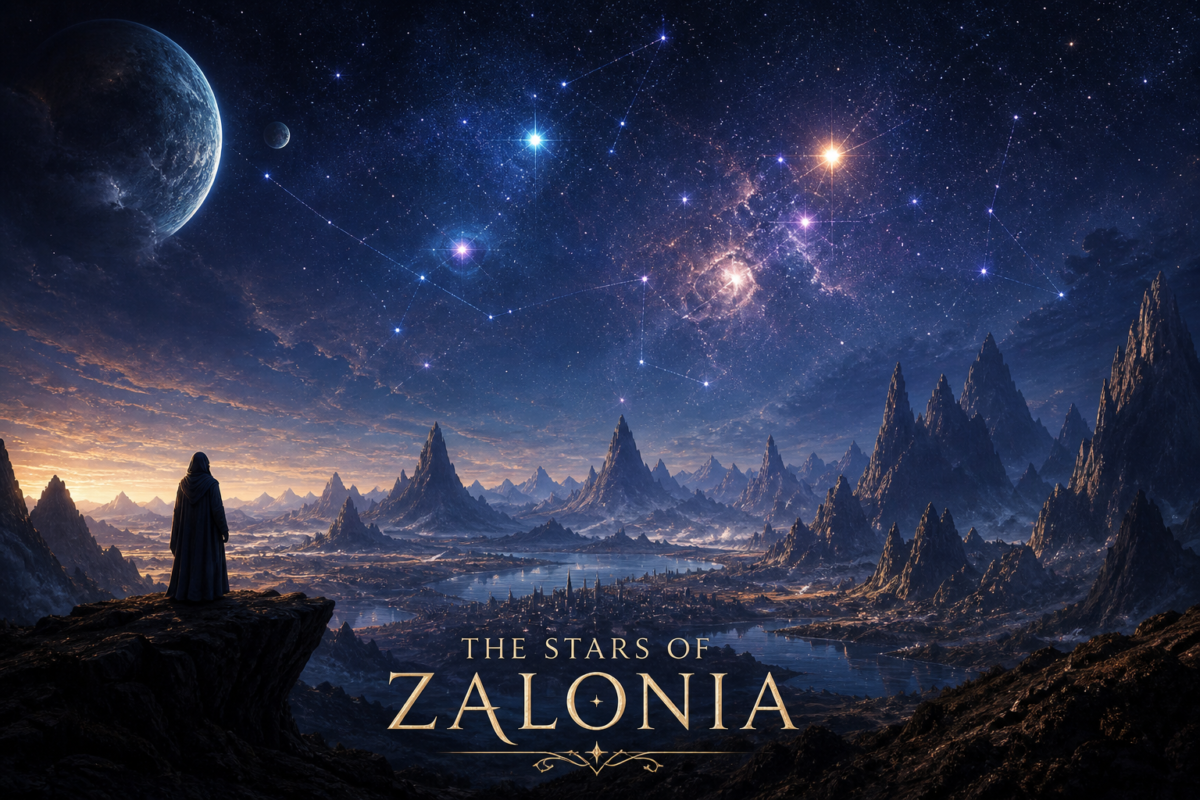
There’s something unique about its night sky. Instead of regular stars, they have these magical constellations known as the “9 constellations.” These constellations are made up of objects with very little gravitational pull. They might look like stars or planets to the naked eye, but they’re different. They don’t twinkle like our stars; instead, they move across the sky like stars, which could be quite puzzling for someone from Earth who notices these differences.

It has 3 primary moons, which can cause various kinds of tides. There is only one star in the solar system similar to our sun.

Populations exist where food, water, warmth, and shelter

World Population
Humans – 13 million
Medes – 950,000
Elves before destruction – 3 million – There is one elven territory not found in Zalonia
Woodland Elves – 100,000 – They are only in Zalonia
Frolm – 500,000 before the shadow thieves and about 2,500 after – All in Zalonia
Rokars – 9 million
Sxiox – 2 million

Alien Satellite (3rd Planet) – Onog

Onog is a satellite that is near Aztharian. It is used as a base for technology and weapons to spy and try to influence things on Aztharian. There is a wormhole on the side that faces away from Aztharian that leads to the aliens’ (Gnonows) home planet. It is a very compact satellite, but small and further away than the blue moon. To the human eye, it looks like a faint planet. The medes can see it better, but they can’t see the aliens themselves. The aliens also use a force field that the medes can’t see through. This is the satellite they used when they fought in the Great Battle of the Fourth Age. Some believe this is the furthest planet away because of its small size, but it is relatively close to Aztharian.

Gas Giant (4rd Planet) – Anohpmi

This is a further out planet, a little bigger than Jupiter, that works as a shield to destructive materials such as comets and asteroids. Seen up close, it looks like a beautiful planet and has several moons. There are said to be over a hundred moons. It has various colors such as red, yellow, blue, brown, and so on. It is an impossible planet to survive on because of the gravity, but the moons could possibly hold life. It is the biggest object in the night sky besides the moons revolving around Aztharian. Its diameter is thirteen times as long as Aztharian. It takes about 8.6 years to orbit the sun. It is often associated with wisdom.

It is a symbol of wisdom according to the medes. When it is seen in the sky, the medes study a little harder because they believe they will gain knowledge more clearly when it is visible. It is a gas giant with hundreds of moons revolving around it.

There are several spots on Anohpmi which the medes believe are dangerous storms, but they are uncertain. The spots seem to move around on the planet and increase and decrease in size at a slow rate. Its magnetic atmosphere is so strong that it can crush virtually everything that comes through it.

Anohpmi has many moons, and it is possible that they have life, especially the moons with water on them. Between their strong eyesight and telescopes, the medes can’t see the moons well enough to see actual other beings on the moon, but there seem to be enormous structures that appear to have been built by intelligent life.

Gas Giant (5th Planet) – Itenasa

This is the furthest planet away from the sun. It is about half the size of Aztharian. The planet appears blueish green due to its methane gases. There is rumored to be life on this planet among the Zalonians, but that’s only been in legends. Not much is known about this planet, and even the Gnonows have never explored it or looked at it closely. It holds about 20 moons, some fully made out of ice. It is also believed to be a portal somewhere in Zalonia that can reach this planet, or at least near it. This planet also has rings like Saturn.

It is often associated with chaos and uncertainty among the Quintum. The Quintum will never point their ships toward Itenasa because they believe this will lead them to chaotic situations at sea, such as large storms and whirlpools.

Sign up for my Newsletter Here

Creating Life – By Ralph Ellefson

The Art of World Building Workbook – By Ralph Ellefson

Fantasy World Building: A Guide To Developing Mythic Worlds and Legendary Creatures – By Mark Nelson

Support Me on Patreon

Important Stars of Zalonia

  • There is no Northern star like we have.
  • They are used to navigate, especially by the quintum when they are at sea.
  • The closest star is 3 light-years away
  • When it comes to stars, they look similar to those in our world, except for the constellations, which are made of non-star material

Arcanis

Purpose: The Star of Magic

Description: Arcanis is a brilliant, deep violet star that pulses with magical energy. It serves as a focal point for all magical spells and rituals, especially those that require tapping into raw magical power. During certain times of the year, when Arcanis is at its zenith, magic users find their abilities greatly enhanced, and it’s a prime time for casting powerful spells or creating magical artifacts.

2. Solara

Purpose: The Star of Healing

Description: A warm, golden star that radiates a soothing light, Solara is revered as the source of all healing magic. It is believed that its rays can mend wounds, cure diseases, and restore vitality. Temples dedicated to healing often align their structures to catch the first light of Solara, and healers draw upon its energy in their practices.

3. Nocturnis

Purpose: The Star of Dreams

Description: Nocturnis is a dim, silver-blue star that only becomes visible during the darkest nights. It is closely associated with dreams, prophecy, and the subconscious. Those who meditate under its light are said to receive visions of the future or guidance from the dream realm. It’s also a star that influences sleep-related spells and rituals.

4. Aegis

Purpose: The Star of Protection

Description: Aegis shines with a steady, pale blue light and is known as the guardian star. It is invoked in protective spells and wards, believed to shield both individuals and entire settlements from harm. When Aegis is high in the sky, it is considered the best time to fortify defenses or to create amulets of protection.

5. Ignis

Purpose: The Star of War

Description: Ignis is a fiery red star that blazes with intensity. It is linked to the aspects of war, strength, and conflict. Warriors and military leaders often seek its favor before battles, believing that its light grants courage and power. During times of war, its presence in the sky is seen as an omen of victory or destruction.

6. Aquilon

Purpose: The Star of the Seas

Description: Aquilon is a bright turquoise star that seems to shimmer like the ocean. It is revered by sailors, fishermen, and anyone who makes their living from the sea. Aquilon is believed to control the tides and currents, and its light is thought to guide ships safely through treacherous waters. Ceremonies to bless voyages are often held when Aquilon is visible.The quintum are known to use this star’s power the most.

7. Umbra

Purpose: The Star of Shadows

Description: Umbra is a dark, almost black star that appears faintly in the sky, often mistaken for a shadow rather than a star. It governs the night, secrecy, and the unseen. Thieves, assassins, and those who operate in the shadows often pray to Umbra for stealth and success. It’s also a star associated with shadow magic and the concealment of truths.

8. Verdantis

Purpose: The Star of Life

Description: Verdantis is a vibrant green star that symbolizes growth, fertility, and the cycle of life. It is particularly important to farmers, druids, and those connected to nature. Verdantis is believed to enhance the growth of crops, the fertility of the land, and the health of living beings. Rituals for bountiful harvests and prosperous births are often conducted under Verdantis.

9. Luminara

Purpose: The Star of Knowledge

Description: Luminara is a radiant, white star that is a beacon of wisdom and enlightenment. Scholars, sages, and those seeking truth often look to Luminara for guidance. Its light is said to illuminate the path to knowledge, uncovering hidden truths and deep mysteries. Libraries and centers of learning are often aligned to this star, and it is said that reading or studying under its light enhances understanding and insight. This star is a favorite among the medes.

Sign up for my Newsletter Here

Creating Life – By Ralph Ellefson

The Art of World Building Workbook – By Ralph Ellefson

Fantasy World Building: A Guide To Developing Mythic Worlds and Legendary Creatures – By Mark Nelson

Support Me on Patreon

Constellations of Zalonia

Astrology was allegedly developed during the Lost Era originally on the 9 constellations and was rediscovered after the 400th year of the First Age. It was put together by various members of the Society of the Lost Realm. Then it was brought to Magdad to help magicians with their magic. There are certain historical events that seems to line up with the position of the stars and planets.

Constellations and months have the same name and are named after backwards Nyanja Words. They move slightly east from the night before. They are typically seen one month at a time. Remember, a month in Zalonia is 40 days. Astrology isn’t as commonly practiced in Zalonia, but the constellations represent the stages of life and follow the years. There are many other constellations, but they aren’t recognized to the same degree. The objects that make up the constellations are not stars, but were put there for the use of magic. They have weak gravity and large volume. They are closer than the stars and rotate in a similar fashion to the planets by going through the sky. They are magical orbs that are not in our universe.

Awdab

This is the first month of the year and the season when life starts to grow back). It is similar to March/April in the northern hemisphere of our world. The symbol of this is a tadpole and seen in the early evening. When this constellation is prominent, magic for new beginnings as at this height. Magic users who work for leaders will often suggest starting a war during this time. Village councils meet together to plan out the new year. Crops are often planted, and individuals begin projects that they want to work on. Medes often have their babies at this time after about 150 days of pregnancy.

Anawbu

This is the second month of the year, and it is when things tend to grow the fastest. This is similar to April/May in the northern hemisphere here. A willow tree symbolizes this. The armies that have started wars will bring in the most recruits during this time. Preparations for war also happen, and magic users will put heavy study into their magic. The snow has melted, and the water is starting to evaporate, making travel easier. Many merchants set up shop around this time for non-food items, mostly.

Uvmah

This is the third month, and growth is still happening, but has slowed a little. May/June for us. This is symbolized by a dandelion. War is likely to start during this time for those places that have tension toward one another. Merchant start selling more food that comes out early. Travel and trading see an increase. Magically, both offensive and defensive magic is strong due to the wars.

Atama

This is the fourth month and the vegetation reaches its full growth. This is symbolized by a growing cat that is full of energy. The constellation appears vaguely as cat whiskers. There is more food in the markets and the traveling remains steady. Magic can be used to help with crop growth, especially in places that are likely to suffer from famines.

Itaka

This is symbolized by a spider where there is a middle star and then it almost looks like eight lines coming off of it. This is usually the warmest month of the year and merchants in the south often have to take shelter and may be more likely to do outdoor selling at night. Magic that is related to heat like fire magic are the strongest at this time.

Amiw

This is shaped like a house because it is known that mature people often have their own houses. Crops are gathering and merchants are in full force as people prepare for the colder months ahead. The leaves start to change color and harvest festivals take place. This is the time for healing magic, as people who have been working may need to heal some of their body after working during the warmer months.

Uluk

This is shaped like a walking staff with some bends to it. Merchants start slowing down and many people have gathered for the colder months. War starts to settle down, especially in the northern areas. There is a lot of rain which slows down travel. Magic is least strong this month so many magicians do inner work so they can improve their magic.

Afmi

The void. There appears to be a hole in the sky with no stars and is shaped like a fluffy cloud. The snow and cold get strong this month and all the leaves fall off the trees. People are indoors now and merchants can only be found in the south. Those who haven’t properly prepared, may go south to gather items. The roads can be dangerous as the winter creatures start to roam the areas. Magic is used for heat and light.

Inastub (kumbutani) Reminisce

This is the time after death when a person reviews their life. This is symbolized by a mirror. There is a cluster of stars that appear to be oval shaped like most of the mirrors used in Zalonia. This is where it is coldest at the beginning of the month. Magicians and others do a lot of self-reflection during this time. They think of how they spent the year and how they could be more productive the next year.

Utawda

The cocoon symbolizes the transformation from death to life. At the beginning of this month, it is the time of the greatest suffering, as people are lacking food and it still isn’t easy to get out. However, there is renewed hope as the sun gets stronger and the snow melts. Plants are about to start to bud. Magic is used to cause the plants to grow better to increase the likelihood of a good harvest. Leaders start to meet together at the end of this month to plan out for the year.


Sign up for my Newsletter Here

Creating Life – By Ralph Ellefson

The Art of World Building Workbook – By Ralph Ellefson

Fantasy World Building: A Guide To Developing Mythic Worlds and Legendary Creatures – By Mark Nelson

Support Me on Patreon