Sign up for my Newsletter Here
Get Curse of Kredaria for free
Support Me on Patreon
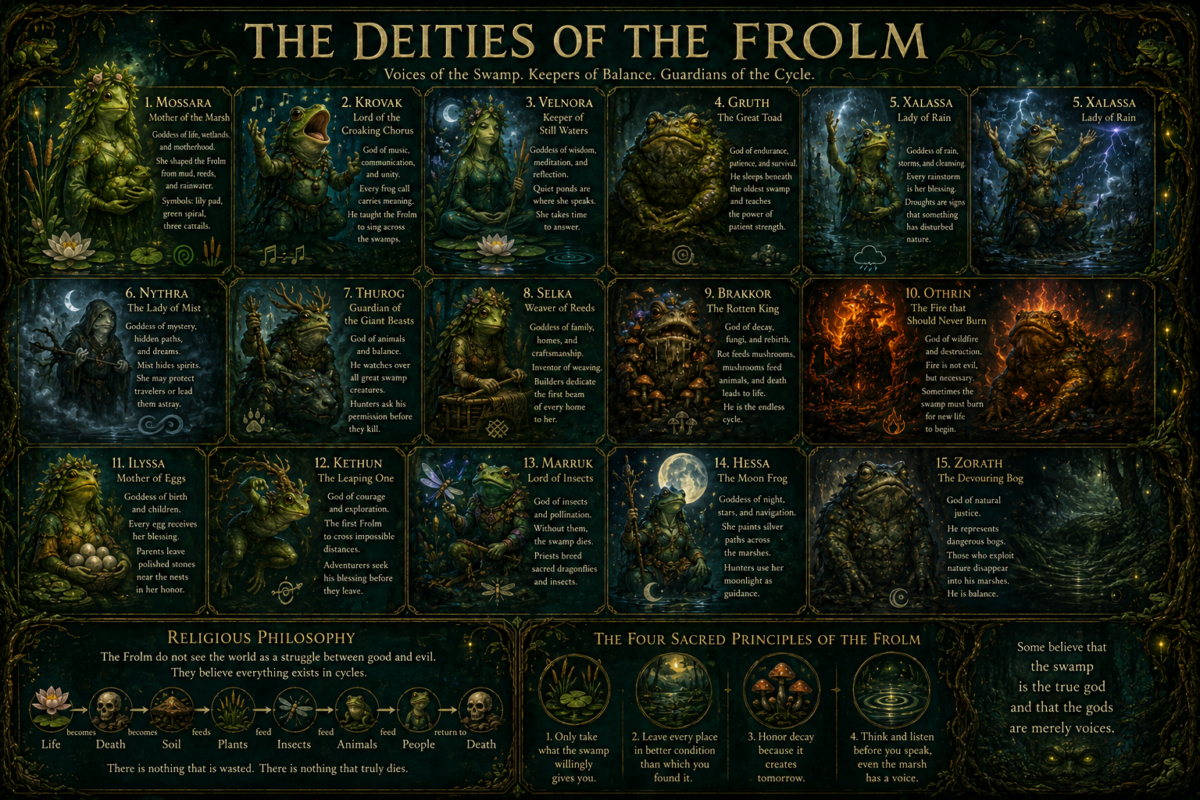
1. Mossara – Mother of the March
She is known as the Goddess of life, wetlands, and motherhood. She is also the supreme goddess among several of the frolm tribe. Mossara is said to have given the Creatrix the idea to create frolm aas a race and that she would watch over them. The frolm were shaped from mud, reeds, and rainwater. Her symbols are the lily pad, green spiral, and three cattails. She is often followed by midwives, farmers, and village elders.
2. Krovak – Lord of the Croaking Chorus
Krovak is known as the god of music, communication, and unity. The frolm believe that every frog call carries meaning with it. He has taught them how to sing to one another across swamps. Frolm priests communicate important messages through a variety of ceremonial chants.
3. Velnora – Keeper of Still Waters
Velnora is known as the goddess of wisdom, meditation, and reflection. Many frolm believe that quiet ponds are places where she speaks. Those who are seeking guidance, even by non-frolm travelers, sit beside still water for days waiting for the answer. She often takes a while to answer.
4. Gruth – The Great Toad
Gruth is known as the god of endurances, patience, and survival. He is said to be an humongous ancient toad said to sleep beneath the oldest swamp. He also teaches the frolm patience. Frolm warrior may gather together before partaking in a long campaign.
5. Xalassa – Lady of Rain
Xalassa is the goddess of rain, storms, and cleansing. In fact, every rainstorm is seen as one of her blessings. These rains often get frolm into the mood to be festive and sometimes parties are thrown at random with the heavy rains. However, droughts are seen as signs that something has disturbed nature.
6. Nythra – The Lady of Mist
Nythra is the goddess of mystery, hidden paths, dreams. The morning fog is said to hide spirits. Those traveling through a thick mist often leave offerings before enterting. She may protect travelers or lead them astray if they have ill will.
7. Thurog – Guardian of the giant beast
Thurog is said to be the god of animals and balance. Frolm believe that every giant swamp creature belongs to him including the great beasts who dwell in the Great Frolm Forest. Hunters will ask him for permission before killing. However, if one takes more than what is needed, his anger will be stirred.
8. Selka – Weaver of Reeds
Selka is the goddess of family, homes, and craftsmanship. She is the inventor of weaving and builders often dedicate the first beam of every home to her.
9. Brakkor – The Rotten King
Brakkor is the god of decay, fungi, rebirth. Some think he is the strangest deity. The frolm do not fear rot, rot feeds mushrooms which feeds animals, and animals feed the swamp. Death leads to life. He represents this endless cycle.
10. Othrin – The Fire that should never burn
Othrin is the god of wildfire and destruction. Unlike woodland elves, the frolm fear fire that isn’t controlled. Othrin is not evil, but necessary. Sometimes a part of the swamp may have to burn for new life to begin.
11. Ilyssa – Mother of Eggs
Ilyssa is the Goddess of birth and children. Every egg receives her blessing. Parents leave polished stones near the nests in honor of her.
12. Kethun – The Leaping One
Kethun is the God of courage and exploration. He is considered the first frolm to cross impossible distances. Those who are young adventurers seek his blessing before they leave for their quest.
13. Marruk – Lord of Insect
Marruk is the god of insects and pollination. While many people in Zalonia hate insects, the frolm recognize that without them, the swamp dies. Some of his priests breed sacred dragonflies and insects.
14. Hessa – The Moon Frog
Hessa is the goddess of the night, stars, and navigation. She is known to paint silver paths across the marshes and hunters use her moonlight as guidance.
15. Zorath – The Devouring Bog
Zorath is the god of natural justice. He represents dangerous bogs. There is the belief that those who exploit nature eventually disappear into his marches. He’s more an inevitable force of balance than he is a villian.
Religious Philosophy
The frolm don’t see the world as a struggle between good and evil. Instead, they believe that everything exists in cycles like life becomes death, death becomes the soil, the soil feeds plants, plants feed insects and some animals, insects feed animals, and animals feed the people. The people eventually return to death. There is nothing that is wasted and there is nothing that truly dies.
The Four Sacred Principles of the Frolm
Their four main teachings are summarized like this
1. Only take what the swamp willingly gives to you.
2. Leave every place in better condition from which you found it.
3. Honor decay because it creates tomorrow
4. Think and listen before you speak, even the marsh has a voice
Some believe that the swamp is the true god and that the gods are merely voices.
Sign up for my Newsletter Here
Get Curse of Kredaria for free
Support Me on Patreon