Sign up for my Newsletter Here
Get Curse of Kredaria for free
Support Me on Patreon
Introduction
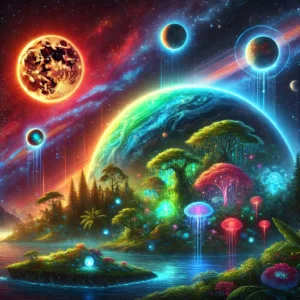
One of the most exciting yet challenging aspects of building a science fantasy world is creating mystical planets with unique ecosystems, cultures, and symbolic meanings. Planets can serve as more than mere backdrops for your story—they can be characters in their own right, shaping the narrative and enriching the setting. In my science fantasy world of Aztharian, I’ve incorporated a diverse solar system filled with intriguing planets, each with its own symbolism and purpose. Here’s how I approached this, along with tips and ideas for crafting your own celestial wonders.
1. Starting with the Heart of Your World
Within my science fantasy solar system is Aztharian, the second planet from the sun. Similar to Earth in its proximity to the sun, Aztharian serves as the focal point of the story. Its climate, ecosystems, and civilizations mirror Earth’s diversity, making it relatable yet fantastical. When designing your primary planet, think about how it connects to the rest of your solar system.
Ecosystems and Symbolism
Aztharian is a magical world where advanced alien species, such as the Gnonows, interact with its inhabitants. Its three moons add layers of symbolism, each representing different omens or natural phenomena.
Phantom moons occasionally appear, serving as harbingers of major events—such as a green moon signaling a plague or a red moon symbolizing fortune.
When designing your main planet:
Consider its role: Is it a hub of life, a battleground for cosmic forces, or a sacred place for your story’s mythology?
Add symbolic elements: Moons, natural phenomena, or celestial alignments can reflect the spiritual or cultural beliefs of its inhabitants.
2. The Gnonows’ Artificial Planet: A Technological Marvel
Beyond Aztharian lies an artificial planet built by the Gnonows, a high-tech alien species with a vested interest in monitoring and influencing Aztharian.
This planet, small and invisible to the naked eye, serves as their vantage point for observing and occasionally manipulating the inhabitants below.
Designing Artificial Worlds
Artificial planets offer endless creative opportunities. They can be sleek, sterile hubs of technology or chaotic amalgamations of machinery and alien life forms. For the Gnonows, their planet houses advanced vehicles and spaceships equipped with tools to monitor Aztharian’s ecosystem and civilizations.
Questions to consider for artificial planets:
Purpose: Is the planet designed for surveillance, research, or conquest? The Gnonows want a certain gem found on Aztharian that they need for their home planet which is slowly falling apart because its atmosphere depends on melting and evaporating the purple gem for their survival. If they don’t steal the purple gems from Aztharian, then their own planet will die off.
Environment: Does it have an atmosphere, or is it a barren technological shell? The planet that the gnonows watch Aztharian from isn’t the same planet that they live on. It has a light atmosphere similar to our moon, but the air is breathable and if anyone visits it from Aztharian, they won’t die from suffication.
Aesthetic: Is it a metallic orb, a crystalline structure, or something entirely alien? The gnonows small planet it mostly made of metal which keeps it heavier for gravity to work effectively.
3. Latrina: A Planet of Artistry and Indulgence
The closest planet to the sun in my solar system is Latrina, a world associated with romantic and sensual love, creativity, artistry, and self-expression. It’s a planet of contrasts, symbolizing beauty and pleasure on one hand and selfishness, greed, and indulgence on the other. Latrina’s hieroglyphic—a sphere with a cross—serves as a reminder to balance self-expression with moderation.
Symbolism and Cultural Impact
Planets like Latrina can influence the culture and belief systems of your world’s inhabitants. For instance:
Cultural Significance: Latrina might inspire artists, poets, and dreamers, while also warning against excess.
Astrological Influence: Inhabitants of Aztharian might interpret planetary alignments involving Latrina as omens for creativity or warnings of greed.
Ideas for symbolic planets:
A planet of war, inspiring fear and courage – in Zalonia, there is no planet that represents war, but there is a nearby star that can often be seen in times of war. It is known as Zephides or the Eastern Star.
A planet of wisdom, associated with learning and enlightenment. The planet Anohpmi is the next planet out from the sun after Aztharian. It is a symbol of wisdom according to the medes. When it is seen in the sky, the medes study a little harder because they believe they will gain knowledge more clearly when it is visible. It is a gas giant with hundreds of moons revolving around it.
A planet of chaos, representing unpredictability and change. Itenasa is the furthest planet out, and it is a gas Giant. It is often associated with chaos and uncertainty among the Quintum. The Quintum will never point their ships toward Itenasa because they believe this will lead them to chaotic situations at sea, such as large storms and whirlpools.
4. The Outer Gas Giants: Guardians of the Solar System
Further out in the solar system are two massive gas giants, which act as cosmic protectors for smaller planets like Aztharian. Their immense gravitational pull shields Aztharian from comets and asteroids, ensuring its continued survival.
Designing Gas Giants
Gas giants offer a wealth of storytelling potential, with their vibrant atmospheres, countless moons, and hidden secrets. In my solar system, the fourth planet, Anohpmi, is a colorful giant with swirling hues of red, yellow, blue, and brown. Though uninhabitable due to its extreme gravity, its hundreds of moons hold the promise of life and exploration.
Key considerations for gas giants:
Atmosphere and Appearance: Unique coloration, storms, or magnetic fields can make your gas giant stand out. There are several spots on Anohpmi which the medes believe are dangerous storms, but they are uncertain. The spots seem to move around on the planet and increase and decrease in size at a slow rate. Its magnetic stratosphere is so strong that it can crush virtually everything that comes through it.
Moons and Exploration: These planets often have numerous moons, which can host civilizations, hidden treasures, or ancient ruins. Anohpmi has many moons, and it is possible that they have life, especially the moons with water on them. Between their strong eyesight and telescopes, the medes can’t see the moons well enough to see actual other beings on the moons, but there seem to be enormous structures that appear to have been built by intelligent life.
Cultural Lore: Gas giants can symbolize protection, power, or mystery, depending on how they’re perceived by the inhabitants of your world.
5. Moons and Phantom Satellites
Moons play a vital role in shaping the identity of planets. In Aztharian’s case, its three moons not only illuminate the night sky but also carry deep symbolic meaning. Phantom moons—celestial phenomena that appear sporadically—add an air of mystery and serve as omens.
Creating Unique Moons
Moons can vary widely in size, color, and purpose:
Habitable Moons: Some moons might support life, serving as colonies or sanctuaries. While there aren’t any moons floating around Aztharian that can be inhabited, other planets might have moons that can carry life.
Mysterious Phenomena: Phantom moons could represent rare cosmic alignments or magical forces, appearing only during significant events. For example, in Aztharian, the green moon will appear over certain places as a warning that there is a plague or at least a plague is coming along. The phantom white moon is a symbol of births and new beginnings. There are more phantom moons, but I won’t go into all of them here.
Symbolic Meanings: Each moon might correspond to an element, emotion, or deity, influencing the culture and rituals of the planet below. The blue moon in Aztharian symbolizes distress, whereas the red moon symbolizes hope.
6. Building Unique Ecosystems for Each Planet
Each planet in your solar system should have a distinct ecosystem that sets it apart. While some planets may teem with life, others might be barren yet rich in resources.
Ecosystem Ideas
Latrina: A lush, jungle-like world with bioluminescent plants and creatures that thrive in heat. Its vibrant landscapes inspire creativity, while its predators symbolize indulgence gone awry.
Anohpmi’s Moons: These moons could host icy tundras, volcanic landscapes, or deep oceans filled with bioluminescent sea creatures. Perhaps one moon has ancient ruins left by a lost civilization.
Artificial Planets: The Gnonows’ planet might have artificial ecosystems, like gardens sustained by advanced technology or holographic environments for training and experimentation.
7. Incorporating Storytelling into Planetary Design
Planets can serve as more than just settings; they can drive the plot, embody themes, and shape character development. Here’s how:
Conflict: A rare resource on one planet might fuel wars or alliances. This is one of the reasons the gnonows want the purple stones from Aztharian, because they need them for their survival.
Exploration: Characters could venture to uncharted worlds, uncovering secrets or ancient relics. In Aztharian, the medes would like to study other equipment, but they don’t have the technology necessary to leave the planet. There are alien races that come from other planets, and often from completely different universes. The Gnonows have their own planet and also have an artificial planet that revolves around Aztharian.
Cultural Exchange: The unique traits of each planet can influence trade, diplomacy, and even conflict among civilizations. For example, the alien race Elyndor exchanges knowledge with the medes about other worlds. There have been attempts by the medes to travel with the Elyndor, but their bodies can’t handle being outside the atmosphere for long. The Elyndor have no need for space suits, which makes it easier for them to travel. They share a lot about their culture with the medes.
Conclusion
Creating mystical planets for a science fantasy world is a rewarding challenge, offering opportunities to blend science, magic, and storytelling. From the romantic allure of Latrina to the technological marvel of the Gnonows’ artificial planet, each celestial body in your solar system can enrich your world and captivate your audience. By adding symbolic meanings, diverse ecosystems, and cultural significance, you can craft a universe that feels alive and vibrant.
When building your own planets, ask yourself: What role does each planet play in the larger narrative? How do its ecosystems and symbolism influence the inhabitants of your world? With these questions as your guide, the possibilities are endless.
Creating Life – By Ralph Ellef
The Art of World Building Workbook – By Ralph Ellefson
Fantasy World Building: A Guide To Developing Mythic Worlds and Legendary Creatures – By Mark Nelson
Support Me on Patreon
Get the electronic version my book, “Curse of Kredaria” for free at various websites including Amazon.