
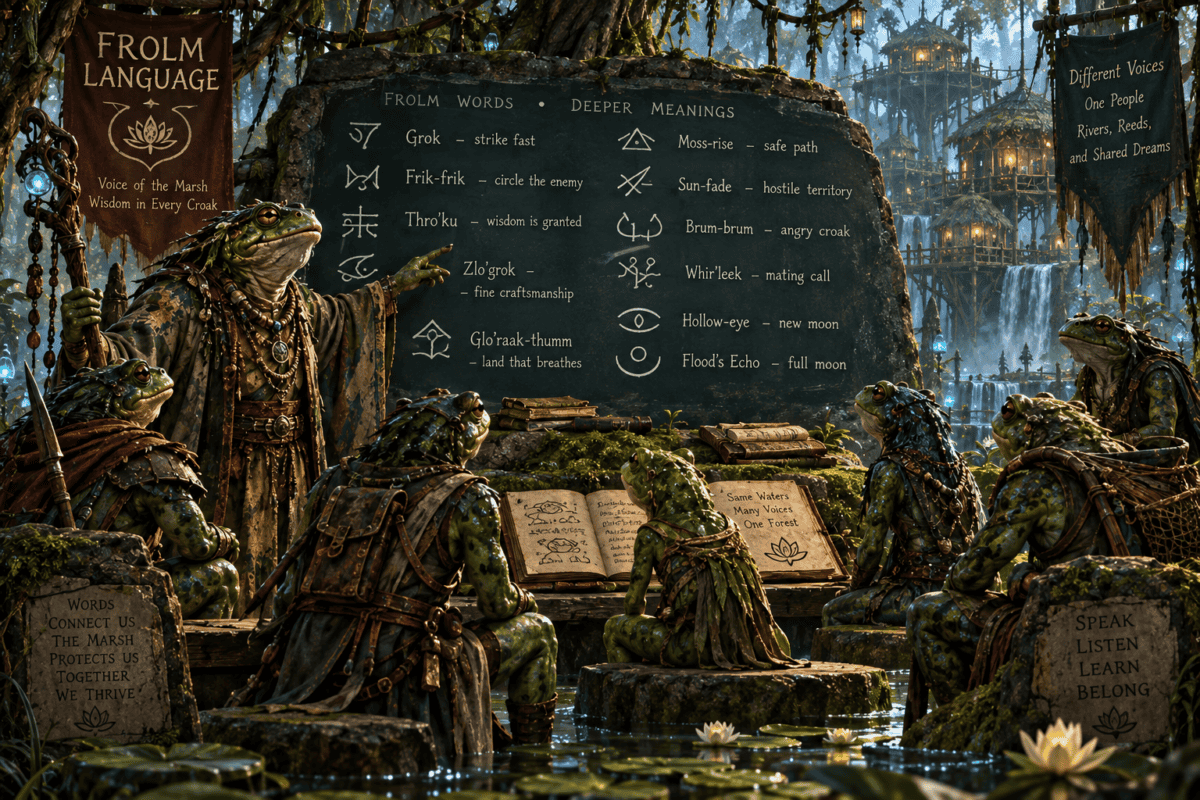
Frolm have their own language which they use with each other, but they often speak common tongue. They are required to learn the frolm language for times of combat when they have to communicate without being intercepted. One cannot be a warrior if he or she doesn’t know the frolm language
By Social Class
Frolm may have warriors, shamans, chiefs, hunters, artisans, foragers, and common gatherers, each with a unique speech distinction.
High-born Leaders (Chiefs, shamans and elders):
These frolm may speak in a measured, melodic tone which mimics the rhythm of the rainfall or the swamp pulsating. They make use of long, flowing sentences, and instead of speaking in direct orders, they prefer metaphors (e.g., “The river does not command the fish, but it leads them with its current”). These frolm may refer to themselves using third person when making decrees (e.g., This one has seen the planets align, and the time for harvest is near”). They often have exclusive ceremonial words not used in regular speech (e.g., “Thro’ku” meaning “wisdom is granted by the mist spirits”).
Warriors and Hunters
They often speak in short, clipped phrases and prefer action-driven language. They often omit pronouns and articles (e.g., “Hunt begins. Warmth comes.” Instead of using “The hunt is beginning” and “The warmth is coming.”). They also use onomatopoeic battle slang such as “Grok” (which means to “strike fast”) or “Frik-frik (Which means “circle the enemy”). They are prone to imitating animal sounds for tactical communication.
Foragers and Gatherers
These frolm often use descriptive language that relates to various things like plants, fungi, and weather patterns. (e.g., “That idea is like a rotting stump, it will quickly crumble). They have a distinct seasonal vocabulary, (e.g., like referring to time in terms of growth cycles (“When the light-colored fungi rise, we shall meet again”)).
Artisans and Traders
These frolm tend to borrow words from various tribes due to their frequent interactions. They tend to speak faster than most frolm, using abbreviations and contractions (e.g., “Zlo’grok” instead of “A fine piece of stonework”). They have a unique slang for quality such as “Slime-rich” which means high-value, and “Dull reed” which means that something is worthless.
By Occupation
Sometimes, frolm who do different jobs develop unique speech quirks:
Frog Tamers (Those who work with giant amphibians for transport & labor)
These frolm use things such as clicking and low hums instead of words when giving orders. They often refer to time based on frog behavior (e.g., “The Long Croak is near” means it is dawn). They have unique names for different frog sounds, such as “Brum-brum” (angry Croak, and “Whir’leek” which is a mating call.
Waterway Navigators & Fisherfolk
These frolm have a fluid, wavy cadence, speaking as if their words are drifting like water. They may use many words for different types of ripples (e.g., “silent drift” for smooth waters, or “whispering pull” for a slow current). These fr have sacred words for deep water animals they do not name directly. They refer to them as “shadow swimmers” or “those who wait below.”
Scouts and Runners
These frolm prefer sharp, staccato phrasing for efficiency. They often use coded phrases to give information quickly, such as “Moss-rise” (safe path) and “Sun-fade” (hostile territory).
By Region
Various wetlands, river systems, and swamp forests create distinct dialects.
Deep Swamp Tribes
These frolm speak in drawled, slow tones which mimic the eerie stillness of their environment. They tend to use more whistles and guttural sounds, as deeper swamp frolm have larger vocal sacs. They usually have longer words for things that are important to them such as “Swamp” being Glo’raak-thumm,” which means “land that breathes”).
Riverbank Frolm
These frolm often have a lighter, more nasal accent that seem to mimic the quick ripple of water. They borrow several words from other species such as travelers, merchants, and entertainers. In fact, they are known for their rhyming speech in which they speak in couplets. (example: “Storm ahead, winds have spread” or “Gather now, before the bough).
Hill Marsh Frolm
These frolm have a more clipped and breathy pronunciation since their terrain is generally more open. They use hand gestures and body language alongside speech more frequently than other groups. Some of their idioms are based on elevation (example: “High reed, far seed” which means that there are long-term benefits that require patients.
By Race (Subspecies of Frolm)
There are various physical features that affect the way they speak
Tree-Frolm (Arboreal, Smaller, Agile, Webbed Fingers)
These frolm generally speak in chirps and trills. In fact, their voices are naturally higher-pitched than other frolm. They tend to interrupt each other in their conversations, as their speech is quick and dynamic. They have many metaphors that are connected with hair such as “Leaf-born” (which means carefree) and “Drift-broken” (which means lost).
Marsh Frolm (Stockier, Bulkier, More Amphibian Than Humanoid)
Marsh frolm generally speak in slow, deep vibrations, which sometimes uses subsonic hums to communicate over long distances. There are many pauses in their speech as they consider each word carefully. They use water-themed proverbs such as “Still water drowns the deepest” (which means, beware the quiet ones.
Tidewalkers (Frolm Who Live on the Ocean’s Edge, Saltwater Amphibians)
These frolm generally speak in short bursts, almost mimicking the tides.
They have distinct terms for where the moon is at regardless of which moon, e.g., “Hollow-eye” for the new moon and “Flood’s Echo” for the full moon
They also borrow clicking sounds from crustaceans which makes their dialect unique.
See Also:
The 13 Sacred Laws of the Frolm




One thought on “Frolm Language: Speech Variation in Frolm Society”