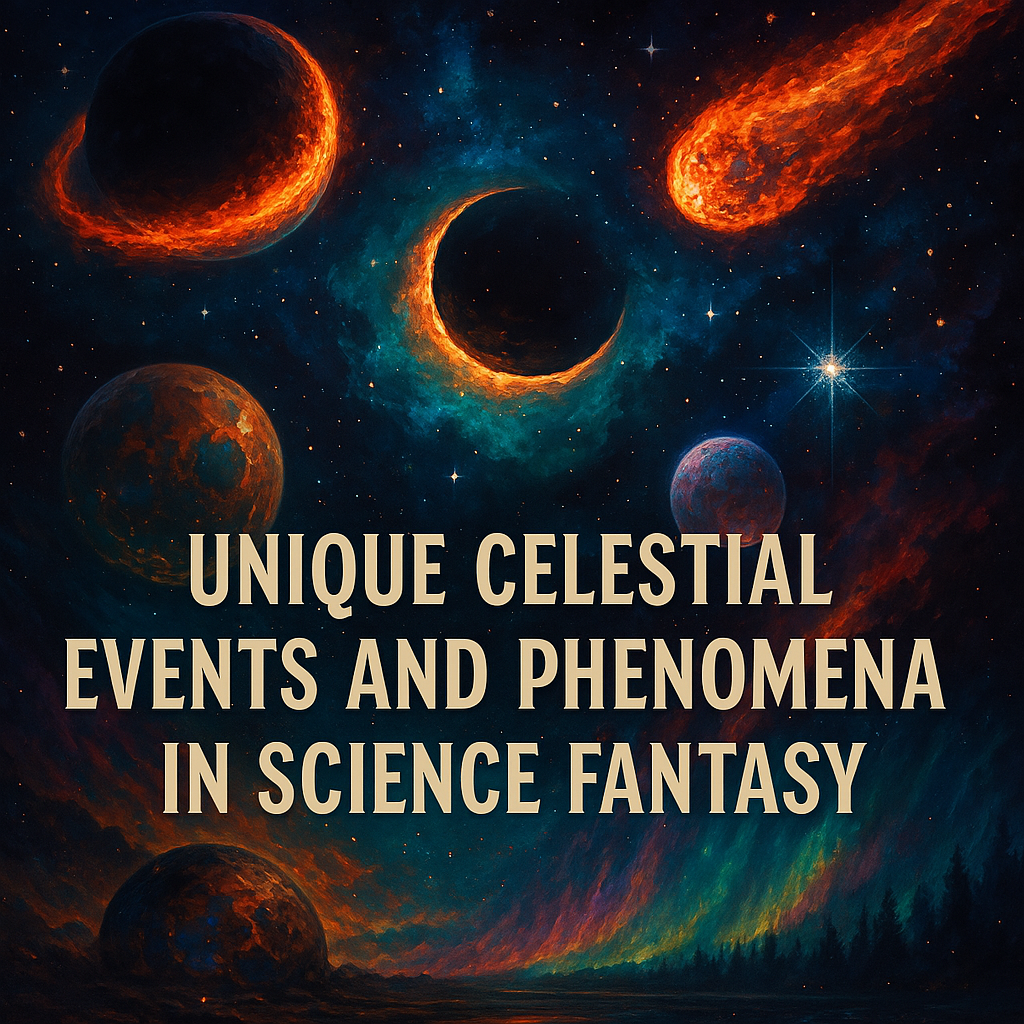
Unique Celestial Events and Phenomena in Science Fantasy

Unique Celestial Events and Phenomena in Science Fantasy

Brainstorming Ideas for Rare Cosmic Events and How They Impact Your World

In science fantasy, the cosmos is not just a backdrop—it’s a living, breathing participant in the drama of your story. Unlike hard science fiction, where astronomy sticks close to physics, science fantasy gives you the freedom to mix magic with astrophysics, mysticism with orbital mechanics, and divine prophecy with planetary alignment.

Here’s your guide to crafting rare, awe-inspiring, and deeply impactful celestial events—plus ways to let them shake your world to its core.

🌠 1. The Eclipse of Memory

Description: Once every so often, two moons overlap during an eclipse. Anyone caught under its shadow forgets one deeply held memory—random or otherwise. This is what happens in Zalonia every 163 years when the red moon eclipses the blue moon. Neutral magic is the most powerful while this is happening.

Impacts: Societies build “Memory Vaults” to protect knowledge and identity. The medes use this method when gaining knowledge that can be lost easily. Their magic users will often write certain amounts of history in a memory fault.

Secret cults intentionally expose themselves, believing forgetting is a divine rebirth.

Wars pause during the eclipse to avoid commanders forgetting critical strategies. This is often done in Zalonia, however, when the gnonows attack, they don’t  realize that Zalonians recognize that day as having significant meaning.

Prophecies suggest that when the eclipse causes the same person to forget the same thing twice, a forgotten god returns.

🌌 2. The Blood Comet

Description: A deep-red comet that appears only during planetary alignments, believed to be the egg of a cosmic serpent. In Zalonia, it represents one of the great beasts. There are a total of 99 great beasts according to legend, and one is bound to appear when this red comet is seen.

Impacts: Its passing causes mutation in unborn children—sometimes blessed, sometimes cursed.

Cults believe drinking water touched by the comet’s light grants visions of the future or madness, or even both.

Alchemists harvest rare “comet dust” that temporarily enhances magic. The magical aspect weakens as time goes by and is usually unworkable within a week so it has to be used fast. Those that keep track of the red comet do so, so they can have magic users ready for when the comet appears.

Entire cities shut off their lights, fearing the comet might “choose” souls for abduction.

Here

🌑 3. The Hollow Moon

Description: A seemingly normal moon occasionally opens like a flower, revealing an ancient spaceborne citadel within. It stays open for 13 days before sealing shut again.

Impacts: Brave adventurers and smugglers attempt to enter the citadel before it closes.

Arcane scholars believe the citadel is the last ark of a forgotten race.

Sometimes, people disappear during the event—and reappear decades later, unchanged.

Religious sects call it the “Womb of the Stars” and believe it’s the source of all magic.

🔮 4. Starfall Chorus

Description: Every few centuries, a rain of musical meteorites falls across the land. The stones sing in alien harmonies and are believed to be fragments of a dead god’s soul.

Impacts: Bards, mystics, and sound-mages flock to the event to record the melodies, which are said to alter reality when performed.

Pieces of the meteorites can power music-based spells or be forged into instruments that manipulate emotion.

Rival cities race to collect the most “songs” to gain cultural and magical supremacy.

There’s a dark legend: if all meteor melodies are played at once, the god might be resurrected—or awaken something worse.

🪐 5. The Planetary Veil

Description: A rare alignment causes the magical fields of several planets to connect and form an invisible web, altering magic and gravity.

Impacts: Gravity weakens or strengthens depending on location—allowing for floating cities or plummeting terrain.

Spellcasters suddenly find their powers inverted or magnified.

A new form of magic—Webweaving—emerges, allowing manipulation of the cosmic threads.

Political factions blame each other for exploiting the veil, leading to tensions, revolutions, or war.

☄️ 6. The Reverse Supernova

Description: Instead of exploding outward, a star collapses in reverse, absorbing nearby light and energy, creating a sphere of “unlight.”

Impacts: Time slows down or even reverses near the event.

An entire civilization is said to have “fallen in,” and their voices still echo across time.

“Unlight crystals” harvested from the region are used in temporal magic, black-market espionage tools, and anti-divination spells.

The Church of Chronos considers it a holy womb of rebirth, sending pilgrims in hopes of ascending.

🌟 7. The Wandering Star

Description: A rogue star drifts through space and communicates telepathically with sentient beings as it passes.

Impacts: Those who hear its voice gain temporary cosmic knowledge, often going mad or ascending to become star-priests.

Empires try to weaponize the star’s whisper, capturing it in psychic resonators.

Some beings are chosen as Starborn, marked by glowing skin and alien tongues.

Prophecies say the star is seeking a host, a vessel to become mortal.

8. The Lunar Migration

Description: Every 999 years, one of your world’s moons slowly detaches from its orbit and drifts across the sky to a new location.

Impacts: Cultures tied to lunar cycles experience chaos—rituals fail, gods fall silent, tides go wild.

Moon-based civilizations go to war to prevent or accelerate the migration.

The New Moon Orbit passes over uncharted lands, activating ancient relics or reawakening buried horrors.

Myths suggest that the moon is fleeing something…

✨ 9. The Aurora of Becoming

Description: A magical aurora, visible across multiple planets, that reshapes reality based on collective dreams.

Impacts: For one night, everyone’s desires can subtly shift the world—for better or worse.

The “Dreamguard” exists to keep nightmares from becoming real.

Criminals try to infiltrate dreamspaces, influencing events or implanting psychic weapons.

Some claim the aurora is not a natural event, but a test from a higher plane—or the last defense of reality.

🧭 10. The Astral Drift

Description: The entire galaxy temporarily enters an “astral sea,” where souls, thoughts, and magic manifest in physical form.

Impacts: Dreams become real, ghosts re-enter the world, and thoughts take shape.

Space travel becomes impossible—ships sail through ideas instead of coordinates.

Pirates and prophets ride this wave to raid or reshape new realities.

The gods are silent—some say they are being reshaped by the minds of the living.

Final Thoughts:

Make Your Celestial Events Matter

Rare cosmic phenomena shouldn’t just look cool—they should affect people, belief systems, governments, and natural laws. A single event can:
Reshape the economy (think magic-meteor harvests).
Set off a cultural revolution.
Mark the rise or fall of empires.
Give birth to entire religions or mythologies.
Be the trigger for your entire plot.
The best celestial events blend mystery, danger, awe, and opportunity. Let them inspire wonder—and make sure your characters, cultures, and conflicts respond in meaningful ways.

Get Book on Creating Life – Affiliate Link
Return to Free Book

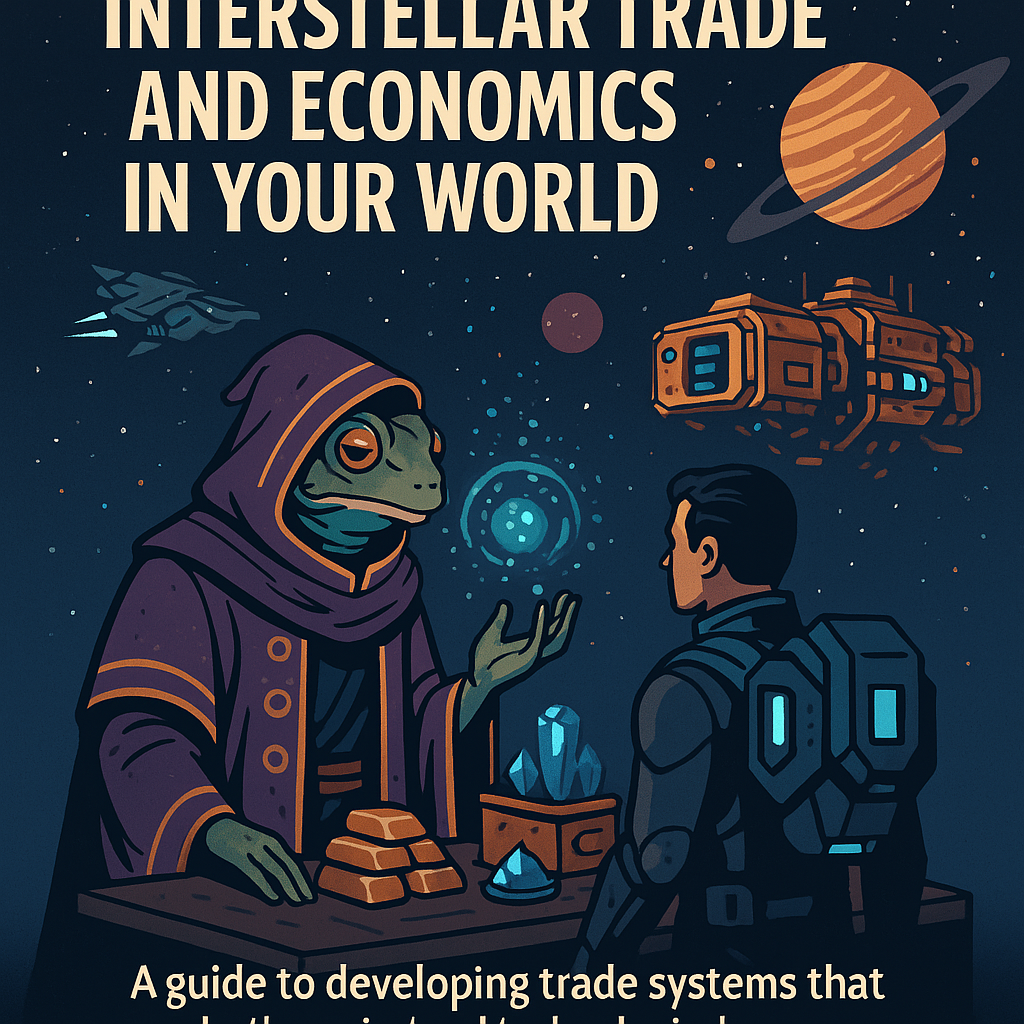
Interstellar Trade and Economics

Crafting Interstellar Trade and Economics in Your World

A Guide to Developing Trade Systems That Use Both Magical and Technological Resources

Whether you’re building a galaxy-spanning empire, a cluster of magic-infused star systems, or a spacefaring fantasy civilization, interstellar trade is the lifeblood of a living universe. Trade and economics add depth, conflict, realism, and opportunity for stories to unfold.

In this guide, we’ll dive into how you can design believable, exciting interstellar economies that incorporate both magical and technological resources, while giving you tools to tie them into the cultures, politics, and tensions of your world.

1. Start With Scarcity: What’s Valuable and Where?

Every trade network begins with scarcity. What do planets or realms lack, and what do others abundantly produce? The gnonows, which are a high tech species that isn’t from Zalonia needs purple gems in order to survive on their home planet. Therefore, they manipulate the species of Zalonia to work hard finding these purple gems since they are found all throughout Zalonia.

However, this plays into the monetary system of Zalonia as purple gems are often up for trade even though they aren’t really worth anything in and of themselves. It’s like gold is on our planet. It is only worth the amount that it is sold for, however, the gnonows need it and they only press down on the population when they are not receiving enough purple gems.

Tech-Based Examples:

A planet with rare hypercrystals that fuel faster-than-light engines. Hypercrystals are found on the original world that the gnonows came from and are used to power their space ships.

A colony with access to superintelligent AI labor, but lacking raw materials.
A space station that trades in quantum computing cores made from frozen neutronium.

Magic-Based Examples:

A moon rich in etherium dust, necessary for spellcasting. Those in Zalonia can call down magic from three moons, a blue one, a red one, and a golden one. The blue one is for negative energy, the red is for positive energy, and both types can be pulled down from the golden one.

A society of mages that exports illusion-weaving silk that can shift shape on command.

A dying world that trades life-essence potions to extend longevity.
By establishing the unique magical or technological assets of each world, you’re not just creating an economy—you’re crafting relationships, rivalries, and dependencies.

2. Define the Medium of Exchange

Is there a universal currency, or is barter still in play? Do different societies accept different forms of payment—tech credits, magical essence, promissory blood-oaths? In Zalonia there is no universal currency to trade with extraterrestrial races. There is only currency among the inhabitants of Zalonia, and sometimes between seas. However, the primary extraterrestrial race is hostile. However, sometimes they partake in Zalonia’s currencies in order to obtain the purple gems that they depend on. There is also another alien race which is more friendly toward those in Zalonia and will sometimes use Zalonia’s primary currency while visiting.

Some hybrid options:

Aethercoins: Magical currency infused with power, accepted for both spells and trade.

Trade Sigils: Enchanted seals bound to a merchant’s soul that function like digital contracts.

Data-Platinum: A high-density mineral that stores both digital and arcane information, used by hackers and wizards.

Tip: Establish exchange rates and conflicts. Is there inflation in magical currency because a world figured out how to mass-produce enchanted gold? Is tech currency destabilizing old mystic economies?

3. Design Trade Routes and Limitations

Just like the Silk Road or maritime empires, interstellar trade routes are shaped by geography, risk, and bottlenecks.

Think about:

Wormholes or stargates: Who controls them? Are they stable or taxed? The gnonows carry their purple gems through a wormhole in order to reach their planet, which is in a parallel universe. The process of going through is that it activates the purple gems’ properties to be distributed throughout the atmosphere of their own planet.

Leyline currents through space: Magical pathways only accessible to spell-powered ships.

Time distortion zones: Regions of space where time passes differently, affecting perishable cargo or aging merchants. In the abandoned city of Ruineneo, there are pockets of energy throughout the city that can transport people and make time go by differently.

These natural and magical features become strategic choke points, breeding grounds for pirates, guild wars, and diplomatic tensions.

4. Mix Magical and Technological Interdependence

The most interesting interstellar economies are ones where magic and tech intersect—and conflict.

A high-tech planet needs mage-powered encryption keys to communicate beyond a light barrier.

A magical society relies on AI navigation systems to chart leyline-safe flight paths. Since the gnonows manipulated people from Zalonia to be on their side, they sometimes will provide landing areas with the technology that the gnonows use, so they don’t have to take as many risks when landing one of their spaceships on Zalonia.

Enchanted bio-hybrids can only be maintained by both technomancers and genetic engineers. In Zalonia, technomancers work secretly with the gnonows who provide them with technology in exchange for fortune telling. This is a great benefit for the gnonows when helping them prepare for attacks.
Interdependence opens the door for cultural tradeoffs, hybrid professions, and universal guilds or unions with strict codes.

5. Account for Culture, Ethics, and Black Markets

Not all goods are traded equally—or legally.

Questions to explore:

Are soul contracts outlawed in tech-centric systems but openly sold on necromancer planets?

Does a technological society ban sentient spell-creatures as slaves, while others see them as property? There are rumors of a lost age in Zalonia where a race called stiminites were used for slavery by the humans and gnonows. The humans that worked for the gnonows made the stiminites do their work for them.

Is there an interstellar black market for memory elixirs, forbidden AIs, or divine artifacts?

You can also develop ethics-based trade bans or moral tariffs:

“No planet dealing in cursed relics shall enter the Galactic Pact.”

“Trade of artificially evolved sentient species is forbidden.”

These cultural value systems affect diplomacy, war, and internal rebellion. What happens when a colony trades illegal dream-dust to survive?

6. Who Controls the Flow? (And Who Tries to Stop It)

Behind every robust trade system is power—and those who want to manipulate it.

Potential power structures:

Trade Consortiums that operate across empires with their own private fleets.
Arcane Banking Houses that tie spells to credit lines and magically enforce interest.

Smuggler Guilds that use invisible ley paths and cloaked AI drones.
Guild Arbiters—neutral zones where even warring nations must honor trade law.

When factions fight for control over markets, monopolies, or materials, you get instant narrative fuel.

7. Logistics Magic and Sci-Fi Workhorses

Don’t forget to address how goods move.

Is there teleportation-based freight? Maybe it’s expensive, limited, or dangerous for living cargo.

Are goods stored in pocket dimensions or data-beads?

Are space freighters infused with sentient navigation spirits that negotiate their own routes?

Does your world consist of magic-proof containers to prevent cursed items from leaking? The elves in Zalonia can make a magic-proof container, but it requires drawing blood from their hand in order to make it magic-proof. This is because elven blood is immune to magic.

By thinking through shipping infrastructure, you add realism and opportunities for sabotage, theft, or disaster.

8. Conflict Breeds Story

Trade isn’t just a backdrop—it can drive entire plotlines:

A diplomatic crisis when a magical substance goes missing during a trade exchange.

A rebellion on a planet that’s been economically strangled by a tech monopoly.

A merchant-turned-hero smuggling illegal life-saving potions to a plague-ridden colony.

A war ignited when two empires fight for control over a ley-crossing that only opens once a century.

When trade affects lives, culture, and survival, it becomes a powerful storytelling engine.

Final Thoughts: Make It Dynamic

Economies shift. Planets collapse. New discoveries disrupt entire industries.

Let your interstellar economy evolve in your world:

What happens when teleportation becomes cheap?

How do people react to the collapse of a trade monopoly?

How does inflation affect spell prices across systems?

Can technology “out-magick” the magicians—or vice versa? In Zalonia, it is pretty evenly matched with it comes to the gnonows and their technology against the inhabitants of Zalonia. However, this leaves the elves at a severe disadvantage because they aren’t able to use magic, and while they are immune to magic, they aren’t immune to high-tech weapons. This is part of the reason they avoid the Great Battle of the Fourth Age.

Trade isn’t static—it’s a breathing, pulsing force that binds your galaxy together or tears it apart.

Return to Home

Religion in Science Fantasy

Building Religions and Spiritual Beliefs in Science Fantasy: A World-Builder’s Guide

Religion and spirituality are powerful elements that shape civilizations, inspire conflict, and provide a sense of meaning in any world—whether real or fictional. In science fantasy, where technology and magic intertwine, belief systems can be even more complex, blending gods with cosmic forces, faith with science, and divine beings with interstellar travelers.

Crafting religions in a science fantasy setting allows for endless possibilities, from celestial deities ruling from deep space to mystical energy guiding civilizations. This article explores how to create compelling religious structures, spiritual beliefs, and divine figures that enrich your world while maintaining internal logic. At times, I will use my own world of Zalonia.

1. The Foundations of Religion: Why Do They Exist?

Before diving into temples, rituals, or gods, consider why religion exists in your world. In both our world and fictional settings, religions typically arise to:

Explain the Unknown

People seek answers to life’s mysteries: Where did we come from? What happens after death? Why do celestial phenomena occur? In my Zalonia series, a race called the medes (eagle-like humanoids) are very interested in this aspect of religion. They want to have an explanation of everything, including how life came to be in the first place. While there is no set religion among the medes, they are still driven by curiosity. The most popular belief in Zalonia is that they originated from a Creatrix who made everything in 99 days. Whether it is literal or allegorical, it is often debated.

Provide Moral Guidance

Religion often dictates ethics, laws, and customs, shaping societal structures. Another race called the frolm in my book are very tribal-like. They often have religious ceremonies that are custom for them. They also have laws that are based on religious ideas and acknowledge many gods. Since their gods are part of nature, they see the trees, animals, and plants as being sacred.

Offer Comfort and Community

Faith can provide hope in dark times and unite followers under shared beliefs. During the Fifth Age in Zalonia, many temples are constructed for specific deities that rule over a certain area. Sometimes people get together at these temples and share in celebrations.

Serve Political or Social Control

Religious institutions might wield power, influence kings, or act as ruling bodies themselves. In Zalonia, some of the human rulers use religion as a way to rule over people. There are also aliens called gnonows that disguise themselves as gods in order to manipulate the population.

Bridge Science and Mysticism

In science fantasy, a religion might attempt to explain natural phenomena using magic, divine intervention, or lost technology. The magic system of Zalonia is complex, but there are some people who pay homage to the gods in order to channel their powers through that god.

How This Translates into Science Fantasy:

A post-apocalyptic civilization might worship ancient AI systems as gods.

A spacefaring empire could see black holes as divine entities consuming sinful souls.

A planet-bound species may believe in spirits that guide their evolution, using psionics instead of prayer.

2. Types of Religions in Science Fantasy

There are many ways to structure a fictional religion, each with its own implications for your world.

1. Monotheism – One Supreme Being

A single god or force oversees the universe. There are some monotheism people within the world of Zalonia. Some pay homage to the Creatrix alone, but others worship other individual gods. Others believe in an all-encompassing deity that is the center of attention. Then there are fractions that think their god is the only one.

Example: A futuristic religion that worships the “Prime Light,” an ancient supernova that birthed their galaxy.

Questions to Ask:

Is this god distant or actively involved in daily affairs? Are the god(s) personal, even if there isn’t much evidence of their existence? Or perhaps they have no trouble showing themselves and are heavily involved in your world. There might be a universal belief that accompanies all the species, or perhaps different territories acknowledge different gods. In Zalonia some gods and goddesses show themselves while others do not. There is a deity name Syvania that appears throughout the First Age as a child.

Does the god have prophets, chosen ones, or avatars? In the land of Zalonia, there are a few prophets, but they may or may not get their information from gods. In a lot of places, it is illegal to give a prophecy because it can become catastrophic can come just  knowing something is going to happen. There is the story of the a prophet warning the Creatrix that the child she would bear would cause her great problems. Upon hearing this, she tried to abort the child but failed and the child escaped. Later the child returns to take vengaence upon the Creatrix. If the Creatrix wasn’t given the prophecy in the first place, she may not have tried to abort the child.

Does technology challenge or support this belief?

2. Polytheism – A Pantheon of Gods

Multiple deities exist, each governing different aspects of life.

Example: A celestial pantheon where each god is an ancient alien race that shaped different worlds.

Questions to Ask:

Do these gods interact with mortals, or are they abstract forces? In Zalonia, the gods communicate with certain people if they want to send a message. Whether or not this message is received depends upon how much the people believe in the gods. If they don’t believe in the gods, then they usually ignore the messages. Many of the gods have their own agendas and aren’t exactly trustworthy.

Do rival deities cause conflict, mirroring real-world polytheistic mythologies?

Are gods linked to real celestial bodies, like stars or planets?

3. Animism – Spirits in Nature

Every tree, river, or animal has a soul or a guiding force.

Example: A jungle-dwelling species believes spirits inhabit massive bio-luminescent fungi that provide wisdom.

Questions to Ask:

Can people communicate with these spirits? In Zalonia, some of the races can speak with spirits. For example, elves can talk to animals and certain humans can communicate with the trees. The trees only seem to speak with the less fortunate of people.

Are spirits good, neutral, or dangerous?

How does technology affect the natural world and these beliefs?

4. Ancestor Worship – The Power of the Past

The souls of the dead influence the living, offering guidance or punishment.

Example: Space travelers seek blessings from ancient “Stellar Elders,” the digital consciousness of their ancestors stored in vast databases.

Questions to Ask:

Are ancestors truly present (as AI, spirits, or ghosts), or is it just cultural tradition? The frolm in Zalonia give a high importance to ancesters and will communicate with them throughout their forest.

Can they intervene in mortal affairs?

Are certain bloodlines considered divine?

5. Cosmic Energy & The Force-Like Belief System

A universal force or energy connects all living things, shaping reality itself.
Example: The “Astral Stream,” an energy field that lets trained individuals channel power through meditation.

Questions to Ask:

Is this force sentient, or just an energy to be manipulated?

Can anyone access it, or is it limited to an elite few?

Does science recognize its existence, or is it dismissed as superstition?

6. Religious Structures: Temples, Priests, and Rituals

Religions aren’t just beliefs; they come with places of worship, spiritual leaders, and daily practices that define a culture.

Temples and Sacred Spaces

Are places of worship cathedrals of glass and metal, or living trees infused with magic?

Do temples float in orbit around gas giants, or are they hidden underground?

Are sacred spaces tied to natural phenomena, like eclipses, planetary alignments, or magnetic fields?

Priests and Religious Leaders

Are they scholars, mystics, cyborgs, or warrior-monks?

Do they possess divine powers, cybernetic implants, or lost technological knowledge?

Is priesthood open to all, or is it inherited through noble bloodlines?
Common Religious Rituals

Pilgrimages – Followers must visit a sacred place to achieve enlightenment.
Sacrifices or Offerings – Gifts to the gods range from blood rituals to energy donations.

Prophecy & Visions – Certain individuals foresee the future through divine intervention or genetic enhancements.
Rites of Passage – Coming-of-age ceremonies involving tests of faith, combat, or intellectual pursuit.

7. Religion and Conflict: Holy Wars, Schisms, and Taboos

Religious belief often leads to division, conflict, and change.

Holy Wars & Religious Crusades

Do spacefaring empires wage war over divine mandates?

Do religious extremists seek to exterminate non-believers?

Is faith used to justify colonization of new planets? In Zalonia, the people who have Zalonia as their homeland dont grasp the concept of colonization new planets because they don’t have the technology. However, the gnonows try to colonize Zalonia.

Schisms & Heresies

Has a prophet or rogue AI challenged the existing order?

Do certain sects see technology as divine, while others see it as blasphemy?

Have rebel priests formed underground movements to oppose religious corruption?

Sacred Taboos and Laws

Are certain sciences forbidden because they intrude upon divine realms?

Do people refuse to set foot on a planet because it is “holy ground”?

Are specific numbers, colors, or symbols considered lucky or cursed?

8. The Role of Religion in Everyday Life

A well-integrated religion influences:

Government & Law – Is it a theocracy? Does the ruling class claim divine authority?

Technology & Science – Are advancements seen as holy, or heretical?

Daily Life & Superstitions – Are people expected to pray at sunrise, avoid flying ships on certain days, or carry religious artifacts?

9. Unique Science Fantasy Religion Ideas

The Celestial Shepherds

A species of sentient beings believes their souls are reincarnated into stars.
Astronomers act as priests, reading constellations as messages from their ancestors.

The Biotech Cult

Worshipers believe in “genetic purity”, bio-engineering their bodies to mimic divine forms.

Elders splice their DNA with “godly” genes harvested from ancient alien remains.

The Eternal Code

A religion based on sacred digital texts left behind by an ancient AI.

The faithful embed scripture into their neural implants and recite prayers in binary.

Final Thoughts: Crafting a Living Religion

A well-designed religion isn’t just a backdrop—it’s an active force in your

world. It influences characters, cultures, conflicts, and progress. Ask yourself:

How does this religion shape daily life?

What role does science or magic play in its beliefs?

Does faith bring people together, or divide them?

By blending science, spirituality, and culture, your world will feel richer, more immersive, and truly alive.

What unique religious beliefs exist in your science fantasy world? Share your ideas below!

Support Me At Patreon

Crafting Mystical Planets and Unique Ecosystems in Science Fantasy

be Crafting Mystical Planets and Unique Ecosystems in Science Fantasy

Crafting Mystical Planets and Unique Ecosystems in Science Fantasy

Introduction

One of the most exciting yet challenging aspects of building a science fantasy world is creating mystical planets with unique ecosystems, cultures, and symbolic meanings. Planets can serve as more than mere backdrops for your story—they can be characters in their own right, shaping the narrative and enriching the setting. In my science fantasy world of Aztharian, I’ve incorporated a diverse solar system filled with intriguing planets, each with its own symbolism and purpose. Here’s how I approached this, along with tips and ideas for crafting your own celestial wonders.

1. Starting with the Heart of Your World

At the center of my solar system is Aztharian, the second planet from the sun. Similar to Earth in its proximity to the sun, Aztharian serves as the focal point of the story. Its climate, ecosystems, and civilizations mirror Earth’s diversity, making it relatable yet fantastical. When designing your primary planet, think about how it connects to the rest of your solar system.
Ecosystems and Symbolism

Aztharian is a magical world where advanced alien species, such as the Gnonows, interact with its inhabitants. Its three moons add layers of symbolism, each representing different omens or natural phenomena. Phantom moons occasionally appear, serving as harbingers of major events—such as a green moon signaling a plague or a red moon symbolizing fortune.

When designing your main planet:

Consider its role: Is it a hub of life, a battleground for cosmic forces, or a sacred place for your story’s mythology?

Add symbolic elements: Moons, natural phenomena, or celestial alignments can reflect the spiritual or cultural beliefs of its inhabitants.

2. The Gnonows’ Artificial Planet: A Technological Marvel

Beyond Aztharian lies an artificial planet built by the Gnonows, a high-tech alien species with a vested interest in monitoring and influencing Aztharian. This planet, small and invisible to the naked eye, serves as their vantage point for observing and occasionally manipulating the inhabitants below.

Designing Artificial Worlds

Artificial planets offer endless creative opportunities. They can be sleek, sterile hubs of technology or chaotic amalgamations of machinery and alien life forms. For the Gnonows, their planet houses advanced vehicles and spaceships equipped with tools to monitor Aztharian’s ecosystem and civilizations.

Questions to consider for artificial planets:

Purpose: Is the planet designed for surveillance, research, or conquest?

Environment: Does it have an atmosphere, or is it a barren technological shell?
Aesthetic: Is it a metallic orb, a crystalline structure, or something entirely alien?

3. Latrina: A Planet of Artistry and Indulgence

The closest planet to the sun in my solar system is Latrina, a world associated with romantic and sensual love, creativity, artistry, and self-expression. It’s a planet of contrasts, symbolizing beauty and pleasure on one hand and selfishness, greed, and indulgence on the other. Latrina’s hieroglyphic—a sphere with a cross—serves as a reminder to balance self-expression with moderation.

Symbolism and Cultural Impact

Planets like Latrina can influence the culture and belief systems of your world’s inhabitants. For instance:

Cultural Significance: Latrina might inspire artists, poets, and dreamers, while also warning against excess.

Astrological Influence: Inhabitants of Aztharian might interpret planetary alignments involving Latrina as omens for creativity or warnings of greed.

Ideas for symbolic planets:

A planet of war, inspiring fear and courage.

Wisdom could be symbolized by a planet, associated with learning and enlightenment.

A planet of chaos, representing unpredictability and change.

4. The Outer Gas Giants: Guardians of the Solar System

Further out in the solar system are two massive gas giants, which act as cosmic protectors for smaller planets like Aztharian. Their immense gravitational pull shields Aztharian from comets and asteroids, ensuring its continued survival.

Designing Gas Giants

Gas giants offer a wealth of storytelling potential, with their vibrant atmospheres, countless moons, and hidden secrets. In my solar system, the fourth planet, Anohpmi, is a colorful giant with swirling hues of red, yellow, blue, and brown. Though uninhabitable due to its extreme gravity, its hundreds of moons hold the promise of life and exploration.
Key considerations for gas giants:

Atmosphere and Appearance: Unique coloration, storms, or magnetic fields can make your gas giant stand out.

Moons and Exploration: These planets often have numerous moons, which can host civilizations, hidden treasures, or ancient ruins.

Cultural Lore: Gas giants can symbolize protection, power, or mystery, depending on how they’re perceived by the inhabitants of your world.

5. Moons and Phantom Satellites

Moons play a vital role in shaping the identity of planets. In Aztharian’s case, its three moons not only illuminate the night sky but also carry deep symbolic meaning. Phantom moons—celestial phenomena that appear sporadically—add an air of mystery and serve as omens.

Creating Unique Moons

Moons can vary widely in size, color, and purpose:

Habitable Moons: Some moons might support life, serving as colonies or sanctuaries.

Mysterious Phenomena: Phantom moons could represent rare cosmic alignments or magical forces, appearing only during significant events.

Symbolic Meanings: Each moon might correspond to an element, emotion, or deity, influencing the culture and rituals of the planet below.

6. Building Unique Ecosystems for Each Planet

Each planet in your solar system should have a distinct ecosystem that sets it apart. While some planets may teem with life, others might be barren yet rich in resources.

Ecosystem Ideas

Latrina: A lush, jungle-like world with bioluminescent plants and creatures that thrive in heat. Its vibrant landscapes inspire creativity, while its predators symbolize indulgence gone awry.

Anohpmi’s Moons: These moons could host icy tundras, volcanic landscapes, or deep oceans filled with bioluminescent sea creatures. Perhaps one moon has ancient ruins left by a lost civilization.

Artificial Planets: The Gnonows’ planet might have artificial ecosystems, like gardens sustained by advanced technology or holographic environments for training and experimentation.

7. Incorporating Storytelling into Planetary Design

Planets can serve as more than just settings; they can drive the plot, embody themes, and shape character development. Here’s how:

Conflict: A rare resource on one planet might fuel wars or alliances.

Exploration: Characters could venture to uncharted worlds, uncovering secrets or ancient relics.

Cultural Exchange: The unique traits of each planet can influence trade, diplomacy, and even conflict among civilizations.

Conclusion

Creating mystical planets for a science fantasy world is a rewarding challenge, offering opportunities to blend science, magic, and storytelling. From the romantic allure of Latrina to the technological marvel of the Gnonows’ artificial planet, each celestial body in your solar system can enrich your world and captivate your audience. By adding symbolic meanings, diverse ecosystems, and cultural significance, you can craft a universe that feels alive and vibrant.

When building your own planets, ask yourself: What role does each planet play in the larger narrative? How do its ecosystems and symbolism influence the inhabitants of your world? With these questions as your guide, the possibilities are endless.

Creating Life – By Ralph Ellef

The Art of World Building Workbook – By Ralph Ellefson

Fantasy World Building: A Guide To Developing Mythic Worlds and Legendary Creatures – By Mark Nelson

Support Me on Patreon

Get the electronic version my book, “Curse of Kredaria” for free at various websites including Amazon.

Incorporating Space Travel in Science Fantasy

Incorporating Space Travel in Science Fantasy: Blending Technology and Magic for Epic Journeys

Incorporating Space Travel in Science Fantasy

Introduction

In the world of science fantasy, space travel holds a unique allure. Unlike traditional sci-fi, where space travel is often purely technological, science fantasy offers the freedom to combine advanced technology with mystical forces. Imagine starships powered by magic, teleportation methods linked to ancient rituals, or interstellar travelers who can slip between dimensions. Blending science and magic allows for endless possibilities, opening up new pathways to create a compelling, immersive universe.

In my world of Aztharian, space travel plays a fascinating role. Though the inhabitants of Aztharian can’t travel through space themselves, an alien species known as the Gnonows has mastered the art of interstellar travel, often visiting and influencing the world. Here’s a look at how you might create a science fantasy space travel system in your own world, with examples, questions, and ideas to spark your creativity.

1. Defining the Nature of Space Travel in Your World

The first step in designing a space travel system is to define the methods by which travel is achieved. Think about whether it’s accomplished solely through magic, advanced technology, or a blend of both.

Technology-Driven Space Travel

If your world leans heavily into sci-fi, consider space travel powered by technology. This could mean spacecraft with engines that rely on traditional physics, high-powered energy sources, or fuel systems that mimic nuclear energy or antimatter. Technology-driven travel allows for structures like spacecraft maintenance bays, space stations, and engineering challenges, adding realism and depth.

Mechanical Starships: For a science-leaning approach, you could design spacecraft that resemble the complex structures we see in modern space travel. Think rockets, space shuttles, or vast cruisers with control panels, engineering rooms, and complex fuel systems.

Advanced Propulsion Systems: In Aztharian, the Gnonows use high-speed spacecraft that can travel faster than 100,000 miles per hour. Their ships are equipped with engines that generate powerful thrust, propelling them across galaxies. You could create propulsion systems that harness antimatter, nuclear fusion, or even solar sails that harness the power of stars.

Alien Aesthetic: Consider unique ship designs. Perhaps the Gnonows’ ships resemble traditional flying saucers, while other alien races use craft shaped like pyramids or even biological organisms that pulse and grow. Each design adds a layer of intrigue and sets your races apart.

Magic-Infused Space Travel

Adding magic to space travel is a hallmark of science fantasy, allowing for unique and otherworldly methods of interstellar movement. Magic-based travel systems can work through spells, enchanted relics, or powerful mystical energy sources.

Spell-Powered Ships: Imagine starships that rely on runes and incantations to stay aloft. They could be fueled by mystical crystals or energy fields rather than conventional fuel. In Aztharian, an alien race uses magic to power their rocketships, making them capable of reaching speeds up to 40,000 miles per hour.

Space Wizards: Certain elite space travelers or wizards could have the knowledge to navigate the stars through ancient spellcasting, creating paths through space where there are none. They could use magical maps or summon entities to guide them through the void.

Elemental Magic Engines: Ships might be powered by elemental magic such as fire, wind, or even darkness, giving them unique abilities in space. A ship powered by wind magic might generate invisible sails that harness the solar winds, while one powered by fire magic might leave a trail of blazing energy behind it.

2. Vehicles of Space Travel: Starships, Teleportation, and Wormholes

Once you decide on the source of travel power, think about the vehicles or methods by which interstellar journeys are made. In science fantasy, you’re free to explore ships, portals, wormholes, and even teleportation magic.

Traditional Starships with Magical Twists

Starships can serve as more than just transport; they can be integral to the story. Some starships might use traditional designs with futuristic features, while others rely on bizarre, fantastical forms.

Gnonows’ Spaceships: In Aztharian, the Gnonows use high-speed, saucer-shaped ships capable of holding various weapons like lasers, missiles, and bombs. These ships allow them to explore and interact with Aztharian’s inhabitants, maintaining a close watch on the planet from a satellite they orbit.

Living Ships: Imagine ships that are alive, with organic bodies that heal themselves, pulse with energy, and respond to their captain’s commands as if they were sentient beings. These living vessels could bond with their pilots, providing companionship as well as transport.

Dimension-Shifting Craft: Some starships might have the power to slip between dimensions, appearing and disappearing at will. They could leave faint afterimages or distort the space around them as they move between realities.

Teleportation and Wormholes

Teleportation and wormholes are popular science fantasy concepts that offer immediate or near-instantaneous travel, creating dramatic plot possibilities.

Wormhole Travel: In Aztharian, the Gnonows create wormholes that allow them to traverse dimensions, instantly covering vast distances. Wormholes could be natural phenomena, harnessed by those who understand their mysteries, or engineered constructs that require high levels of magic or technology to open and control.

Teleportation Relics: Perhaps certain magical artifacts allow for short-range or long-range teleportation, letting characters bypass traditional travel methods entirely. The artifact could require activation through a spell or an energy source, making it a valuable and potentially dangerous item.
Gateways to Other Worlds: For a more mystical touch, your world could have ancient, enchanted gateways that transport travelers across galaxies or dimensions. These gateways might be hidden, guarded by mythical creatures, or protected by magical wards that only the worthy can bypass.

3. Navigating Space Travel Challenges in Science Fantasy

Creating a dynamic space travel system means balancing the power of technology and magic with realistic challenges. Consider what obstacles travelers may face in your world.

High-Speed Travel and Time Effects

If your ships travel faster than light, think about the potential consequences. How does this impact time for the travelers? Will they experience time dilation, where time passes slower for them than it does back home? This could lead to fascinating narrative twists, where a traveler returns to find that centuries have passed.

Aging and Time Distortion: In Aztharian, the Gnonows’ high-speed travel could hypothetically allow them to escape black holes or reverse time effects. You might explore whether certain characters age more slowly due to frequent interstellar journeys, adding an element of mystery and longevity.

Space Travel Strain: Traveling faster than light could put intense strain on both the body and the mind, requiring specialized training or equipment. Characters could face physiological changes or mental fatigue after prolonged space journeys, adding stakes to each trip.

Protective Magic or Technology Shields

In a science fantasy setting, space is filled with cosmic dangers. Shields—whether magical, technological, or a blend of both—can provide protection.
Energy Barriers: Advanced alien civilizations might use powerful energy fields that deflect space debris or enemy fire. These shields could require a steady power source or regular recharging, adding tension during extended journeys.

Magical Aura: A ship might be surrounded by a magical aura that repels threats, providing defense against cosmic hazards and attacks. Perhaps these auras can only be activated by skilled wizards or a rare magical element, making them highly valuable and sought after.

Unknown Space Phenomena

Space is full of mysteries, and for science fantasy, these mysteries can be magical as well as scientific.

Dimensional Rifts: Ships could encounter rifts in space that lead to strange, uncharted territories, each with unique rules and environments. These rifts might be home to bizarre creatures, energy anomalies, or lost civilizations.
Sentient Nebulae: Imagine star systems where nebulae are sentient and aware of travelers passing through. These entities could communicate telepathically, offer guidance, or even impede journeys, forcing travelers to negotiate passage.

4. Building the Societies and Cultures of Space Travelers

Consider the cultural impact of space travel on your world. Some cultures might view space travel as a rare and revered skill, while others treat it as routine.

Elite Space Navigators: In Aztharian, only the alien Gnonows possess advanced space travel abilities, making them a formidable presence. You might have a class of elite space navigators who are highly trained in both technology and magic, respected or feared by those who stay planet-bound.
Intergalactic Diplomacy: Space travel could foster alliances or tensions between planets or species. Diplomatic ships might be equipped with advanced communication tools, allowing ambassadors to interact and negotiate with distant worlds.

Conclusion

Incorporating space travel in a science fantasy world offers a wealth of possibilities. By combining magical and technological travel methods, you can create a unique setting that stands out. Whether it’s starships powered by magic, wormholes that bend dimensions, or high-speed vessels equipped with advanced weapons, space travel adds depth, excitement, and intrigue to any science fantasy world.

By asking questions about the origins, mechanics, and social impact of space travel, you’ll bring new layers of realism and mystery to your setting, inviting readers to explore a universe where technology and magic coexist in harmony—or conflict.

Creating Life – By Ralph Ellef

The Art of World Building Workbook – By Ralph Ellefson

Fantasy World Building: A Guide To Developing Mythic Worlds and Legendary Creatures – By Mark Nelson

Support Me on Patreon

Get the electronic version my book, “Curse of Kredaria” for free at various websites including Amazon.