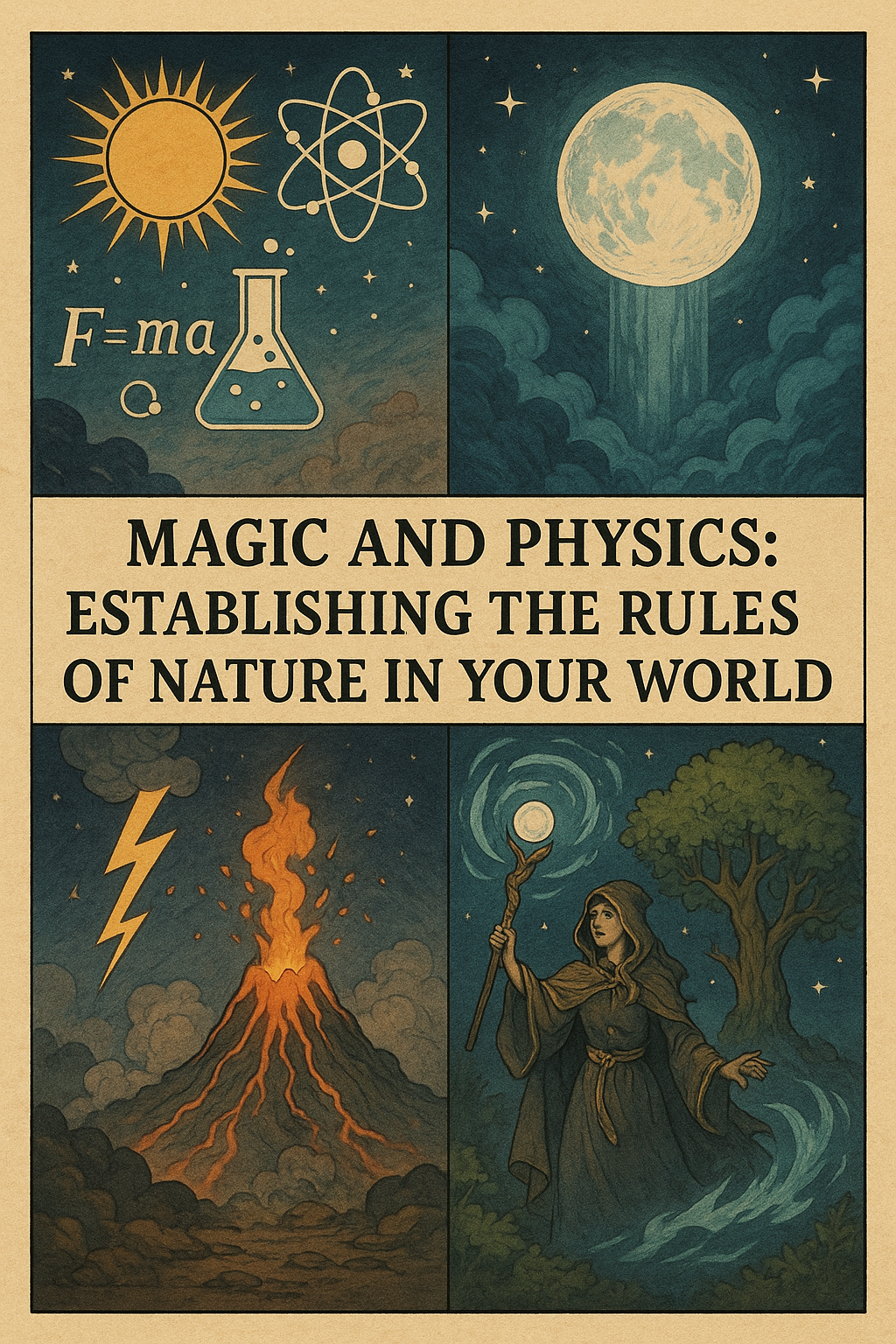
Establishing the Rules of Nature in Your World
How to Design Natural Laws That Blend Scientific and Mystical Principles
In fantasy and science fantasy world-building, one of the most powerful tools at your disposal is consistency. Whether you’re crafting a world of airships and spellcasters or dimensional gateways powered by runes and equations, your magic system and natural laws must feel like they belong together.
But how do you blend magic with physics—two disciplines that often seem like opposites? How do you create a world where both the laws of thermodynamics and the manipulation of arcane energies coexist in harmony?
In this guide, we’ll explore how to design natural laws that intertwine scientific logic with mystical wonder, resulting in a setting that’s not only immersive but rich with possibility and tension.
⚛️ Why Blend Magic and Physics?
Creating a unified rule system where magic and physics reinforce each other helps you:
- Avoid plot holes and deus ex machina
- Make your world feel internally consistent
- Introduce clever constraints and story challenges
- Spark conflict between magic-users, scientists, or hybrid practitioners
- Deepen immersion by giving your audience rules they can follow (and break…)
- Rather than having magic arbitrarily override nature, your world becomes more compelling when magic is nature—just a deeper layer of it.
🌌 Step 1: Decide What Magic Is
Before you blend it with science, define what magic actually is in your setting.
Consider:
Is it a form of energy like radiation, electricity, or gravity? In my world of Zalonia, magic involves the use of antimatter within the world. I kind of defy the law of physics in our world because all antimatter would do is explode. Therefore, if a magician from the world I created came into our world, there would be an explosion.
- Is it sentient or will-based, responding to thought or emotion?
- Is it encoded in particles or fields, like quantum forces?
- Is it divine or cosmic law, gifted or discovered?
- Is it tied to language, symbols, or geometry (like mathematical magic)?
Example: In the world of Myreon, magic is the fifth fundamental force, alongside gravity, electromagnetism, and the strong and weak nuclear forces. It’s called “essentia,” and its strength increases near dense masses—explaining why magic is more powerful in mountains or near black holes.
🔬 Step 2: Establish Core Physical Principles (Then Modify Them)
Use known scientific laws as a baseline, then decide where and how magic modifies or replaces them.
Blend with:
- Conservation of energy – Magic must draw from somewhere: a ley line, personal stamina, a blood ritual, etc.
- Entropy – Magic might speed up or reverse decay, but never truly destroy entropy’s influence.
- Thermodynamics – Elemental magic may only shift energy, not create it from nothing.
- Quantum mechanics – Spells work probabilistically, requiring emotion or intent to collapse a magical waveform.
Tip: Let magic respect physics until it doesn’t, and then explain why. The more grounded your world’s natural laws are, the more wondrous it is when magic bends them.
🧪 Step 3: Create Magical Equivalents to Physical Forces
If gravity pulls objects together, maybe aether pulls magical essence into clusters—resulting in high-magic zones. If light refracts in prisms, maybe divine light splits into different spell colors, each with a specific effect.
- Some mystical – physics ideas:
- Arcane inertia – Objects enchanted with speed spells can’t stop without magical braking.
- Mana pressure – Like atmospheric pressure, affecting how powerful a mage is depending on elevation or ley alignment.
- Chronoflux – Time has currents like wind or rivers; time mages “sail” these to see or affect the past/future.
- Resonant harmonics – Each element vibrates at a magical frequency; spellcasters must tune into these like sound waves.
⚙️ Step 4: Set the Boundaries of Magic (and What Breaks Them)
Great systems aren’t limitless—they have costs, resistances, or consequences.
Ask:
- What happens when magic and science collide?
- Can tech disrupt spells? Can magic disable tech?
- Are there anti-magic zones like cold spots or vacuums?
- Does using magic affect time, health, mental clarity, or ecosystems?
Example: In the floating city of Kael, magic works only when harmonized with local gravitational fields. Too much ambient magic can cause gravitational storms—swallowing neighborhoods in pockets of collapsed space.
🧠 Step 5: Connect Magic and Physics to Consciousness
Fantasy often introduces mind, spirit, or intention into the equation. Make that part of your world’s laws.
Concepts to explore:
- Cognitive fields – Reality can be bent where belief is strongest.
- Dream mechanics – Magic is stronger during REM cycles or in places where dreams “echo.”
- Psionic mass – The brain emits measurable magical energy when in states of focus, emotion, or trance.
- Ritual resonance – Repetition of symbols or phrases creates a field strong enough to affect reality.
Tie these back into science through neuroscience, behavioral psychology, or information theory—letting your world feel both mythic and modern.
📚 Step 6: Use Magic to Explain or Reframe Scientific Concepts
Sometimes, real-world phenomena are so strange they feel magical already. Use that to your advantage.
Real scientific ideas that feel magical:
- Quantum entanglement – Two particles affecting each other across distance = telepathy?
- Dark energy/matter – Unseen forces that shape galaxies = raw magic flow?
- Black holes – Portals to another dimension, or massive magical drains?
- String theory – The “strings” of reality are literal threads mages pluck to cause spells.
- Wave-particle duality – Spells function only when observed—or change based on who’s watching.
You don’t have to explain everything scientifically, but nodding to real theory makes your magic feel intelligent and layered.
🔁 Step 7: Let Conflicts Arise from Natural Law
Laws lead to limits, and limits lead to conflict. Don’t just explain how your magic works—ask how it changes society.
Potential plot hooks:
- A rogue wizard uses a forbidden formula to change the mass-to-magic ratio, threatening gravity itself.
- A scholar discovers a theorem that disproves divine intervention, causing magical temples to crumble.
- Scientists create a device that mimics magic through quantum computing—sparking war between mages and technocrats.
- A new law of magical thermodynamics invalidates all fire-based spells unless cast in “ignition zones.”
Let your laws drive revolutions, heresies, discoveries, and disasters.
🧮 Recap: Designing Blended Natural Laws
- Define what magic is (force, energy, divine will, etc.)
- Start with science, then twist or evolve it
- Invent magical counterparts to physical laws
- Limit the system with costs, contradictions, or consequences
- Involve consciousness or perception as variables
- Use real science to explain or mirror magic
- Generate tension through your rules of nature
✨ Conclusion: Let Magic Be a Deeper Physics
When you blend magic and physics, you’re not just building cool systems—you’re building a world that thinks differently. A reality with its own truths, its own wonders, and its own horrors. One where the rules make sense, even when they’re strange.
- And when your characters test those rules, your audience gets to discover the laws of the universe right alongside them.
Buy the First book in the Creating Life Series
Return to Homepage