Creating Government Systems in Fantasy Worlds


Aliens and the Government in a Fantasy World

The form you have selected does not exist.

Creating Government Systems in Fantasy Worlds

Introduction

In both fantasy and science fiction, world-building goes beyond geography, magic systems, and character development. A well-crafted government structure adds realism, depth, and intrigue to your world, shaping everything from political alliances and social hierarchy to how characters navigate power and justice. In this blog, we’ll explore ideas for building government systems in fictional worlds, touching on monarchy, councils, alien influence, and more.

Whether your world has monarchs, elected councils, or mysterious alien overlords, government structures can deeply impact your story. Let’s delve into how to create these systems and explore ways they might interact with the inhabitants of your world.

1. Establishing the Government in Your Alien Species

If you’ve created an alien species, consider their government setup. Is it similar to earthly governments, or does it operate on principles that are uniquely alien? Perhaps their governance style reflects their cultural values or physical traits. Alien governments might be:

Centralized Empires: An authoritarian regime where one powerful leader or council controls vast regions and subjugates various planets or races. Such a government might have a strict hierarchy, with each level monitoring the loyalty and obedience of the levels below it.

Collective Councils: A decentralized government where each member has a say in decisions, perhaps casting votes as part of a planetary or interstellar council. These aliens might have a council made up of representatives from different regions or factions, balancing power and unity.

Manipulative Shadow Leaders: Some alien species may have infiltrated other civilizations, subtly guiding or controlling their governments for their own purposes. These aliens might present themselves as deities or trusted advisors, using their advanced technology or wisdom to steer the native population.

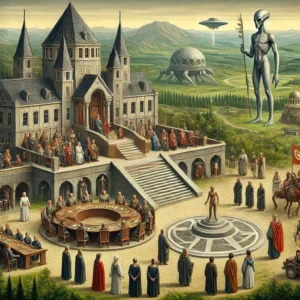
In your world, aliens could influence or manipulate the existing governments, whether through overt control or covert guidance. In some cases, they might even establish a puppet government, presenting themselves as “benevolent overseers” while subtly enforcing their own agenda.

2. Crafting Governments in Fantasy Worlds: Kingdoms, Councils, and Beyond

When creating governments in a fantasy world, consider the structures that best fit the society, geography, and technology level. In a medieval-inspired setting, you might use monarchies, councils, or tribal leadership. In other cases, a more democratic or council-based approach might fit. Let’s explore some options.

Monarchies and Nobility

In many fantasy worlds, monarchies remain a popular choice, with kings, queens, and their nobility ruling over kingdoms. Monarchies can be structured in various ways:

Absolute Monarchies: The king or queen has complete control, with all laws and policies stemming from their rule. Nobles may play a role but are ultimately subservient to the monarch.

Constitutional Monarchies: A council or parliament shares power with the monarch. This creates a political dynamic where the monarch’s influence is checked by a governing body, adding complexity to the system.

Noble Hierarchies: In some worlds, regional nobility plays a significant role in governance, ruling over towns or provinces. These nobles may pledge loyalty to the crown but have autonomy in their territories, creating opportunities for alliances, betrayals, and rivalries.

For example, in my world of Zalonia, there are kings and queens who oversee their realms, but many cities and villages have their own councils of twelve members who handle local governance. Larger councils, such as those in major cities, sometimes influence smaller councils in nearby villages, creating a tiered system of authority.

Councils and Village Governance

In smaller communities or democratic regions, councils may be the governing body. Councils are ideal for settings where decisions are made collectively, reflecting the needs and values of each community. Councils can operate differently depending on their structure:

Local Councils: Small villages may have a council that deals with everyday issues, representing the people’s voices. In Zalonia, the village of Kredaria has a council of twelve that manages local affairs, although it is influenced by a larger council in the nearby city of Mhea. Kredaria’s council can address minor issues, but it consults Mhea’s council for larger decisions, such as law changes.

City Councils with Regional Influence: In larger cities, councils may extend their power beyond city borders, influencing nearby towns or villages. This setup could lead to power struggles between councils, especially if smaller communities resist city-imposed decisions.

Federations of Councils: Some fantasy settings use a federation of councils, where each town or city has its own governing body, and representatives meet for important regional decisions. This setup allows for diverse perspectives and fosters alliances.

Direct Democracy: In some societies, every individual may have a voice in every major decision. In Zalonia, the eagle-like medes operate under a direct democracy. All medes cast individual votes on issues, including sensitive topics like reproduction. Given their millennia-long lifespans, this policy prevents overpopulation by limiting reproduction to maintain balance.

3. Exploring Unique Alien Government Systems

Aliens bring a chance to create truly original government systems. An alien society could be governed in ways we would find unusual or even incomprehensible. Here are a few examples:

Social Collectivism: Some aliens may have a highly cooperative, collectivist society without centralized leadership. They could make decisions through consensus, valuing collective well-being over individual authority.

Technological Rule: Aliens might rely on advanced artificial intelligence or predictive technology to govern. This AI-driven system could analyze data to predict outcomes and make decisions, leaving minimal human or alien intervention in daily governance.

4. Alien Influence on the Governments of Your Fantasy World

Your alien species might secretly manipulate the local governments in your fantasy world, using them as proxies to control resources or populations. Alternatively, the aliens might offer guidance, teaching the locals new technologies or social systems to improve their governance. Here are some possibilities:

Secret Manipulation: The aliens could work behind the scenes, controlling the rulers of different kingdoms through mind control, technological bribes, or even magic. The rulers, believing the aliens to be gods, might carry out their will without question.

Beneficial Rule: Alternatively, the aliens could be genuinely benevolent, offering assistance to the local rulers. They might help to avert wars, heal the sick, or teach the locals advanced knowledge. These aliens could even be welcomed as wise rulers in some regions, gaining the trust of the people.

5. Government Dynamics and Laws: Handling Crime and Justice

How does your government handle crime and justice? The structure of your judicial system can add realism and intrigue to your world.

Court Hierarchies: Some governments have a tiered court system where smaller crimes are handled locally, while more severe offenses go to a higher court. For example, Zalonia has smaller courts for minor issues, but serious crimes are judged by the central council or even by the king.

Juries and Trials: If your world has a legal system with juries, consider who serves and how they’re selected. Are juries drawn from the nobility, or are they common people? Do certain cases call for a larger jury, or can serious cases lead to a gathering of wise leaders?

Cross-Jurisdictional Law: If your world has different kingdoms or territories, it’s possible that criminals fleeing one jurisdiction might be protected by another. This could create tension, with rulers threatening war over extradition rights or treaty breaches.

6. Magic and Governance: Are Leaders Required to be Magical?

In a fantasy world, magic may influence leadership. Perhaps rulers are required to possess magical abilities, or maybe magic is forbidden among the governing class.

Magic as a Requirement: In some societies, magical ability could be a prerequisite for leadership. This would make rulers both political and magical authorities, balancing both spheres of power.

Magic-Free Zones: In other cases, magic might be outlawed within government circles, with rulers relying solely on logic, tradition, or military power. Such a ban on magic could stem from past abuses of power, where magic led to tyranny or unrest.

Magicians as Defenders: Some worlds could establish an order of magicians specifically tasked with protecting the realm from external threats, including aliens or otherworldly creatures. These magicians could act as an elite force, blending politics and mystical guardianship.

Conclusion

Creating a government system in your fantasy or science fiction world brings richness and realism to the setting, providing context for social dynamics, conflict, and alliances. From alien manipulators to local councils, each type of government structure offers new story opportunities and adds depth to your world.

When building a government system, think about how it shapes the daily lives of your characters, the flow of power, and the potential conflicts that arise from these structures. Whether it’s a kingdom ruled by magic-wielding monarchs or a society influenced by alien overseers, a well-developed government will add depth and intrigue to your world. Have fun creating government systems in a science fantasy world.

Creating Life – By Ralph Ellefson

The Art of World Building Workbook – By Ralph Ellefson

Fantasy World Building: A Guide To Developing Mythic Worlds and Legendary Creatures – By Mark Nelson

Support Me on Patreon

By my book, “Curse of Kredaria” for free at various websites.

Mixing Magic with Science: How to Blend Technology and Fantasy in World-Building

Magic and Science

Image by Stefan Keller from Pixabay

Blending Magic and Science in World-Building: Crafting the Best of Both Worlds

Introduction

As a writer, I sometimes feel torn between creating fantasy and science fiction. Fantasy allows for limitless imagination, letting me escape reality entirely to explore magical realms and mystical creatures. Science fiction, on the other hand, satisfies my curiosity about the laws of physics. This enables me to delve into scientific principles even though I’m not a physicist. But what if there’s a way to combine the best of both worlds?

In crafting the world of Aztharian, I initially approached it as a pure fantasy setting with battles fought using medieval weapons like swords, spears, and powerful magic. Yet, I couldn’t help but wonder if magic in Aztharian could be rooted in scientific principles. Could there be a balance where the seemingly mystical forces are influenced by physics and universal laws? In exploring this idea, I discovered exciting ways to blend magic with science. This helped me in creating a unique hybrid that shapes the Aztharian world. Here’s how I approached it and some ideas to help you incorporate science-inspired magic in your own world-building.

1. Defining the Role of Magic and Science in Your World

When combining magic and science, the first question to ask is: How do they coexist? How do the inhabitants of your world perceive them? Is magic seen as a mysterious force, or is it studied and understood similarly to scientific phenomena? The answers will set the tone for how magic operates within your world’s laws of physics.

For Aztharian, I envisioned a world where people rely on magic but have developed a scientific understanding of it. In this world, magic isn’t just an unexplained force—it has a structure, and its effects can be predicted and measured. I wanted Aztharian’s magic to feel as if it had scientific roots, so I explored theoretical physics concepts to create a magical system grounded in science.

2. Antimatter as a Source of Magic

In researching potential scientific foundations for magic, I came across the fascinating concept of antimatter. Physicists often wonder why our universe has so much more matter than antimatter. This question led me to imagine a world where magic is connected to antimatter, giving it a unique and volatile energy source.

In Aztharian, certain individuals can tap into antimatter to harness magical abilities. However, this is not without risks—using antimatter as a power source could lead to catastrophic explosions if not handled carefully. To avoid destruction on an astronomical scale, I needed to adjust Aztharian’s atomic structures. Instead of standard matter or antimatter, the inhabitants and objects of Aztharian are composed of a neutral particle structure, which interacts safely with antimatter. This “neutral force” enables magic to draw from antimatter without causing explosions, adding an element of tension and restraint for magic users.

3. Exploring White Holes as a Magical Phenomenon

Another concept that sparked my imagination was the theoretical white hole, an inverse of black holes that would repel matter and light instead of pulling them in. If black holes swallow everything, a white hole would theoretically push everything away, including light. Ironically, this would make white holes appear dark, not white, due to the absence of light.
In Aztharian, I decided to incorporate white holes as a rare but observable cosmic phenomenon. Occasionally, sudden “explosions” in the night sky, caused by white holes, are visible to Aztharian inhabitants, sparking awe and curiosity. Some Aztharians consider these white holes divine signs or manifestations of the gods, while others view them as natural phenomena. By using white holes, I was able to add a scientific concept with mystical implications, which contributes to the cultural beliefs and lore of the world.

4. Ancient Aliens as Deities

While I’m not personally invested in ancient alien theories, the concept aligns well with science fantasy by combining ancient times with advanced technology. In Aztharian, extraterrestrial beings with advanced technology visit the planet, manipulating the population and presenting themselves as gods. The inhabitants, unable to comprehend the aliens’ technology, perceive their machines and abilities as divine. This dynamic adds layers to Aztharian’s social structure, where religion, technology, and control intertwine. The “gods” use their perceived divinity to influence and control the people, who, in turn, create myths and legends around these powerful figures.

5. The Fifth Force of Nature: A New Fundamental Power

In our world, scientists have identified four fundamental forces: gravitational, electromagnetic, strong nuclear, and weak nuclear. But what if there were a fifth force, unique to your world? This force could be magical in nature, woven into the fabric of the universe, and accessible to those trained in its usage.

For example, imagine a “magical field” that permeates Aztharian’s atmosphere, acting as an invisible energy source for spellcasting, rituals, or enchanted items. The field could behave similarly to electromagnetic fields but with distinct properties, enabling magic users to manipulate it with specialized tools or gestures. By designing this fifth force with its own scientific rules and limitations, you can create a magic system that feels both mystical and scientifically plausible.

6. Quantum Mechanics and Spellcasting

Quantum mechanics, with its unpredictable and paradoxical nature, is another rich source of inspiration for blending science with magic. Concepts like particle entanglement, superposition, and uncertainty can serve as foundations for a unique magical system. In Aztharian, I introduced the idea that spellcasting relies on manipulating quantum particles, where practitioners must concentrate on influencing outcomes, similar to focusing intent in traditional magic.

For instance, wizards in Aztharian might use spells that alter quantum states, allowing them to teleport by “entangling” with a specific location. However, the uncertainty principle introduces an element of risk—if a spellcaster is distracted or loses focus, the results could be disastrous. This adds a layer of complexity and danger, making magic both a powerful and risky tool.

7. Symbiotic Magic and Technology

Another approach to blending magic with science is creating symbiotic relationships between the two. In Aztharian, magic and technology coexist and sometimes even enhance each other. For example, magical artifacts might require scientific devices to function correctly, or advanced machines might need magical energy sources to operate.

Imagine a society where healers use enchanted medical devices that detect illness through magical auras but require technologically enhanced lenses to make those auras visible. Or consider alchemists who need technologically engineered containment vessels to safely experiment with volatile magical elements. By creating a symbiosis between science and magic, you can explore the idea that one cannot fully thrive without the other.

8. Space-Time Manipulation: Traveling the Cosmos with Magic

Space-time manipulation is a staple of science fiction and fantasy, so why not blend the two? In Aztharian, space-time magic allows skilled practitioners to create portals, travel between planets, or explore alternate dimensions. This is possible because magic in this world has evolved to influence the fundamental structure of the universe. However, such manipulation is demanding and risky, often requiring the collaboration of multiple spellcasters to open stable portals.

To prevent overuse of such a powerful ability, I established that space-time magic takes a heavy toll on the body, limiting how often a character can safely perform it. Space-time manipulation in Aztharian isn’t just a convenient plot device—it’s a rare skill with consequences that impact the narrative, creating tension and adding depth to the magic system.

Conclusion: Crafting a World Where Magic and Science Thrive

Blending magic and science in a science fantasy world opens up endless possibilities for storytelling. Whether you’re grounding magic in scientific principles or adding supernatural twists to natural laws, this approach lets you explore fascinating themes and create a world that feels both magical and logical. In Aztharian, this balance enriches the characters, culture, and conflicts, making the world a place of wonder and complexity.

For writers interested in crafting their own science-fantasy world, consider the scientific concepts that inspire you. From antimatter and quantum mechanics to cosmic phenomena, there are countless ways to incorporate these ideas into your magic system. By blending science and magic, you create a unique setting that offers both the escapism of fantasy and the curiosity-driven depth of science fiction.

Creating Life – By Ralph Ellefson

The Art of World Building Workbook – By Ralph Ellefson

Fantasy World Building: A Guide To Developing Mythic Worlds and Legendary Creatures – By Mark Nelson

Support Me on Patreon

By my book, “Curse of Kredaria” for free at various websites.


Essential Writing Tools For Authors: A Comprehensive Guide

Writing Tools for authors Laptop

As a writer, having the right tools can significantly streamline your creative process, help you stay organized, and ultimately improve your writing. In today’s digital age, the variety of tools available can feel overwhelming. This post provides an overview of my personal toolkit, along with additional writing, editing, and design tools to consider. Whether you’re a novelist, screenwriter, or blogger, these tools offer diverse functionalities to help you accomplish your writing goals more efficiently.

1. Scrivener: A One-Stop Solution for Writers

Scrivener is my favorite tool when it comes to large-scale projects like novels and extensive world-building. Unlike most writing software, Scrivener is a one-time purchase, making it a cost-effective option. It excels in helping writers organize complex projects, from keeping track of characters and plot notes to structuring chapters and scenes. Scrivener’s corkboard feature allows you to visualize your work, giving you an overview of sections like chapters or scenes in a layout that resembles index cards pinned on a board. This feature is especially useful for writers who enjoy outlining or need to track multiple storylines.

Another standout feature of Scrivener is its publishing capabilities. When your book is ready, Scrivener can help format it for self-publishing platforms such as Amazon and Barnes & Noble. While it has a bit of a learning curve, the software is worth it for the extensive organizational and editing tools it provides.

Purchase Scrivener [affiliate link].

2. Microsoft Word: The Classic Choice

Microsoft Word is a staple in any writer’s toolkit and a versatile choice for various writing tasks. It’s particularly useful for short-form writing like essays, articles, and short stories, where extensive organization isn’t necessary. The Navigation Pane feature allows you to organize your content quickly, a helpful tool for longer documents.
One advantage of Microsoft Word is its compatibility with cloud storage via OneDrive, giving you 1 TB of space for automatic backups and easy access across devices. I started my writing journey with Word, and while I’ve since moved most of my projects to Scrivener, I still find Word invaluable for drafting and editing shorter pieces.

3. Google Docs: Collaboration Made Easy

Google Docs is an excellent choice for writers who collaborate with others or work across multiple devices. Its real-time editing and commenting features allow for seamless collaboration, making it perfect for co-authoring projects or receiving feedback. Additionally, Google Docs is cloud-based, meaning your work is automatically saved and accessible from anywhere with internet access.

While I am still exploring all Google Docs offers alongside Scrivener and Microsoft Word, I find it to be a valuable addition to my toolkit. For writers looking to share drafts or work with beta readers and editors, Google Docs’ collaborative features make the process smooth and efficient.

4. Additional Writing Programs to Explore

Beyond Scrivener, Microsoft Word, and Google Docs, several other writing programs cater to specific needs or budgets:

Apple Pages: A user-friendly, feature-rich option for Mac users.

LibreOffice Writer: An open-source, budget-friendly alternative to Word.

Final Draft: The industry standard for screenwriters, with specialized features for script formatting and scene management.

Ulysses: Another excellent tool for Apple users, particularly novelists, with a clean interface and distraction-free writing environment.

Evernote: A powerful tool for organizing research and notes, ideal for writers who need to track multiple sources or ideas in one place.

Each of these tools provides unique features tailored to various aspects of the writing process, from research to formatting. Trying a few of them can help you find the one that aligns best with your workflow and creative needs.

5. Inkarnate: Bringing Maps to Life

For fantasy writers and world-builders, maps can be a critical storytelling tool. Inkarnate is my go-to software for map-making, offering both free and paid versions with a wide range of features. Whether you’re creating a world overview, a city map, or the interior layout of a building, Inkarnate’s user-friendly interface and design options make it easy to bring your fictional worlds to life visually.

Other map-making tools to explore include:

Wonderdraft: Known for its detailed textures and stylized maps, perfect for fantasy worlds.

Campaign Cartographer 3: A professional-level tool with extensive customization for tabletop role-playing game maps.

Azgaar’s Fantasy Map Generator: A free, browser-based option for creating random maps with customizable elements.

6. World Anvil: Structured World-Building

World Anvil is an online tool designed for world-building, offering a structured way to organize your fictional universe. This tool helps you categorize elements like character biographies, histories, geographical features, and cultural details, making it invaluable for writers developing intricate worlds. World Anvil also offers tutorials to guide you through the world-building process, sparking new ideas and providing inspiration.
While not essential, World Anvil can add depth and coherence to your writing, helping you keep track of the complex details that make a world feel real. For writers creating expansive worlds with unique histories, World Anvil is an excellent organizational aid.

7. Grammarly: Your Editing Companion

Grammarly has become an essential tool in my writing process. It goes beyond simple grammar and spell-checking by suggesting improvements for tone, style, and clarity. Grammarly’s plagiarism checker is also beneficial, particularly for non-fiction writers, to ensure originality. I find Grammarly helpful during the self-editing phase before submitting drafts to an editor, as it catches errors I might have overlooked.

Grammarly offers a free version with basic editing tools, while the paid version provides advanced style suggestions and additional checks, making it well worth the investment.

8. ChatGPT: Your AI Writing Assistant

ChatGPT is an incredibly versatile tool for modern writers, providing support in areas ranging from brainstorming ideas to query letter preparation and overcoming writer’s block. The AI can help you outline stories, generate character backstories, or even draft marketing content like synopses. Both free and paid versions of ChatGPT offer unique benefits, allowing you to leverage AI to streamline your creative process.
In addition to writing assistance, ChatGPT can be used for research, asking questions, or clarifying concepts, making it an invaluable addition to any writer’s toolkit.

9. Image Editing Tools for Authors

For authors looking to create book covers, social media graphics, or promotional materials, image editing software is essential. Here are some popular tools:

Photoshop: Ideal for those with graphic design skills, Photoshop offers extensive customization and editing options. However, it can be expensive, with a subscription-based payment model.

GIMP: A free alternative to Photoshop, GIMP provides many of the same tools, making it a good choice for authors on a budget.

Canva: Canva is a user-friendly online tool with both free and paid versions. It offers templates and easy-to-use tools for creating social media graphics, promotional images, and even book covers. Canva’s library of stock photos and design elements makes it accessible to beginners and a great choice for quick projects.

10. Video Editing Software for Book Promotions

If you’re looking to create video ads or trailers for your books, video editing software can be a powerful asset. Some top choices include:

Adobe Premiere Pro: A professional-grade video editor with extensive features, though it requires a subscription.

Final Cut Pro X: A high-quality video editing tool for Mac users, known for its user-friendly interface and advanced editing capabilities.

DaVinci Resolve: Offers a free version with robust editing features, ideal for authors new to video production.

Lightworks: A lesser-known option with both free and paid versions, offering professional-grade video editing on a budget.

11. Pixabay and Free Stock Resources

For authors seeking free, high-quality images for book covers, blog posts, or promotional material, stock photo sites like Pixabay and Unsplash are invaluable. These sites offer royalty-free images that you can use without worrying about licensing fees, making them a practical choice for budget-conscious writers. Many of these images are also compatible with Canva and other design tools, simplifying the process of creating cohesive promotional content.

Conclusion

The right writing tools can greatly enhance your writing, editing, and publishing processes. From Scrivener’s robust organizational features to Grammarly’s editing support, each tool serves a unique purpose, allowing you to focus more on your creativity and less on logistics. Exploring different options is key to finding what suits your workflow best. My personal preferences lean towards Scrivener and Grammarly for the bulk of my work, but every writer has their own toolkit. Embrace the process of finding yours, and let these tools help bring your stories to life.

Creating Life – By Ralph Ellefson

The Art of World Building Workbook – By Ralph Ellefson

Fantasy World Building: A Guide To Developing Mythic Worlds and Legendary Creatures – By Mark Nelson

Support Me on Patreon

By my book, “Curse of Kredaria” for free at various websites.

Exploring Fantasy Subgenres

Fantasy Genres

Exploring Fantasy Subgenres: Finding the Perfect Fit for Your World-Building

Note: All Amazon Links in “Fantasy Subgenres” are affiliate links, but are no extra charge to you. They help me though.

Exploring the myriad subgenres within fantasy writing is essential for authors who are building their own worlds. Each subgenre presents unique opportunities and challenges, shaping the world, characters, and plot. Understanding these genres can significantly enhance the storytelling process, enabling creators to build Immersive and captivating settings. Whether you’re crafting an entirely new universe or blending fantasy elements into a familiar setting, here’s an overview of popular fantasy subgenres and the world-building potential they offer.

High Fantasy

High fantasy features worlds entirely disconnected from our own, often with their own rules governing everything from physics to magic systems. These worlds are rich with fantastical creatures like elves, dwarves, and goblins, set in landscapes that range from majestic forests and ancient mountains to mysterious seas. J.R.R. Tolkien’s The Lord of the Rings epitomizes high fantasy with its detailed, self-contained world and distinct cultures.

World-Building in High Fantasy: High fantasy worlds are often governed by unique natural laws, making them ideal for elaborate magical systems, mythical creatures, and sprawling kingdoms. This genre allows writers to craft entirely new social structures, languages, and histories, providing a blank slate for creativity.

Low Fantasy

In contrast to high fantasy, low fantasy links the created world to our own reality. This genre explores the interaction between magical and non-magical elements within a shared world. J.K. Rowling’s Harry Potter series exemplifies low fantasy, where the magical world of Hogwarts coexists alongside non-magical society. The interplay between these realms and the movement of characters between them creates a captivating dynamic that grounds the story in a familiar setting.

World-Building in Low Fantasy: Low fantasy allows creators to introduce magical elements while keeping one foot in the real world. This genre is ideal for exploring themes of secrecy, dual identities, and the impact of magic on ordinary life. World-building in low fantasy often focuses on hidden places, secret societies, and the effects of the fantastical on mundane reality.

Sword and Sorcery Fantasy

Sword and sorcery fantasy is typified by stories that emphasize a combination of magic and medieval-style weaponry. This subgenre often overlaps with high fantasy, but it places a greater emphasis on action, adventure, and personal heroism. Dragonlance and Conan the Barbarian are classic examples, set in worlds brimming with elaborate magical systems, legendary weapons, and daring quests.

World-Building in Sword and Sorcery Fantasy: In this genre, world-building focuses on smaller, more intimate settings with a high degree of personal danger. Kingdoms, dark forests, and ancient ruins provide the backdrop for epic battles and magical duels. Magic in sword and sorcery fantasy tends to be elemental, flashy, and tied closely to the fate of the heroes.

Epic Fantasy

Epic fantasy, similar to high fantasy, involves highly detailed, distinct worlds with intricate cultures, histories, and languages. Series like The Wheel of Time by Robert Jordan and Brandon Sanderson showcase complex plots, a large cast of characters, and sprawling narratives that span continents and generations.

World-Building in Epic Fantasy: Epic fantasy allows for extensive development of political systems, historical events, and magical lore. Authors often create maps, genealogies, and detailed timelines, crafting a sense of history that enhances the reader’s immersion. This genre is ideal for authors who enjoy long, multi-layered stories and world-building that encompasses entire civilizations.

Dark Fantasy

Dark fantasy combines elements of horror with fantasy, creating worlds that are often bleak, perilous, or morally ambiguous. These settings are filled with creatures like vampires, demons, or ghosts, and characters may confront existential or psychological horror. Stephen King’s Dark Tower series offers a compelling example, blending dark, supernatural elements with a fantasy narrative.

World-Building in Dark Fantasy: In dark fantasy, world-building emphasizes atmosphere and mood, often focusing on decayed landscapes, cursed lands, and haunted places. Magical systems might come with dangerous consequences, and the setting itself may feel hostile. Dark fantasy allows for the exploration of fear, power, and the nature of evil, making it perfect for stories that challenge traditional notions of heroism.

Urban Fantasy

Urban fantasy is a fantasy genre set in contemporary or urban environments, often within our own world. The genre creatively integrates magical systems and paranormal beings into familiar urban settings, as seen in The Dresden Files by Jim Butcher. Urban fantasy typically explores how magic coexists with modern life, weaving supernatural elements into the mundane.
World-Building in Urban Fantasy: This genre focuses on creating hidden or “underground” magical communities within modern cities. World-building in urban fantasy often involves magical factions, secret histories, and mystical hotspots. This genre is ideal for authors who enjoy blending fantasy with detective work, mystery, or romance, with magic hidden in plain sight.

Portal Fantasy

Portal fantasy involves travel between the real world and a fantastical realm, with characters moving between these worlds through magical portals. The Chronicles of Narnia by C.S. Lewis is a classic example, where a wardrobe serves as a portal to a magical kingdom. Portal fantasy often explores themes of escapism, wonder, and the contrast between two worlds.
World-Building in Portal Fantasy: This genre allows for the creation of a complete fantasy world but with a direct connection to reality. The portal’s origin and function become essential parts of the world-building. Creators can explore what it means to belong in one world but desire another, often blending low fantasy elements with high fantasy settings.

Steampunk Fantasy

Steampunk fantasy draws inspiration from 19th-century technology and aesthetics, often featuring steam-powered machines, airships, and advanced gadgetry. It can be either high or low fantasy, with worlds operating on unique steam-powered technology. Works like Mortal Engines by Philip Reeve showcase how advanced technology can shape a fantastical setting.

World-Building in Steampunk Fantasy:  This genre combines Victorian or industrial-era sensibilities with fantasy elements, often resulting in anachronistic technology, clockwork automatons, and a strong focus on invention. Steampunk worlds frequently explore themes of progress, industrialization, and the clash between nature and technology.

Mythic Fantasy

Mythic fantasy blends elements of mythology with fantastical narratives. My own Elements Pentalogy incorporates Celtic mythology, creating a world filled with gods, ancient temples, and magical creatures. Rick Riordan’s Percy Jackson & the Olympians is another example, introducing Greek mythology into a contemporary setting.

World-Building in Mythic Fantasy: Mythic fantasy allows creators to build worlds influenced by real-world myths and folklore or to develop original myths and legends for their settings. Mythology becomes a vital part of the culture, religion, and history of the world. Authors often create new deities, sacred sites, and legendary artifacts that carry deep meaning within the world’s lore.

Choosing Your Fantasy Subgenre

With so many subgenres in fantasy, the possibilities for world-building are endless. Each subgenre brings unique world-building elements, from the dark atmospheres of dark fantasy to the mythological richness of mythic fantasy. Choosing the right subgenre for your story depends on the themes you want to explore, the characters you envision, and the tone of your narrative.

For instance, if your story focuses on ancient magic and gods, mythic fantasy provides the perfect framework. If you’re drawn to dark, haunted landscapes and morally complex heroes, dark fantasy might be ideal. Urban fantasy suits stories grounded in modern-day settings, while epic fantasy works best for sweeping narratives and political intrigue.

Embracing the Joy of World-Building

World-building is an art, a journey of creativity, and a tool for expressing your vision. While the subgenres of fantasy offer different paths, the joy of building a fantasy world comes from weaving your imagination into every detail. Whether you’re designing a realm governed by mythical deities, a society with advanced steam technology, or a city where wizards walk among us, world-building invites you to step beyond reality and shape a new, immersive world.

In my own writing journey, I’ve found inspiration in Celtic mythology, crafting a world filled with ancient lore, mythical creatures, and rich landscapes. World-building has allowed me to explore themes that resonate with me, blending mythology, adventure, and the magic of the unknown. So, as you embark on your world-building adventure, remember to enjoy the process. Embrace the genre that speaks to you, and let your imagination run free.

Creating Life – By Ralph Ellefson

The Art of World Building Workbook – By Ralph Ellefson

Fantasy World Building: A Guide To Developing Mythic Worlds and Legendary Creatures – By Mark Nelson

Support Me on Patreon

By my book, “Curse of Kredaria” for free at various websites.

Introduction to the Fantasy and Science Realm


Introduction to the Fantasy and Science Realm
Image by JCK.H from Pixabay

Introduction to the Fantasy and Science Realm

Here is an Introduction to the Fantasy and Science Realm. In the vast canvas of fantasy literature, world-building stands as the cornerstone.  This cornerstone breathes life into tales of wonder and adventure. It’s the process that shapes realms of magic and mystery.  The only limit is the creator’s imagination.

The Scale and Terrain of New Worlds

The genesis of crafting a fantasy universe begins with envisioning its scale and terrain. Does it mirror the familiar landscapes of Earth, or does it defy the mundane, stretching into the realms of the unfathomable? Aztharian, for instance, emerges as a testament to the latter. It is a realm where the laws of physics intertwine with the threads of magic to create a tapestry of wonder. The decision between creating worlds with earthly familiarity or alien landscapes sets the stage for narrative possibilities. These possibilities influence everything from the stories that unfold to the characters that inhabit these realms.

The Role of Outer Space

In Aztharian, the cosmos plays a pivotal role, not merely as a backdrop but as a character in its own right. The night sky, adorned with nine Skygleams, serves as more than just a celestial spectacle; it’s a canvas that holds the secrets of the universe. These bright, low-gravity spheres form constellations unknown to Earth, guiding the fates of those below. The presence of three moons orbiting Aztharian introduces a complex layer of cultural and mystical significance, influencing the tides of destiny and the ebb and flow of magical energies.

Delving into Cosmic Laws

When constructing a fantasy world, considering the foundational laws that govern its existence is crucial. The mass of your planet, for instance, directly influences its gravity. Then gravity affects everything from the architecture of civilizations to the physiology of its inhabitants. In Aztharian, the adherence to physical laws similar to our own anchors the fantastical elements in a sense of realism. This attempts to make the world more immersive and believable.

Inhabitants of the Universe

Central to any world are its inhabitants. The decision of who dominates the landscape—be it humans, mythical creatures, or entirely new species—shapes the social and political fabric of the world. Azarthian is a melting pot of diversity. It is home to seven articulate species, each with its culture, intellect, and lifespan. This diversity enriches the narrative, offering a plethora of perspectives and interactions that drive the story forward.
Crafting Otherworldly Settings

The physical environment of a fantasy world, from its mountains and deserts to realms inspired by the planets of our solar system, sets the stage for adventure. Azarthian’s landscapes are a blend of Earth’s geophysics and fantastical elements. This offers settings that range from the grounded to the miraculous. The Celestial Realm, a sky-borne domain accessible through magical shortcuts, exemplifies the boundless creativity that fantasy world-building affords.

Astrophysical Phenomena and Interstellar Life

The exploration of space in fantasy worlds often introduces astrophysical phenomena that challenge our understanding of the universe. Azarthian’s sky is a testament to such creativity, featuring white holes and hidden wormholes that connect it to alien life and distant planets. These elements not only expand the geographical boundaries of the narrative but also its thematic depth, exploring concepts of connection, isolation, and the unknown.

Conclusion

The Art of World-Building in Fantasy Science Literature

As we continue to explore Azarthian in future blog posts, we invite readers to join us on this journey of discovery. World-building, at its core, is an act of creation that transcends the boundaries of imagination, offering a gateway to worlds untold. Azarthian, with its rich tapestry of celestial wonders, diverse species, and magical realms, serves as a beacon for aspiring world-builders, illustrating the limitless possibilities that await when we dare to dream.

Welcome aboard the voyage to Azarthian, where the art of fantasy world-building unfolds in all its glory.

Books to Read(Affiliate Links)

Creating Life – By Ralph Ellefson

The Art of World Building Workbook – By Ralph Ellefson

Fantasy World Building: A Guide To Developing Mythic Worlds and Legendary Creatures – By Mark Nelson

Support Me on Patreon