
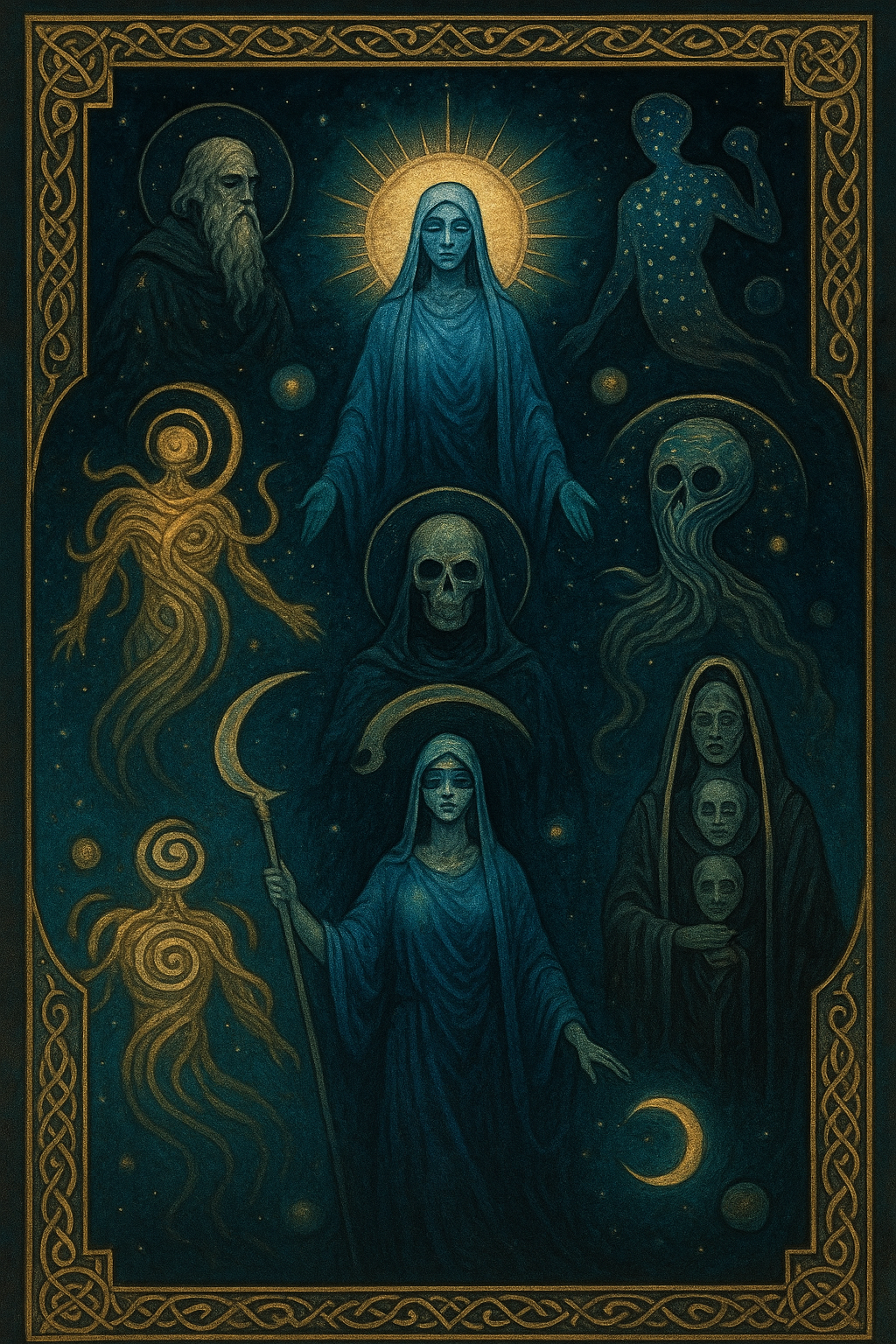
Ideas for designing cosmic beings and magical gods unique to a science fantasy setting
In science fantasy storytelling, gods and mystical entities don’t just live on mountaintops or rule over storms. They might exist as quantum consciousnesses, time-bending architects, or soul-weavers in dark matter realms. Your pantheon can reflect the fusion of science and mysticism, offering a rich tapestry of lore, religion, and narrative fuel.
In this guide, we’ll explore how to craft a pantheon of cosmic beings that fits naturally within a science fantasy universe.
🪐 1. Start with Cosmogenesis: How Did the Universe Begin?
The origins of your pantheon often reflect how your world began. In my world of Aztharian, the gods are not considered the most ancient of beings. There are the Nine Ancient Ones who supposedly created the universe. Some inhabitants in my world think they are literal while others believe it is allegorical. Then there are the Second Generation of beings that come from the ancient ones. They are kind of like children. After this comes the third generation of gods. Finally there are gods that are created by other gods, Nine Ancient Ones, or the Second Generation.
Was the universe sung into being by vibration entities (e.g., sound-as-magic)?
Did fractal beings of light explode into lesser gods during a stellar cataclysm?
Were the gods once mortals who ascended through magic, AI, or cosmic events? This is rare in my created world, but one of the children of the Second Generation likes to experiment and sometimes crosses into other worlds where this type of thing could happen.
Your origin myth sets the tone. For example:
“When the First Pulse echoed through the void, twelve fragments of sentient energy became the Celestials, each embodying a law of nature distorted by magic.”
🌌 2. Design Divine Domains: What Do the Gods Rule Over?
- Rather than typical domains like “God of Fire,” consider unique cosmic and magical hybrids:
- The Architect of Spiral Time: Deity of time loops, deja vu, and prophecy. In my world, some entities can give prophecy, although prophecy is generally frowned upon in the world because it can change people’s destinies.
- The Weaver of Photonic Dreams: Governs light-based illusions and starborn visions
- The Eater of Echoes: Absorbs forgotten prayers and extinct civilizations
You might divide them by: - Forces of reality: Time, entropy, dimensionality
Magical concepts: Emotion-magic, memory-spells, soul-weaving
Scientific paradoxes: Uncertainty, quantum tunneling, dark energy
⚖️ 3. Hierarchy and Divine Politics
Is your pantheon hierarchical like the Greek gods? Or decentralized like elemental avatars? I use both in my world of Aztharian.
Options include:
- The High Convergence: A trinity or council of primal entities
- The Orbitals: Lesser gods bound to planets or moons
- The Forgotten: Entities erased from records but still exerting influence
Include divine intrigue: - Do gods feud over mortals?
- Have any been banished or imprisoned in black holes or cursed stars?
- Are there false gods, artificially created by rogue AI or deluded mystics?
✨ 4. Form and Function: What Do They Look Like?
In science fantasy, gods don’t need to look remotely human.
- A god of entropy might appear as a collapsing waveform
- A goddess of healing may manifest as crystalline nanobot clouds
- The trickster deity could be a sentient constellation visible only at certain times
Let appearance reflect their domain and metaphysics. A god tied to interdimensional gates may fracture reality around them or speak in overlapping voices from multiple timelines.
🔮 5. Mortals and Worship Practices
A good pantheon shapes culture, not just cosmology.
- Are there priesthoods, temple ships, or ritual stations orbiting sacred planets?
- Do mortals worship gods, bargain with them, or mine their remnants?
- Can some gods only be accessed through magic-enhanced neural implants or dream-walking rituals?
Interesting systems might include:
- Prayer crystals that must be attuned via astral alignment
- Pilgrimages through wormholes to reach divine nexuses
- Forbidden rites that tear holes in space to commune with sleeping gods
🧬 6. Fallen Gods, Dead Gods, and Rogue Entities
No pantheon is complete without drama.
- What happens when a god dies? Does it leave behind divine husks?
- Are there rogue deities—gods corrupted by technology, madness, or betrayal?
- Can a mortal ascend to godhood? What’s the cosmic cost?
For instance:
The Devourer of Suns was once a gentle forge spirit, but when a human empire fed it dying stars, it mutated into a god of consumption, erasing worlds to sustain its ever-hungering mass.
🌠 7. Mythical Relics and Locations
Divine beings often leave behind:
- Artifacts: Starforged weapons, soul-etched tomes, nanite altars
- Sacred locations: Floating temples, moonlit void caverns, reality cracks
- Sentient ruins: Forgotten AI-gods that still whisper old commands
These locations can become pilgrimage sites, quest destinations, or the source of forbidden knowledge.
Support Me On Patreon
Purchase “Creating Life” Book (Affiliate Link)
Return to Home